Notice is hereby given that an ordinary meeting of the Horowhenua District Council will be held on:
|
Date:
Time:
Meeting Room:
Venue:
|
Wednesday 30
August 2023
1:00pm
Council Chambers
126-148 Oxford St
Levin
|
|
Council
OPEN AGENDA
|
MEMBERSHIP
|
Mayor
|
His Worship The Mayor Bernie Wanden
|
|
|
Deputy Mayor
|
Councillor David Allan
|
|
|
Councillors
|
Councillor Mike Barker
|
|
|
|
Councillor Rogan Boyle
|
|
|
|
Councillor Ross Brannigan
|
|
|
|
Councillor Clint Grimstone
|
|
|
|
Councillor Nina Hori Te Pa
|
|
|
|
Councillor Sam Jennings
|
|
|
|
Councillor Paul Olsen
|
|
|
|
Councillor Jonathan Procter
|
|
|
|
Councillor Justin Tamihana
|
|
|
|
Councillor Piri-Hira Tukapua
|
|
|
|
Councillor Alan Young
|
|
|
Contact
Telephone: 06 366 0999
Postal
Address: Private Bag 4002, Levin 5540
Email:
enquiries@horowhenua.govt.nz
Website:
www.horowhenua.govt.nz
Full Agendas are available on Council’s website
www.horowhenua.govt.nz
Full Agendas are also available to be collected from:
Horowhenua District Council Service Centre, 126 Oxford Street,
Levin
Te Awahou Nieuwe Stroom, Foxton,
Shannon Service Centre/Library, Plimmer Terrace, Shannon
and Te Takeretanga o Kura-hau-pō, Bath Street, Levin
|
|
Council
30 August 2023
|

|
ITEM TABLE OF CONTENTS PAGE
KARAKIA
PROCEDURAL
1 Apologies 5
2 Public
Participation 5
3 Late Items 5
4 Declarations
of Interest 5
5 Confirmation
of Minutes 5
REPORTS
6 Elected
Members Reports
6.1 Mayoral Report - August
2023 7
6.2 Chairperson's Report - Te
Awahou Foxton Community Board 11
7 Reports
for Decision
7.1 Horowhenua District Draft
Speed Management Plan: Public Engagement Review and Endorsement 15
7.2 Selecting the Electoral
System for Local Body Election 2025 37
7.3 Support for Petition
Calling for Citizens Initiated Referenda on State Highway Maintenance 47
7.4 Council's response to
concerns raised over the increase in vaping for young people and children 57
7.5 Housing Action Plan Review 69
7.6 Final Capex Carry Forward
to 2023-24 71
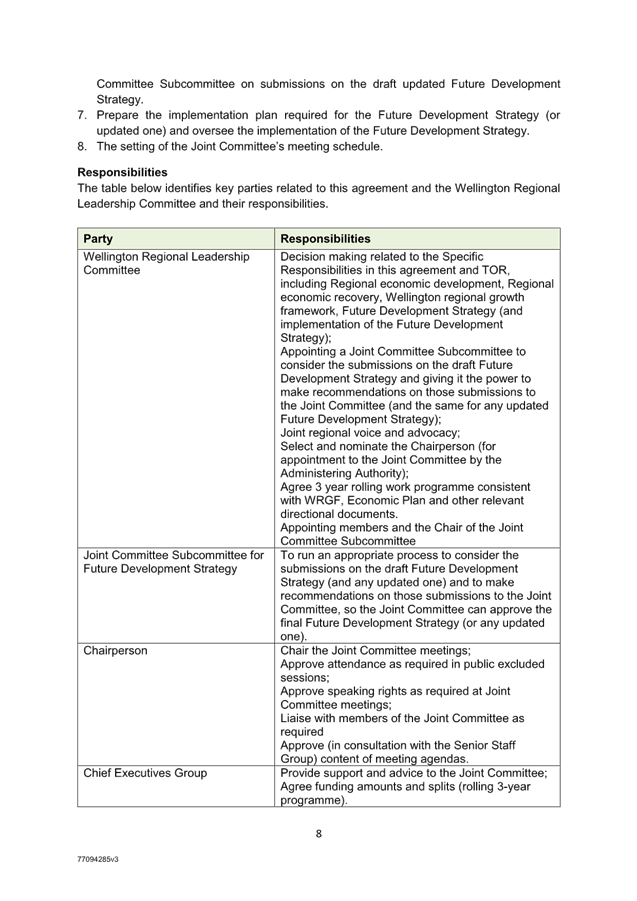
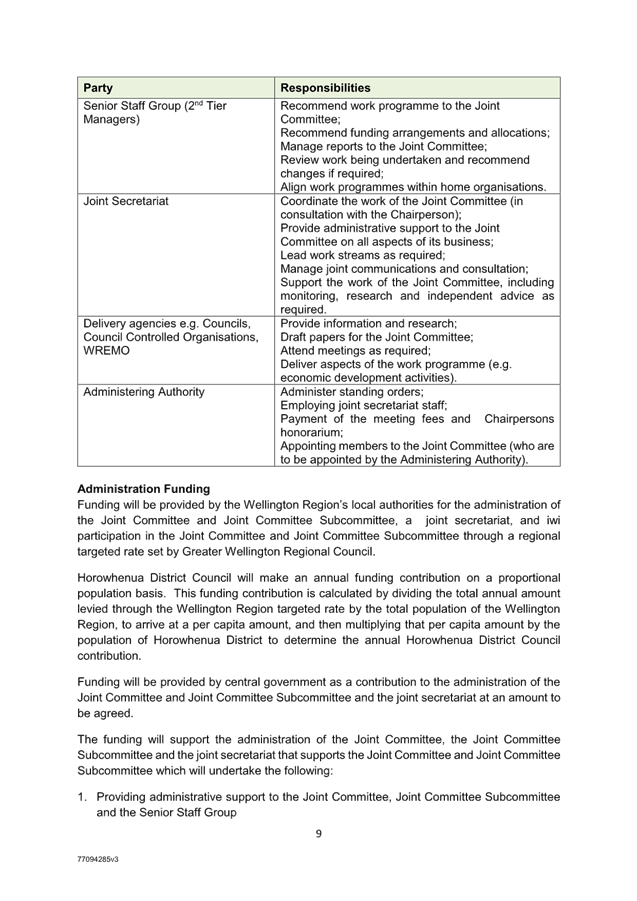
7.7 Wellington Regional Leadership
Committee - update to Terms of Reference to incorporate the Future Development
Strategy 75
8 Reports
for Noting
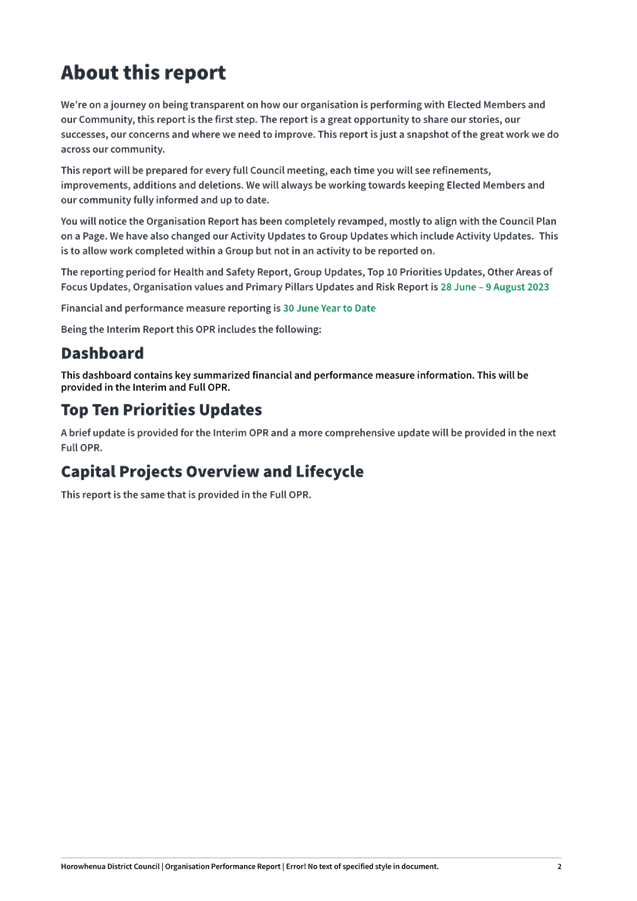
8.1 Interim Organisation
Performance Report 151
8.2 Long Term Plan 2021-2041
Monitoring Report 167
8.3 Council Resolution and
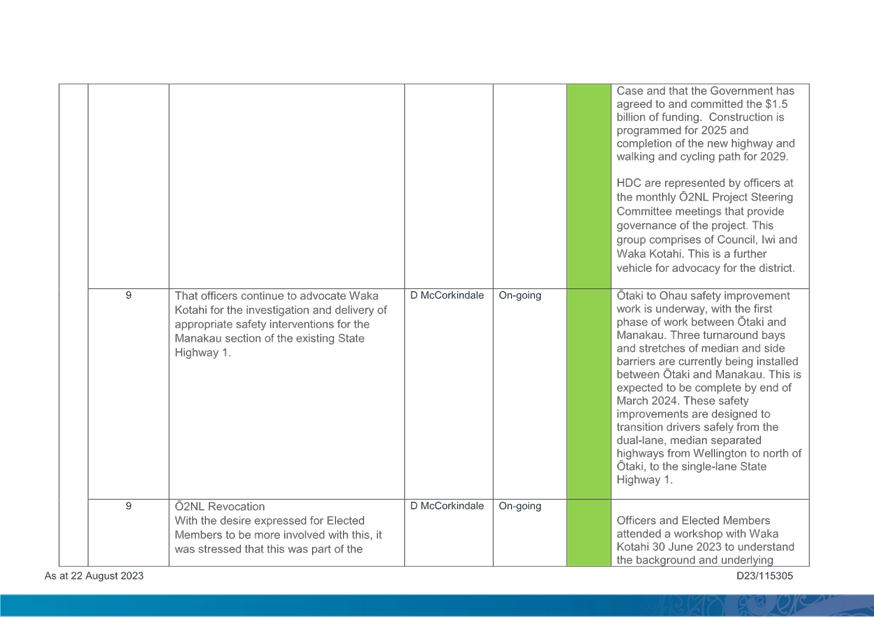
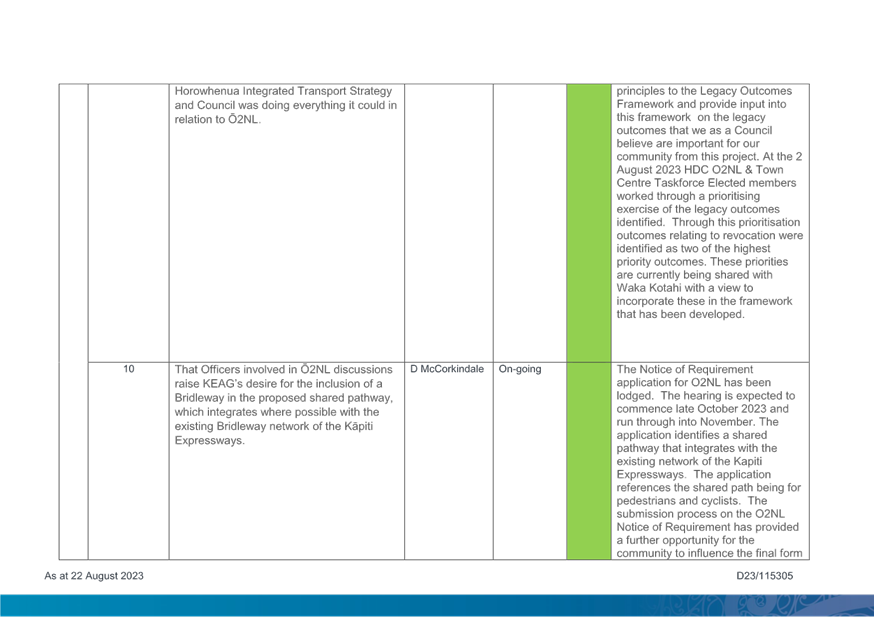
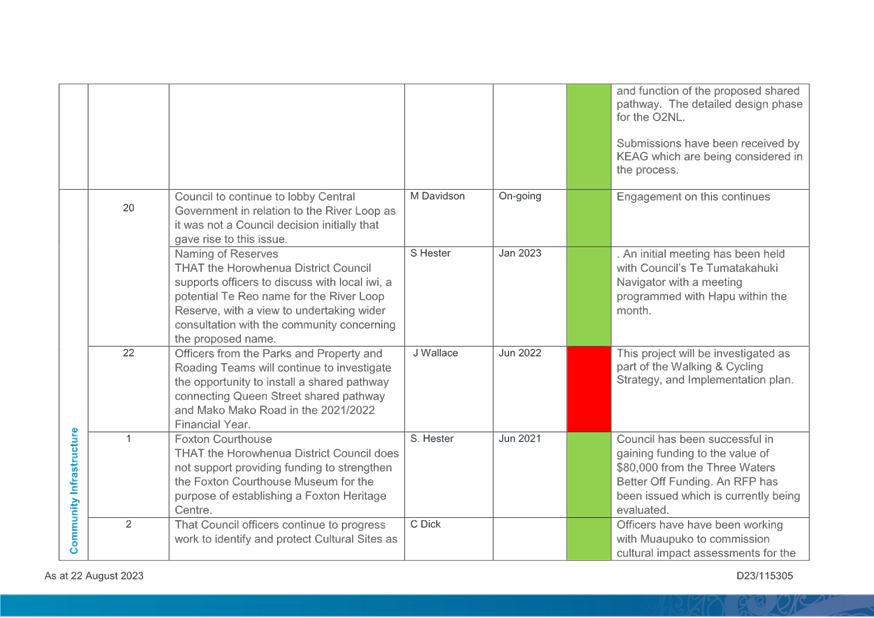
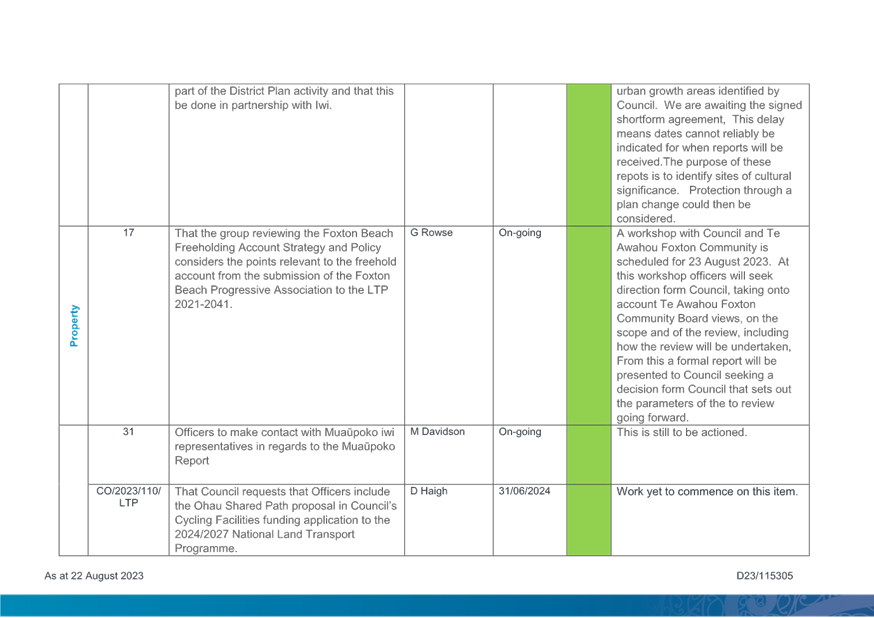
Actions Monitoring Report August 2023 179
9 Proceedings
of Committees
9.1 Proceedings of the Risk
and Assurance Committee 16 August 2023 185
9.2 Proceedings of Te Awahou
Foxton Community Board 7 August 2023 195
IN COMMITTEE
10 Procedural motion to
exclude the public 215
C1 Housing Outcomes for
Lincoln Place Reserve - Levinable 215
C2 Affordable Housing
Consideration - Western Park 215
C3 Tara-Ika Queen Street Stage
1 Stormwater Private Developer Agreement 215
C4 Property Purchase Brief
– Tara Ika East / West Arterial 216
C5 Delegation for Variation of
contracts - York Street / Stafford Street 216
C6 Muhunoa West Road Reserve
Lease 216
C7 Poplar Partners Lease 217
C8 Update on potential rating
sales 217
C9 Proceedings of the
In-Committee Chief Executive Employment and Performance Committee 16 August
2023 217
Karakia
|
Whakataka te hau ki te uru
Whakataka te hau ki te tonga
Kia mākinakina ki uta
Kia mātaratara ki tai
E hī ake ana te atakura
He tio, he huka, he hau hū
Tīhei mauri ora!
|
Cease the winds from the west
Cease the winds from the south
Let the breeze blow over the land
Let the breeze blow over the ocean
Let the red-tipped dawn come with a sharpened air.
A touch of frost, a promise of a glorious day.
|
1 Apologies
2 Public
Participation
Notification of a request to speak is
required by 12 noon on the day before the meeting by phoning 06 366 0999 or
emailing public.participation@horowhenua.govt.nz.
3 Late
Items
To consider, and if
thought fit, to pass a resolution to permit the Council to consider any further
items which do not appear on the Agenda of this meeting and/or the meeting to
be held with the public excluded.
Such resolution is
required to be made pursuant to Section 46A(7) of the Local Government Official
Information and Meetings Act 1987, and the Chairperson must advise:
(i) The
reason why the item was not on the Agenda, and
(ii) The
reason why the discussion of this item cannot be delayed until a subsequent
meeting.
4 Declarations
of Interest
Members are reminded of their obligation to
declare any conflicts of interest they might have in respect of the items on
this Agenda.
5 Confirmation of Minutes
5.1 Meeting minutes Council, 19 July 2023
5.2 Meeting
minutes In Committee Meeting of Council, 19 July 2023
5.3 Meeting minutes Extraordinary Council 28
June 2023
5.4 Meeting minutes Extraordinary In
Committee Meeting of Council, 19 July 2023
Recommendations
That the
meeting minutes of Council, 19 July 2023 be accepted as a true and correct
record.
That the
meeting minutes of the In Committee Meeting of Council, 19 July 2023 be
accepted as a true and correct record.
That the
meeting minutes of the Extraordinary Council 28 June 2023 be accepted as a true
and correct record.
That the
meeting minutes of the Extraordinary In Committee Meeting of Council, 19 July
2023 be accepted as a true and correct record.
|
Council
30 August 2023
|

|
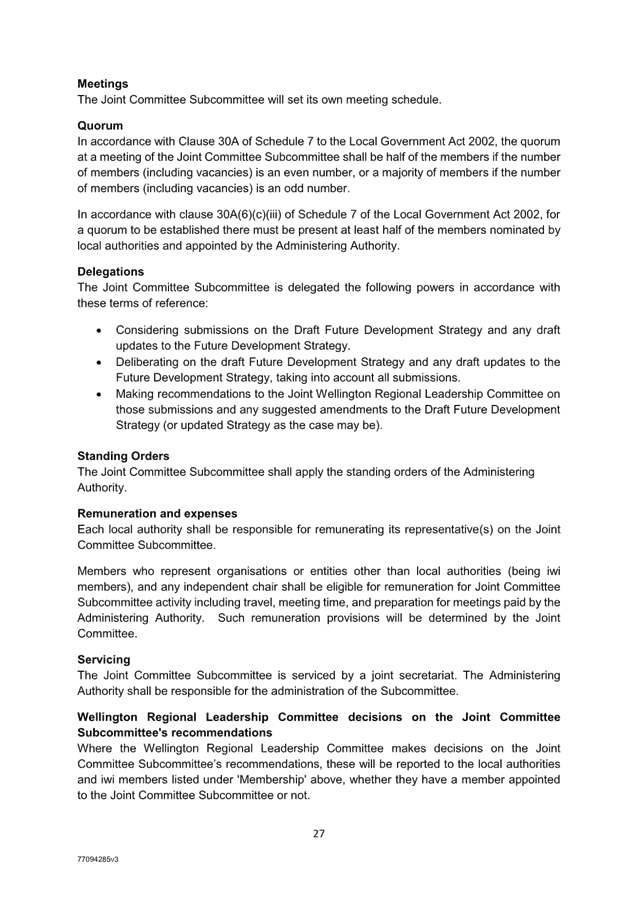
6.1 Mayoral Report - August 2023
File No.:
23/591
1. Purpose
1.1 The purpose of this report is for His Worship the Mayor to report to
Council on community events and Council-related meetings attended during July
and August 2023, and provide an update on items of interest.
|
2. Recommendation
2.1 That Report Mayoral Report - August 2023 be received.
2.2 That this matter or decision be recognised as not significant in
terms of s76 of the Local Government Act 2002.
|
3. July and August 2023 - Meetings, Functions and Events Attended
3.1 Mayoral duties were covered by Deputy Mayor David Allan for part of
July while Mayor Bernie was on annual leave.
|
July 2023
|
|
Build Horowhenua
– builders and developers forum
|
|
Council Workshop
– Speed Management and Transport Options
|
|
Kiribati Flag
Raising Event – Language Week and Independence Day
|
|
Cuppa with a
Councillor
|
|
Matariki Event
– Night Lights over Te Awahou
|
|
July Council
Meeting
|
|
Electra Business
After 5 (BA5)
|
|
Local Government
New Zealand Conference and AGM
|
|
Age Concern
Horowhenua – opening of new building
|
|
August 2023
|
|
Shannon Railway
Station – upgrade karakia and blessing
|
|
District Plan
Steering Group meeting
|
|
Ō2NL
Steering Group and Levin Town Centre Taskforce meeting
|
|
Waste and Landfill Taskforce
meeting
|
|
Cultural
Competency Briefing
|
|
Transport
Choices Briefing
|
|
Horowhenua Older
Person’s Network meeting
|
|
Arawhata Wetland
Project Meeting
|
|
Horowhenua
District Council Matariki Kaimahi Awards
|
|
Levin Bowling
Club – official opening of the new artificial green
|
|
Regional
Transport Committee meeting with Waka Kotahi
|
|
Arohanui Hospice
annual update meeting
|
|
Te Awahou Foxton
Community Board Meeting
|
|
Informal meeting
of the Lake Domain Board with Dept. of Conservation representative
|
|
Te Tiriti o
Waitangi & Cultural Competency Training
|
|
Briefing:
2023/24 Capital Projects Programme overview
|
|
Cuppa with a
Councillor
|
|
Wellington
Regional Leadership Committee – Check-in Interview for Mayor and CE
|
|
Mayor’s
Taskforce for Jobs Governance Group meeting
|
|
Local Roads
Discussion with residents group
|
|
WRLC - Future
Development Strategy workshop
|
|
Chief Executive
Employment and Performance Committee meeting
|
|
Risk &
Assurance Committee meeting
|
|
Council Workshop
– 2024 LTP
|
|
Electra Business
After 5 (BA5)
|
4. Local Government New Zealand (LGNZ) Conference Update
4.1 The annual Local Government New Zealand conference was held in
Christchurch recently in the impressive Te Pae Convention Centre. Over 700
delegates from across the country met to discuss and be informed about
“Super Localism”.
4.2 The AGM set the tone for the Conference where all remits were passed
with significant majorities and Sam Broughton, Mayor of Selwyn was elected as
the new President of LGNZ and Campbell Barry, Mayor of Lower Hutt elected as
the Deputy President.
4.3 With the Future for Local Government report released recently and
the upcoming election looming it was a great opportunity to hear from our
political leaders as to how they see the future of the relationship with Local
Government developing.
4.4 The report contains 17 recommendations and conference agreed that as
a sector we should reach some consensus on these recommendations and present
them early in the term to the next Government, whoever that might be.
4.5 The major theme of the Conference was “localism” and how
we ensure that localism is at the centre of all we do. Through speakers and
panels – one of which I participated in, we spent some time imagining
what we could do to own and drive the future we all want. Here is the link to
the panel – The big question – What is Superlocal? A panel
reimagining Local Government:
What
is Superlocal? A panel reimagining Local Government
5. Local Government New Zealand (LGNZ) AGM – Outcome of Proposed
Remits
5.1 All of the proposed remits to the July 2023 LGNZ AGM were supported
by Horowhenua District Council at the June 2023 meeting, except the remit
proposing kiwi saver contributions for elected members (remit 10).
5.2 Mayors in attendance at the LGNZ AGM accepted all 11 of the proposed
remits submitted from around the country including the remit submitted by
Horowhenua District Council regarding working to streamline the Rates Rebates
process. The purpose of this is to increase accessibility, and make it less
cumbersome for ratepayer applicants.
5.3 Here is a summary of the remits accepted at the AGM;
1. That LGNZ:
• Engage directly with the
Minister for Building and Construction to advocate for a change to the current
joint and several liability framework, including examination of the MBIE policy
position statement Risk, Liability and Insurance in the Building Sector.
• Make the case for alternatives
and changes to joint and several liability through updating policy advice and
engaging with industry groups.
2. That LGNZ advocate to Central Government to:
• Raise the income threshold for
rates rebate eligibility to enable more low and fixed income property owners
access to the rebate
• Adjust the rebate amount in
line with inflation and the cost of living Investigate options to make rates
rebates more accessible for residents by implementing an income data sharing
process similar to that of Horowhenua District Council and Levin MSD office.
This will enable Councils to obtain benefit income on behalf of the ratepayer
and make it easier to apply for the rates rebate
• Investigate options for data
sharing between Councils, Internal Affairs and Ministry of Social Development
to proactively identify households that qualify for a rates rebate rather than
waiting for people to apply.
3. That LGNZ:
• Publicly lobby all political
parties to increase Crown funding for state highway and local road maintenance
budgets.
• Consider and pursue other
avenues including the Office of the Auditor General to seek resolution of the
issues facing the country in relation to the systemic rundown of our national
roading infrastructure.
4. That LGNZ ensure Local Government Elections are fully
accessible by advocating to central government to make local government
candidates eligible for the Election Access Fund.
5. That LGNZ explores and promotes options that enable
councils to make greater use of co-chair arrangements for standing committees,
joint committees and sub committees.
6. That LGNZ advocate to central government to enable
councils to determine penalties for parking infringements.
7. That LGNZ:
Acknowledges
the Government stated support for a major uplift in all urban bus networks
nationwide under New Zealand’s first emission reduction plan.
• Calls on the
Government and opposition parties to commit to increasing investment in public
transport for rural and regional communities to support access to essential
services and amenities, vibrant rural communities and just transition to a low
emission transport system.
8. That LGNZ:
• Investigates the
creation of an LGNZ independent, national process to handle complaints or
concerns, ensuring fairness, protection, and accountability in local
government.
• Works with the
Local Government Commission to implement findings from its September 2021
Report – Local Government Codes of Conduct.
9. That LGNZ investigate and
report to members on ways to help councils and communities that are struggling
with the time-frames in the Earthquake Prone Building (EPB) sections of the
Building Act and council policies pertaining to Priority Thoroughfares.
10. That LGNZ ask the Government to amend
the law to enable councils to make contributions to an elected members’
KiwiSaver scheme.
11. That LGNZ calls on central government to
take action to reduce council audit fees by:
• revisiting the
scope and requirements of reporting and auditing on councils
• conducting a
review on the practice of audit in councils and work on best practice guidance
to streamline this process.
This review
should examine whether the reporting and audit requirements of councils are
consistent with the level of reporting and audit that is required of other
public entities.
Attachments
There are no attachments for this report.
Signatories
|
Author(s)
|
Bernie Wanden
Mayor
|
|
|
Approved by
|
Bernie Wanden
Mayor
|
|
|
Council
30 August 2023
|

|
6.2 Chairperson's Report - Te Awahou Foxton
Community Board
File No.:
23/596
1. Purpose
1.1 To present the report from Te Awahou Foxton Community
Board Chair and provide an opportunity for the Chairperson to highlight matters
from the last Board meeting.
2. Recommendation
2.1 That Report
23/596 Chairperson's Report - Te Awahou Foxton Community Board be received.
2.2 That this
matter or decision be recognised as not significant in terms of s76 of the
Local Government Act 2002.
3. Background/Previous Council Decisions
3.1 The
Board met on 7 August 2023 and the unconfirmed minutes from that meeting are
presented to the Council today for consideration as proceedings of committees.
3.2 The
Chairperson’s Report from that meeting is attached to this report for
information.
4. Issues for Consideration
4.1 Issues for consideration are included in the Proceedings of
Committee report at item 9.2.
Attachments
|
No.
|
Title
|
Page
|
|
a⇩
|
Te Awahou Foxton Community Board
Report Chairperson's Report 7 August 2023
|
13
|
Signatories
|
Author(s)
|
John Girling
Chairperson, Te Awahou Foxton Community Board
|
|
|
Approved by
|
John Girling
Chairperson, Te Awahou Foxton Community Board
|
|
|
Council
30 August 2023
|

|
File No.: 23/535
7.1 Horowhenua District Draft Speed Management
Plan: Public Engagement Review and Endorsement
1. Purpose
1.1 To
discuss the feedback received during public engagement on the Horowhenua
District Draft Speed Management Plan 2024 – 2034, recommend an option for
inclusion in the three year implementation programme, and endorse submitting
the Draft Speed Management Plan 2024-2034 for inclusion in the Regional Speed
Management Plan.
This report directly aligns with
two of Council’s top 10 priorities “Get the basics right and
support the customer focussed delivery of core services” and “Reset
our engagement and partnership approach, and work more with and for the
community”.
2. Executive Summary
2.1 Horowhenua
District Council is required to develop and consult on a Speed Management Plan
to set safe and appropriate speeds limits in the Horowhenua District (excluding
State Highways). The process that Horowhenua District Council is required to
follow and the content and form of the Speed Management Plan is outlined in the
Land Transport Rule: Setting of Speed Limits 2022.
2.2 Council
officers, following the guidance of Waka Kotahi New Zealand Transport Agency,
are proposing a staged approach to implementing any changes to the transport
network. It is proposed that the initial three year Implementation Programme
outlined in the Speed Management Plan focus on:
· Improving
safety around schools by applying safe and appropriate speed limits,
· Applying
safe and appropriate speed limits to areas of Waikawa Beach and Manakau,
· Confirm a
number of legal speed limits around the District where there are anomalies
between sign posted and legal speed limits.
2.3 Council
officers have sought feedback from the community on the proposed inclusions in
the Draft Speed Management Plan and based on this are presenting three options
for Council to consider. The option endorsed by Council will be included in the
Draft Speed Management Plan and submitted to Horizons Regional Council for
inclusion in the Regional Speed Management Plan, then to Waka Kotahi New
Zealand Transport Agency for certification by the Director of Land
Transport.
3. Recommendation
3.1 That
Report 23/535 Horowhenua District Draft Speed Management Plan: Public
Engagement Review and Endorsement be received.
3.2 That
this matter or decision is recognised as not
significant in terms of S76 of the Local Government Act.
3.3 That
Council adopt Option A which is described as:
· Variable 30km/h speed limit for Koputaroa School Zone
· Variable 30km/hr speed limit for Manawatu College and
Foxton School zone, with the exception of Hulke Street.
· Permanent 30km/hr speed limits for all other local road
school zones.
· Permanent 30km/hr speed limit for Manakau Village
· No speed limit change for Waikawa Beach
Changes and additions included in Option A are
described below:
· Shannon School zone 30km/h zone is extended 275m south
east to the intersection on Vogel Street on Grey Street, as requested from
Shannon School.
· Foxton Beach School zone extended 20m east along
Thomas Place, incorporating Low Avenue, changed as the original plan’s
threshold is too close to the drop off/pick up zone.
· Coley Street School zone permanent 30km/h extended to
in include Futter Street from Coley Street to Avenue Road, and Avenue Road from
west of Futter Street intersection to east of Spring Street intersection
· Foxton Beach School, Hart Street speed limit change
has been removed based on a feedback form from Foxton Beach School. Foxton
Beach School has suggested other changes which have not been included at this
stage, but will be noted for future Speed Management Plans.
· Tokomaru School, 30km/h Speed Limit has been extended
to 300m south east of SH57 intersection, to be in line with the Speed
Management Guidelines
· Levin School, Levin Intermediate, Horowhenua College
and St Joseph’s School zones, 2 private roads have been removed, off Bath
Street, and two private roads have been removed off Durham Street
· Levin North School zone has extended 48m north east
along Weraroa Road, to start the 30km/h speed limit at the top of a hill,
rather than at the bottom
· Ohau School zone has been reduced, moving closer to
the Bishops Road intersection on Bishops Road and Muhunoa East Road. The
existing 50km/hr zone on Muhunoa East Road has been extended to just east of
Fayden Close, including Fayden Close to comply with the minimum speed limit
lengths as described in the Rule
· Arete Lane, Ruapai Drive and Oriwa Lane have been
changed from 80lm/hr to 60km/hr. These roads were included in the confirmation
of signposted speed limits section of the engagement SMP. Feedback received
from resident suggests a lower speed limit, which Officers agree with. These
roads have a similar form and function of other roads with 60km/h speed limits
within the district.
· Te Whanga Road has been included with a 60km/h speed
limit, reduced from 80km/hr. Residents have provided feedback suggesting a
50km/hr speed limit, however the safe and appropriate speed for Te Whanga Road
according to the Speed Management Guidelines is 60km/h
· Buller Road has been included with two speed limit
reductions. Buller Road currently has a speed limit of 80km/h throughout. The
proposed changes see a 60km/h speed limit from SH1 to CD Farm Road, and a
30km/h speed limit from CD Farm Road to the road end by Papaitonga Reserve.
These changes have been suggested in Feedback forms, however the 60km/r suggested
extents were from SH1 to Bruce Road. Officers have determined that it is more
appropriate for the 60km/r speed limit to extend to CD Farm Road.
OR
3.4 That
Council adopt Option B which reflects the minimum changes required and is
described as:
· All local road school zones have variable 30km/hr
speed limits
· No speed limit change for Waikawa Beach
· No speed limit change for Manakau, with the exception
of a variable 30km/hr speed limit for the Manakau School zone.
· Some of the school zone extents change between Option
A and B, this is due to requirements around minimum speed limit lengths in the
Rule, which do not apply for variable zones.
· Option B includes a speed limit change to 60km/h for
Arete Lane, Ruapai Drive and Oriwa Lane. This is not strictly required under
the Rule at this time, however confirmation of the speed limit is required at
this location, either to 80km/h (current sign posted speed limit) or 60km/h
(safe and appropriate speed limit). With feedback supporting 60km/h, and 60km/h
being supported by the Speed Management Guidelines, 60km/h has been proposed in
all options.
OR
3.5 That
Council adopt Option C which reflects the maximum possible changes and is
described as:
· Permanent 30km/h speed limits for all local road
school zones.
· Permanent 30km/h speed limit for Manakau.
· Permanent 30km/h speed limit for Waikawa.
Option C includes all the additional
changes described for Option A. In addition to these, the following changes are
included in Option C:
· An addition 30km/h speed limit on Stafford Street,
Shannon from SH57, extending 230m east to cover a back entrance to Grey Street
School. This suggestion was not made by the school so has not been included in
Options A or B.
· A 30km/h speed zone on Muhunoa West Road, from SH1,
extending 280m west.
· Palmer Road 60km/h speed limit from Foxton Beach Road,
extending 600m west.
· Potts Road, 60km/hr speed limit change for the full
length.
· Moutere Road, 60km/hr speed limit change for the full
length.
· Gladstone Road, 60km/h speed limit change for the full
length.
3.6 That
Council note that the required review of 70km/hr and 90km/hr road speed limits
have been completed as part of this consultation and no changes are
recommended.
3.7 That
Council confirms the current legal speed limits of roads listed in Appendix E
to ensure consistency with current sign posted speed limits.
3.8 (If
Option C is selected) That Council approves a change in speed limit for:
· Gladstone Road from intersection with
Tararua Road to intersection with Queen Street East change from 80km/hr
to 60km/hr
· Palmer
Road first 600m from Foxton Beach Road change from 80km/hr to 60km/hr
3.9 That
Council authorise the Chief Executive to finalise the Draft Speed Management
Plan 2024-2034 and submit to Horizons Regional Council for inclusion in the
Regional Speed Management Plan.
4. Background / Previous Council Decisions
4.1 The Minister
of Transport introduced the Land Transport Rule: Setting of Speed Limits (the
Rule) in 2022, which requires a new approach to speed management to be taken
for all Road Controlling Authorities in New Zealand. The Rule requires
Horowhenua District Council, as a Road Controlling Authority, to develop and
engage with the community on a Speed Management Plan.
4.2 The primary
purpose of this new process is to facilitate the implementation of safe and
appropriate speeds to improve safety, save lives and prevent debilitating
injuries. A safe and appropriate speed is a speed limit that is safe according
to the standards set by the ‘Safe System’ and appropriate in terms
of aligning with community wellbeing objectives as well as the movement and
place function, design and infrastructure of the street or road. Additional
guidance on the process has been provided by Waka Kotahi in The Speed
Management Guide.
4.3 The completed
draft plan is required to be submitted to Horizons Regional Council for
inclusion in the Draft Regional Speed Management Plan before being certified by
the Waka Kotahi Director of Land Transport. The timeframes of when this needs
to occur have been set by Waka Kotahi. The first deadline is 5 October 2023
which is the final date for the publication of any consultation draft speed
management plan. The second deadline is the 29 March 2024 which is the last
date for submitting the final draft speed management plan for certification.
Horizons Regional Council officers have indicated that they will be seeking an
extension to this deadline to 30 June 2024.
4.4 At the
council meeting on 19 July 2023, council discussed the Draft Speed Management
Plan 2024-2034 and authorised Council Officers to commence community engagement
on the Draft Speed Management Plan. Council Officers subsequently commenced
public engagement activities from Monday 24 July 2023 to Monday 21 August 2023.
4.5 School zones
make up 1.23% of Horowhenua’s roading network (excluding State
Highway’s), which is just over 7km of road. Between 1 July 2013 and 1
July 2023 there were a total of 103 death and serious injury crashes across our
local road network. A total of 10 or 9.7% occurred in school zones. Therefore,
crashes in schools zones are significantly more likely to result in death or
serious injury than other areas of the road.
5. Discussion
Community Engagement Activities
5.1 Community
engagement started on Monday 24 July 2023 and finished on Monday 21 August
2023. As part of this the following activities were undertaken:
· Development
of a Let’s Korero page that included information on the Draft Speed
Management Plan and an online Feedback Form.
· Publication
of a community connection article on Speed Management on Friday 11 August 2023.
· 14
Social media posts on Horowhenua District Council social media channels.
· Letters
were put in directly affected people’s letterboxes between Thursday 27
July 2023 and Monday 31 July 2023 e.g. residents of areas where speed limits
may change outside their home address.
· Facebook
Live event held on Tuesday 15 August 2023 with Councillor Justin Tamihana,
Councillor Ross Brannigan, and Council Officers James Wallace, Land Transport
Manager and Justine Moore, Infrastructure Planning Lead.
· Media
Release published on 1 August 2023.
· Front
page news article in the Horowhenua Chronicle published on Friday 11 August
2023.
· Presentation
to the Older Person’s Network on Thursday 3 August 2023.
5.2 90
feedback forms and seven additional submissions were received. The feedback
received is summarised below and the complete feedback forms are attached in
Appendix D.
5.3 14
posts were shared on Horowhenua District Council social media channels. This
included six posts to Facebook timelines, 2 posts to Instagram timeline, 3
posts to Facebook/Instagram stories, 1 post to LinkedIn timeline, 1 post to the
Waikawa community page, and 1 Facebook Live video. There were a total of 41,245
impressions (number of times this content was displayed on a screed) with a
total reach of 27,518 (number of unique users who saw the posts). In addition,
the total number of engagements (comments, shares, likes) was 4,074. While this
campaign received an impressive volume of engagement, it is hard to measure in
terms of positive/negative sentiment. However, overall analysis showed that
there was positive emotion sentiment of published posts.
5.4 Let’s
Kōrero Horowhenua District Council’s community engagement online
platform Speed Management page received 872 site visits and the Draft Speed
Management Plan was downloaded 55 times.
Feedback on
Speed Limit Changes around Schools
5.5 The
majority, 60% of people, who submitted feedback agreed with the proposed
changes around schools. This related to the implementation of permanent 30km/h
speed limits around schools within the district, excluding Manawatu College,
Foxton Primary School, and Koputaroa School.
|
Question:
Do you agree with the proposed speed limit changes around schools?
|
Number
of responses
|
|
Yes
|
58
(60%)
|
|
Yes,
with some changes
|
22
(23%)
|
|
No
|
12
(12%)
|
|
Blank
|
5 (5%)
|
5.6 Where
changes or comments were made these related to:
· Support
for speed limit changes to improve safety for tamariki.
· Request
for speed limit changes to be implemented around early childhood centres.
· Requests
for variable speed limits (a) around school drop off and pick up times, (b) all
day during term time.
· Request
for additional safety infrastructure.
· Enforcement.
· Near
misses observed.
· Request
for additional roads to be included or school zones to be extended.
· Reduced
school zone size.
· Driver
behaviour.
· Education
on the dangers of roads and traffic for children.
5.7 Where comments have suggested speed limit changes,
they have either been included in the one of the three options, or discarded
for one of the following reasons:
· The suggested changes would be result in beach of Land
Transport Rule: Setting of Speed Limits 2022. For example, suggesting a change
which would result in a speed limit length less than the minimum lengths
described in Schedule1 of the Rule.
· The suggested change may have merit, but may require
more in depth investigation, planning and consultation than our present Speed
Management Planning process allows for. Such as proposing a seasonal speed
limit.
· Feedback with these suggested changes have been
recorded for investigation in future processes.
· The suggested change is for a road outside the control
of Horowhenua District Council, such as changing speed limits on State
Highways.
5.8 Where comments have suggested feasible changes to the
Speed Management Plan, they have been used to develop the three options. The
three options have been developed using the following method:
· Where a feasible change has been suggested which would
result in a speed limit change less impactful than the changes described in our
engagement documents, it has been included in Option 2 as the Do-Minimum
option. The suggested changes may have been altered slightly to align with
Speed Management Guidelines, or to comply with the Rule
· Where a feasible change has been suggested that would
not have a significant impact, but would see reduced speed limits, and officers
agree that it is a sensible change, it has been included in Option 1 as the
Recommended Option.
· Where a feasible change has been suggested that would
generally be more impactful than the changes included in the Recommended
Option, it has been included in Option 3 as the “Do-Maximum”
option.
5.9 Where suggestions have been made for speed limit
changes that are not feasible due to the timeframe of the current Speed
Management Planning process, they have been recorded and will be investigated
in future Speed Management Plans.
5.10 Where suggestions have been made for physical safety
improvements, or enforcement, they have been noted for investigation, or will
be passed on to the appropriate authority / agency.
Feedback on
Speed Limit Changes around Manawatū College and Foxton Primary School
5.11 The
majority (64%) of people who submitted feedback supported a change to the speed
limit outside Manawatū College and Foxton Primary School. For the people
who supported a speed limit change, the majority (52%) preferred a variable
30km/h speed limit.
|
Question: Do you
support the proposed changes around Manawatu College and Foxton Primary
School?
|
Number of
responses
|
|
Yes, permanent
30km/h speed limit on Ladys Mile, Robinson Street, Duncan Street and Park
Street
|
28 (29%)
|
|
Yes, variable
30km/h speed limit on Ladys Mile, Robinson Street, Duncan Street and Park
Street
|
32 (33%)
|
|
Yes, but did not
specify variable or permanent
|
2 (2%)
|
|
No
|
12 (12%)
|
|
Blank
|
23 (24%)
|
Relevant
feedback comments on speed limit changes around Manawatū College and
Foxton Primary School
5.12 One person submitted an addition comment related to Manawatū
College and Foxton Primary School:
Feedback form #6:
“Option 1
- Making all of Lady’s Mile in Foxton, the primary thoroughfare to
Foxton Beach, carrying a 30kph zone 24hrs a day, 365 days a year is ridiculous
given the adverse impact on its many (but not dangerous level) vehicle users.
Is the current
proposal based on hard facts on the number of car on person accidents, the
times of occurrence and the severity of the injuries incurred? If so -
please share to justify. I do not subscribe to the “save every
life/injury at any cost message being pushed by NZTA as it is both economically
and morally severely flawed but that’s another day’s debate.”
How speed limit
changes around Manawatū College and Foxton Primary School have been
proposed in the recommended option.
5.13 Option A, the recommended option, includes a variable
speed limit for the roads around Manawatū College and Foxton Primary
School, in line with a slight majority of feedback among people who preferred
speed limit changes.
5.14 The school zone considered from Manawatū College
and Foxton Primary School is a fairly unique situation among our speed limit
changes, as Lady’s Mile has the highest traffic volume of all local roads
which pass through a school zone, and is subject to significant seasonal
variation, with much higher daily traffic volumes during summer weekends, as
the main access road to Foxton Beach.
5.15 Due to the function of Ladys Mile, a permanent speed
limit would present a more significant increase to travel time and vehicle
operating costs compared to recommended permanent speed limit changes in other
school zones. The higher level of traffic, particularly on weekends when school
related activities are less likely, would therefore have less net
benefits which target school zones.
5.16 Officers
believe that either a permanent or variable speed limit of 30km/hr at this
location would result in a reduction in the risk of severe crashes. A permanent
30km/hr speed limit at this location may result in an overall lower crash risk
than a variable speed limit, however officers have been unable to sufficiently
determine the extent of improved safety outcomes of a permanent speed limit at
this location to justify a recommendation which does not align with the views
of the community, or the priorities of Councillors as described during the
Speed Management Plan Council Workshop held on 17 May 2023. The potential
safety benefits that a permanent 30km/h speed limit change in this area would
present over a variable speed limit would not be specifically targeted towards
reducing the risk of a crash involving a school student, but would rather be a
benefit to road users in general. Officers have interpreted the
community’s and Council’s feedback to mean that general traffic
safety benefits of permanent speed limit reductions in urban areas to 30kmh are
not widely supported, however the opportunity to revisit this approach in more
detail will be available in future Speed Management Plans.
Feedback on
Speed Limit Changes around Koputaroa School
5.17 The
majority (59%) of people who submitted feedback supported a change to the speed
limit outside Koputaroa School. For the people supported a change in speed
limits, a small majority preferred a permanent 30km/h speed limit.
|
Question: Do you
support the proposed changes around Koputaroa School?
|
Number of
responses
|
|
Yes, permanent
30km/h speed limit on Koputaroa Road
|
29 (30%)
|
|
Yes, variable
30km/h on Koputaroa Road
|
28 (29%)
|
|
No
|
14 (14%)
|
|
Blank
|
26 (27%)
|
Relevant
feedback comments on speed limit changes around Koputaroa School
5.18 Two people submitted additional comments related to
Koputaroa School:
Feedback form #34:
“Koputaroa
students are dropped off by cars & buses on one side of the road. There is
nobody walking alongside a road, or crossing a road, like in town. Kids are
dropped off & walk straight on to school grounds. I don’t see
why the speed limit would ever need to be 30km/hr like a town school, when the
set up of Koputaroa school is completely different.”
Feedback form #16:
“I
support a VARIABLE 30kmph speed limit on Koputaroa Rd. I think people are more
likely to adhere to the limit if it's variable.”
How speed limit
changes around Koputoroa School have been proposed in the recommended option
5.19 Option A, the recommend option, includes a variable
speed limit for Koputaroa School. A variable speed limit is recommended despite
a greater number of responses preferring a permanent speed limit.
5.20 Officers believe a variable speed limit will have a
greater level of compliance for this specific location. Considering the current
80km/h speed limit on Koputaroa immediately outside the school zone, it is
expected that many drivers may regularly fail to comply with a permanent 30km/r
speed limit. Particularly if drivers are regularly travelling through the
school zone when there are no school activities taking place, drivers will
likely form a habit an exceeding 30km/h. It is proposed to replace the existing
active warning signs (flashing speed limit signs) to set the recommended
variable speed limit. A variable speed limit supported by active warning signs
is expected to achieve a greater level of compliance during the drop off and
pick up times for Koputaroa School.
5.21 One of the key reasons permanent speed limits outside
schools have been recommend elsewhere is to provide a safer environment outside
the school pick up and drop off periods, as urban schools can see children
walking to and from schools outside these times. As Koputaroa School is rural,
without footpaths or significant pedestrian use, this reason does not apply for
Koputaroa School.
Feedback on
Speed Limit Changes in Manakau
5.22 57% of people who submitted feedback supported
changing the speed limits in Manakau.
5.23 Feedback was received from nine people who identify
their town as Manakau, of these people 4 people agreed with the proposed
changes and 3 agreed with the proposed changes with some additions or
suggestions. None of these additions or suggestions related to decreasing the
scope of what has been proposed. 2 people did not support the proposed
changes.
|
Do you agree with the proposed speed limit
changes in Manakau?
|
Number of responses
|
|
Yes
|
46 (47%)
|
|
Yes with some changes
|
9 (9%)
|
|
No
|
20 (21%)
|
|
Blank
|
22 (23%)
|
Relevant feedback comments on speed
limit changes around Manakau Speed Limits
5.24 Six people submitted additional
comments related to Manakau Speed Limits.
Feedback form #16:
“30km should go
over the cutting to Eastern Rise, or at least continue to the south end of Honi
Taipua St.”
And;
“So very happy to finally see
reasonable speed limits in Manakau! The number and size of vehicles has
increased immensely since I was a child there, and it no longer feels very safe
walking in the village. Especially in winter, when it's too muddy to walk on
the berm. We might need speed bumps in Manakau to actually slow some drivers
down, though.”
Feedback form #21
“I would be very happy to see
the speed limit lowered in Manakau Village. With the extra housing developed
there are a lot more people, young and old, and cars using the roads”
Feedback form #61: (Officers
believe this comment is regarding State Highway 1)
“The change is: that between
South Manakau road and the entrance signs into Manakau, there are NO STREET
LIGHTS!!!! Why not?! Numerous people have been killed on this small stretch of
road at night due to the NON-EXISTENT lighting. Put up a couple of lights for
God's sake. Myself like numberless others hate driving through this small
stretch (1 km max?) of road at NIGHT. It is a death trap at NIGHT. Please do
something about this for God's sake, and don't take the easy opt out of
throwing my suggestion in the bin, with the justification "this is a
different matter to speed. I deal with speed issues, someone else deals with
street lights, therefore I will throw this suggestion out, as I am confident that
this matter will eventually be handled by the appropriate team members - in due
course. What a cop out! I do not know who you are, but my confident in your
team to put up 2-3 street lights in this so-dangerous area is very low. Q: Why?
A: Because it has been abundantly clear to ALL but the most mentally challenged
person that this tiny stretch of road is very DANGEROUS at night. Please fix
it, and not just bin this suggestion. Thank you.”
Feedback form #81
“Waikawa Beach Road from SH1 to
Takapu Road is a race track. Drivers race down the road because it's a
straight piece of road and it's tempting. We no longer will walk our dogs
down the road as we don't feel safe to do so. Obviously there are no
foopaths. Sometimes even pulling out of our driveway is risky.
Since we moved here 18 years ago, the road has become a nightmare because it's
so much busier. People will always go beyond the speed limit.
Currently some still go 100kph. So, if the limit was reduced from 80kph
to, say, 60kph, then we would achieve averages of 80kph.”
Feedback form #88
“I would like the speed
restriction extended to the whole of Honi Taipua Street, as many people walk
their children to school from Manakau Heights and drivers often do not even
observe the 50km restriction at the south end”
How speed limit changes around Manakau
have been proposed in the recommended option
5.25 Option A, the recommended option, includes a permanent
speed limit for change to 30km/h for Manakau, with no change made from the
engagement proposal.
5.26 All 7 people who listed their town as Manakau or
Manakau 5573 supported the proposed speed limit changes, with 1 of these
supporting with some changes.
5.27 Feedback form suggests extending the 30km/h speed
limit to the Southern end of Honi Taipua Street, this suggestion has been
incorporated into Option C, the “Do-Maximum” Option.
Feedback on Speed Limit Changes in
Waikawa Beach
5.28 The majority (49%) of
people who submitted feedback supported the proposed changes to the speed
limits in Waikawa Beach. With a further 6% supporting the proposal with some
changes.
5.29 13 responses were
received from people who identified their town as Waikawa Beach. Of these 4
supported the proposed changes, 2 supported changing the speed limits with some
additional changes, and 7 did not support the proposed speed limit
changes.
|
Question: Do you support the proposed
changes around Waikawa Beach?
|
Number of responses
|
|
Yes
|
48 (49%)
|
|
Yes, with some changes
|
6 (6%)
|
|
No
|
23 (24%)
|
|
Blank
|
20 (21%)
|
Relevant feedback comments on proposed
speed limit changes around Waikawa Beach
5.30 Nine people provided comments relevant to the proposed
speed limit changes in Waikawa Beach
Feedback form #22:
“30km at Waikawa beach is
overkill. I barely see another vehicle on the road and there have been no
accidents of consequence. I would rather a focus on sh1 turning out of Waikawa
beach southbound where there are regular accidents and turning is becoming more
difficult with traffic increases.”
Feedback form #26
“Just thrilled about the lower
speed limit in Waikawa Beach. 50km is too fast in the area with so many people
and others using the road, as there are no footpaths. We don’t want
footpaths with Btw. we like the very laid back beach feel If the Neighbourhood.
Thanks”
Feedback form #39
“waikawa beach road should stay
same the request for reduded speed limit as forwarded by a few
ratepayers not the majority was for ONLY DURING school holidays long
weekend s . this was put forward by non resident
holiday bach owners. as we have few school kids living
here it seems ridiculous to have a 30km speed. I have lived
here for 20years + and as far as i know there has never been
a pedidisitain accident . we walk the roads for excise
and it is not often there is more than one car passes us .
the information that was put out by council about NARROW
roads where are they ?? most roads you can have acar
parked on each side and is have room for cars to pass
90 % of the roads at beach (villiage Are striaght and can see at
300 meters ahead . The only NORROW road is the entrance of
about 400 meters we have approx 2000mtres these have
formed gutters + 500mtres of no formed gutters this
area has only 5 houses that have permament residents .
the total number of premament resident dwellings is about 38 my estimate
of house here is aprox 234 that is roughly 15% of houses are
permament residents”
Feedback form #40
“The first option should be to
provide footpath in Waikawa beach Silly to reduce speed to 30? When people are
walking on the road”
Feedback form #65 (Under
“When would you like to see these changes made?”)
“As soon as possible because it
is highly likely that many people driving around Waikawa Beach will ignore the
new speed limits”
Feedback form #70
“I have been going to Waikawa
Beach for over 25 years and have lived there permanently for 7.
I have been a member of Police for
over 30 years also and policed road safety and attended, investigated traffic
related offending.
My opinion is that compared to other
more highly densely populated areas where goads a much narrower with greater on
street parking, Waikawa has quite wide streets in comparison.
There are wide
berms that people can walk on. It the council does not maintain trees and
vegetation on the berms that cause people to have to go onto the road to avoid
the obstructions.
Logan horses
ride on the berms here too where they can and I see this regularly too.
The only
reduction in speed in the area I know of that I was involved in as a member of
the Waikawa Beach Ratepayers Assn as a committeee member since moving here
permanently was for taking Strathnaver Drive from 80 to 60km:h. That speed was
too fast for the width of that road which for a main feeder road in the winding
section is narrower than most streets in the Beach area. Strathnaver and Reay
Makay Grove also have extensive berms of width for pedestrians to use and I do
when walking my did daily.
The full time
residents and those who own holiday homes here do adapt their driving for
holiday periods. We also ‘have a word’ with those May transgress
with motorbikes or quads heading to the beach.
Personally and
professionally I do not feel that for the number of residents permanently here
and the amount of traffic through here, permanent reduction of speeds within
the village is not warranted”
Feedback form
#77
“Having
lived here for the last 5 years the speed limit around the village in Waikawa
has never been a topic of conversation or apparent concern. We are a quiet
community with few people and not much traffic. The wide roads and generally
sensible driving gives plenty of room for all users. What is of concern over
the years has been the beach access and the intersection from the main road on
to state highway 1. Maybe an option would be to put up temporary speed limits
in the village during peak periods such as when the recycling station is here
over Christmas.”
And;
“Maybe
Strathnaver drive could be slowed down to about 50km.”
Feedback form
#80:
“We
object to the speed limit changes at Waikawa Beach
• We live at the south end of Reay MacKay
Grove, Waikawa Beach.
• Council are proposing to lower the speed on
our road to 30km/hr.
• We object to this and believe the road should
retain the speed limit of 60km/hour.
• This is a quiet rural road with a cul de sac
at each end, the road is at least 6 metres wide and visibility along the road
is excellent.
• The road is in a good condition and is about
20 years old.
• There are less than 10 houses of permanent
residents on Reay MacKay Grove.
• Walking on the road or biking along the road
and even riding horses along the road can all be done very safely, with hardly
ever seeing a car on the road.
• Recent years have brought a lot of building
and construction in our area and even this level of traffic has not caused any
issues with regards to safely
• We do not believe there has been any
accidents causing injury or death on Reay MacKay Grove and the same applies to
the Waikawa Beach Village area.
• We do not agree with the reduction of speed
in the village either, mainly the folks in the village are only residing there
as a holiday house occupancy.
• The people in the village and in Strathnaver
and Reay MacKay are always respectful towards pedestrians, cyclists, horse
riders and other vehicles.
• We would be agreeable to Council changing the
speed limit on Strathnaver and Reay
MacKay to 50 km/hour to match the speed limit in
Waikawa Village
• We are willing to speak to our submission as
we feel strongly that Council are heading along the wrong track in relation to
Waikawa Beach.
Feedback form #89
“For many
years we have asked for a speed reduction during Christmas Holidays. What about
Strathnaver Drive? Why has it not had speed reduced”
Feedback form #96
“Housing and population density has increased
greatly along Waikawa beach rd. Residents and users along Waikawa Beach Pd
between SH1 and Takapu Rd would like the speed limit reduced to 60km/hr in
keeping with road use, road condition and housing density.”
How speed limit
changes around Waikawa Beach have been proposed in the recommended option
5.31 Option A, the recommended option, includes no speed
limit for change for Waikawa Beach, despite the majority of feedback supporting
a permanent speed limit change.
5.32 A majority of people (6 out of 11 responses) who
listed their town as Waikawa Beach opposed the proposed speed limit changes,
with 4 supporting the proposed changes, and 1 supported the proposed changes,
but only for the summer holiday period.
5.33 Reviewing past engagement with the Waikawa Community
has indicated advocacy on speed limits for Waikawa Beach has been focused on a
Seasonal Speed Limit.
5.34 Officers believe a Seasonal Speed Limit would be more
widely supported in Waikawa Beach, however it is not feasible to implement as
part of this Speed Management Plan due to resourcing and timeframes.
5.35 Investigating Seasonal Speed Limits across all of
Horowhenua’s beach settlements may be prioritised for the next Speed
Management Plan.
5.36 Two people have suggesting reducing the speed limit of
Waikawa Beach Road from SH1 to Takapu Road from 80km/h to 60km/h. This
suggestion has not been included in any of the three options. Officers believe
a more thorough planning process is required for planning rural connector roads
through the district in a future Speed Management Planning Process.
70km/h speed limit and 90km/h Speed
Limit Review
5.37 There are no local roads
with a speed limit of 90km/h within the Horowhenua District.
5.38 Roslyn Road has a
current sign posted speed limit of 70km/h and it was proposed that the speed
limit remain as it is. 49% of those who provided feedback agreed with this
proposal. 25% of those who provided feedback did not agree with this proposal,
but did not provide any feedback on this.
5.39 Council Officers
recommend that the speed limit on this road remains at 70km/h.
5.40 It is a requirement of
‘The Rule’ that all roads with a 70km/h or 90km/h speed limit are
reviewed as part of each Speed Management Plan. Therefore, if the speed limit
on this road remains 70km/h this will be included in the next speed management
plan.
Confirmation of Sign Posted Speed
Limits
5.41 Council Officers are
proposing that the current speed limits are confirmed on identified roads
within the Horowhenua District. This process is required due to a legal anomaly
to confirm that the legal speed limits are the same as the speed limit signs.
5.42 Appendix E outlines the
roads where speed limits are required to be confirmed.
6. Options
6.1 Three options for changes to speed limits have been
developed for Council consider. Council Officers have assessed that each option
will meet the requirements outlined in the Land Transport Rule: Setting of
Speed Limits 2022. Council Officers recommend that Council approve Option A:
Recommended be included in the Speed Management Plan 2024-2034.
6.2 In addition it is the Officer’s recommended
approach for Council to adopt the points listed below.
6.3 That Council approve the proposed approach to 70km/h
or 90km/h roads.
6.4 That Council approve the proposed changes to confirm
the legal speed limits to ensure consistency with current sign posted speed
limits on identified roads in Horowhenua, as outlined in Appendix E. Noting
that if Option C: Do Maximum is adopted, the speed limit changes in Option C
will be implemented instead of confirming the current sign posted speed limits
for the roads also included in Appendix E.
6.5 That Council authorise Council Officers to finalise
the Draft Speed Management Plan 2024-2034 and submit to Horizons Regional
Council for inclusion in the Regional Speed Management Plan.
Option A: Recommended. (Maps shown in Appendix A)
6.6 Option A is the most similar to the draft Speed
Management Plan used for engagement
6.7 A summary of Option A is provided below:
· Variable 30km/h speed limit for Koputaroa School Zone
· Variable 30km/hr speed limit for Manawatu College and
Foxton School zone, with the exception of Hulke Street.
· Permanent 30km/hr speed limits for all other local
road school zones.
· Permanent 30km/hr speed limit for Manakau Village
· No speed limit change for Waikawa Beach
6.8 Changes and additions included in Option A are
described below:
· Shannon School zone 30km/h zone is extended 275m south
east to the intersection on Vogel Street on Grey Street, as requested from
Shannon School.
· Foxton Beach School zone extended 20m east along
Thomas Place, incorporating Low Avenue, changed as the original plan’s
threshold is too close to the drop off/pick up zone.
· Coley Street School zone permanent 30km/h extended to
in include Futter Street from Coley Street to Avenue Road, and Avenue Road from
west of Futter Street intersection to east of Spring Street intersection
· Foxton Beach School, Hart Street speed limit change
has been removed based on a feedback form from Foxton Beach School. Foxton
Beach School has suggested other changes which have not been included at this
stage, but will be noted for future Speed Management Plans.
· Tokomaru School, 30km/h Speed Limit has been extended
to 300m south east of SH57 intersection, to be in line with the Speed
Management Guidelines
· Levin School, Levin Intermediate, Horowhenua College
and St Joseph’s School zones, 2 private roads have been removed, off Bath
Street, and two private roads have been removed off Durham Street
· Levin North School zone has extended 48m north east
along Weraroa Road, to start the 30km/h speed limit at the top of a hill,
rather than at the bottom
· Ohau School zone has been reduced, moving closer to
the Bishops Road intersection on Bishops Road and Muhunoa East Road. The
existing 50km/hr zone on Muhunoa East Road has been extended to just east of
Fayden Close, including Fayden Close to comply with the minimum speed limit
lengths as described in the Rule
· Arete Lane, Ruapai Drive and Oriwa Lane have been
changed from to 60km/hr. These rods were included in the confirmation of
signposted speed limits section of the engagement SMP. Feedback received from
resident suggests a lower speed limit, which Officers agree with. These roads
have a similar form and function of other roads with 60km/h speed limits within
the district.
· Te Whanga Road has been included with a 60km/h speed
limit, reduced from 80km/hr. Residents have provided feedback suggesting a
50km/hr speed limit, however the safe and appropriate speed for Te Whanga Road
according to the Speed Management Guidelines is 60km/h
· Buller Road has been included with two speed limit
reductions. Buller Road currently has a speed limit of 80km/h throughout. The
proposed changes see a 60km/h speed limit from SH1 to CD Farm Road, and a
30km/h speed limit from CD Farm Road to the road end by Papaitonga Reserve.
These changes have been suggested in Feedback forms, however the 60km/r
suggested extents were from SH1 to Bruce Road. Officers have determined that it
is more appropriate for the 60km/r speed limit to extend to CD Farm Road.
Option B: Do Minimum (Maps shown
in Appendix B)
6.9 Option B has been developed to provide a plan which
makes the minimum changes necessary to be compliant with the Land Transport
Rule: Setting of Speed Limits 2022.
6.10 A summary of Option B is provided below:
· All local road school zones have variable 30km/hr
speed limits
· No speed limit change for Waikawa Beach
· No speed limit change for Manakau, with the exception
of a variable 30km/hr speed limit for the Manakau School zone.
· Some of the school zone extents change between Option
A and B, this is due to requirements around minimum speed limit lengths in the
Rule, which do not apply for variable zones.
· Option B includes a speed limit change to 60km/h for
Arete Lane, Ruapai Drive and Oriwa Lane. This is not strictly required under
the Rule at this time, however confirmation of the speed limit is required at
this location, either to 80km/h (current sign posted speed limit) or 60km/h
(safe and appropriate speed limit). With feedback supporting 60km/h, and 60km/h
being supported by the Speed Management Guidelines, 60km/h has been proposed in
all options.
Option C: Do
Maximum (Maps shown in Appendix C)
6.11 Option C has been developed to provide a plan which
makes as many suggested feasible changes as practicable.
6.12 A summary of Option C is provided below:
· Permanent 30km/h speed limits for all local road
school zones.
· Permanent 30km/h speed limit for Manakau.
· Permanent 30km/h speed limit for Waikawa.
6.13 Option C includes all the additional changes described
for Option A. In addition to these, the following changes are included in
Option C:
· An addition 30km/h speed limit on Stafford Street,
Shannon from SH57, extending 230m east to cover a back entrance to Grey Street
School. This suggestion was not made by the school so has not been included in
Options A or B.
· A 30km/h speed zone on Muhunoa West Road, from SH1,
extending 280m west.
· Palmer Road 60km/h speed limit from Foxton Beach Road,
extending 600m west.
· Potts Road, 60km/hr speed limit change for the full
length.
· Moutere Road, 60km/hr speed limit change for the full
length.
· Gladstone Road, 60km/h speed limit change for the full
length.
6.14 Estimated Costs
|
Option
|
Estimated
Costs
|
|
A
(Recommended)
|
$80,000
(includes new active warning signs for Koputaroa Road and Ladys Mile, and
permanent speed signs at all other locations).
|
|
B (Do
Minimum)
|
$85,000
(includes new active warning signs for Koputaroa Road and Ladys Mile, plus
static variable signs at all other locations).
|
|
C (Do
Maximum)
|
$65,000
(includes new active warning signs for Koputaroa Road, which are still
recommended with a permanent speed limit, not required for Ladys Mile.
Permanent signs at all other locations).
|
7. Rate Impact
7.1 There
will be no rate impacts arising. The costs associated with implementing the
Speed Management Plan can be achieved within safety improvements existing
budgets.
8. Community Wellbeing
8.1 The Draft
Speed Management Plan is aligned with the Community Outcomes of Strong
Communities, Fit for Purpose Infrastructure, Outstanding Environment, and
Partnership with Tangata Whenua.
8.2 By ensuring
that vehicles travelling on our roads are doing so at safe and appropriate
speeds we can improve safety for all road users, including those who are
walking, cycling, or using mobility devices. In addition, the speed management
plan will support the provision of equitable access to a variety of safe and
healthy transport options. This will include supporting the increased use of
active transport modes such as walking and cycling particularly for getting to
and from school or work, and for recreation.
8.3 The proposed
changes outlined in the Draft Speed Management Plan have not been assessed as
having any significant negative impacts on community wellbeing.
9. Consenting Issues
9.1 There are no
consents required or consenting issues arising.
10. LTP Integration
10.1 There is no LTP
programme related to the options or proposals in this report. There are no
special consultative processes required.
11. Consultation
11.1 Initial engagement
activities were undertaken by Council Officers with school principals, iwi
partners, and NZ Police. When received, their feedback was incorporated into
the initial Draft Speed Management Plan that was presented for community
feedback.
11.2 As part of the initial
engagement process, Council Officers contacted the school principals of each of
the potentially affected schools. Responses were received from the principals
of the following schools:
· Levin
School,
· St
Josephs School,
· Manawatū
College,
· Fairfield
School,
· Koputaroa
School,
· Ohau
School,
· Foxton
School,
· Tokomaru
School,
· Manakau
School,
· Taitoko
School, and
· Levin
East School.
7.3 All responses
supported the proposed changes and where suggestions were made this included
adding in areas where there were entrances to schools that Council Officers
were unaware of. This feedback was incorporated into the Draft Speed Management
Plan.
12. Legal Considerations
12.1 Horowhenua District
Council, as a Road Controlling Authority, is required to complete a Speed
Management Plan for implementation in 2024. The timeframes for completion are
set by Waka Kotahi.
12.2 The process for how
speed limits are set changed in 2022 with the Minister for Transport
establishing the Land Transport Rule: Setting of Speed Limits 2022 (‘The
Rule’). Specifically this includes setting out the requirements for how
Road Controlling Authorities must comply when setting speed limits. ‘The
Rule’ significantly changed how speed limits are set and removed the
requirement for Councils to set speed limits through bylaws and instead the
Director of Land Transport at Waka Kotahi will certify Speed Management Plans.
A new Speed Management Plan will be required to be completed every three years.
12.3 Waka
Kotahi has provided guidance on how to apply ‘The Rule’ to support
national consistency. As this is a new process, it is anticipated that Waka
Kotahi will be able to provide feedback to Road Controlling Authorities
following the certification process.
12.4 Waka
Kotahi has advised that any changes to speed limits, including speed limit
signs or additional safety infrastructure will need to be funded out of
existing land transport budgets.
13. Iwi
Considerations
13.1 Māori
must be engaged from the development stage of the Speed Management Plan to
provide a meaningful opportunity to contribute. This is a requirement in
‘The Rule’ and also outlined in the guidance provided by Waka
Kotahi. Waka Kotahi also outline that the Safe Speed System and safe and
appropriate speed limits are expected to contribute to improved speed
management for Māori communities and improved Māori road safety
outcomes overall.
13.2 Council
Officers engaged with iwi partners. Information was shared on what was being
proposed and input into developing the plan was sought. The feedback received
outlined support for reducing speed limits around schools and in areas where
there are high numbers of vulnerable road users, e.g. people walking and
cycling, to improve safety.
13.3 In
addition, Council Officers sought specific feedback and input into setting
speed limits around marae. Speed limit setting around marae is similar to that
used around schools, however the feedback received from iwi partners is that
they do not believe it would be beneficial to permanently reduce speed limits
on the roads next to marae entrances at this time. ‘The Rule’ does
not require speed limits around marae to be reduced at this time, the way that
it requires speed limits around schools to be addressed.
13.4 Council
Officers will continue to work with iwi partners to improve safety around
marae. For example, a variable speed limit may be required where the safe and
appropriate speed limit would be too high under certain circumstances. This may
include: kaupapa at the marae generate significant changes to the volume of
traffic entering and exiting the marae; and kaupapa at the marae such as tangi
require processions of people to walk on the road. A variable speed limit does
not require certification from the Director of Land Transport as part of a
Speed Management Plan, therefore the requirements for variable speed limits
around marae will continue to be discussed and will be implemented if
appropriate, following engagement with relevant parties.
14. Climate
Change Considerations
14.1 Waka
Kotahi have provided the following information about climate change impacts of
lower speeds in the Speed Management Guide: Road to Zero edition 2022.
14.2 Speed
management is a proven way to improve safety, saving lives and preventing
debilitating injuries. It also represents a major, yet under-appreciated
opportunity to improve the climate change impacts of travel, support better
health and wellbeing, and create greater inclusion.
14.3 While
speed management contributes to improving the climate impacts of travel, the
proposed changes in the three year implementation plan are unlikely to have a
significant impact, either positive or negative.
15. Environmental
Considerations
15.1 Waka
Kotahi have provided the following information about environmental benefits
arising from lowering speeds in the Speed Management Guide: Road to Zero
edition 2022.
15.2 Safe
speeds make travel more comfortable and accessible for people outside vehicles
because of improved safety, reduced noise and emissions, and the reduced
division of communities by high-speed roads. As safe speeds are achieved on
more of the network and more people walk and cycle, a positive feedback loop
can be created where private vehicle use is reduced and health grows.
15.3 Environmental
benefits from lowering speeds overall and reducing acceleration and
deceleration include reduced particulate matter, emissions, and noise
pollution. Research has found that reducing speed to safe speed limits reduces
particulate matter from diesel vehicles. The reduction is more significant on
higher speed roads such as motorways than on local roads, but the research
noted a reduction in all contexts.
15.4 When
a vehicle travels at a lower average speed, the wind and rolling resistance
decreases, so the car requires less energy and fuel to maintain speed.
Therefore fewer emissions are produced on safe speed roads. A vehicle moving at
a constant speed produces fewer emissions than a vehicle moving between speeds
needing to use more fuel accelerating and decelerating. This is particularly
relevant for urban areas where lowered speed limits can contribute to more
consistent travel speeds and reduce acceleration and deceleration.
16. Health & Safety Considerations
16.1 There are no health and
safety impacts for completing the Draft Speed Management Plan.
16.2 Any health and safety
considerations involved with implementing any subsequent changes, including
changing or installing road signs, will be managed using current health and
safety processes.
16.3 The predominant aim of
implementing safe and appropriate speeds is to improve the safety and
accessibility of local roads in the Horowhenua District for all road users.
Implementing the proposed changes will increase both the perceived and actual
safety for all road users.
17. Other Considerations
17.1 A number of
recommendations for improved road safety infrastructure were raised by
community members during the engagement process. These suggestions have been
recorded and will be considered and prioritised as part of forward work
planning.
17.2 Council Officers will
continue to engage with New Zealand Police and where comments have been made
regarding enforcement these will be shared. This will help to contribute to a whole
of system approach to make our roads safer for all road users.
18. Next Steps
Draft Speed Management Plan
Certification Process
18.1 Once Council have
recommended an option for inclusion in the three year implementation programme
and endorsed submitting the Draft Speed Management Plan 2024-2034 for inclusion
in the Regional Speed Management Plan, Council Officers will finalise the draft
plan. This plan will then be submitted to Horizons Regional Council for review
and inclusion in the Regional Speed Management Plan.
18.2 The
Regional Speed Management Plan will then be reviewed by the Regional Transport
Committee, who after endorsement will authorise Horizons Council Officers to
submit this for certification by the Director of Land Transport at Waka Kotahi.
Horizons Council Officers have advised that they are considering seeking an
extension on the deadline for submitting the draft plan to Waka Kotahi until 30
June 2024.
18.3 Once
submitted to Waka Kotahi, the draft plan is then reviewed by the Speed
Management Committee who provide a recommendation to the Director of Land
Transport about whether the plan should be certified and any other feedback.
18.4 Once
the plan is certified, speed limits are able to be updated in line with the
three year implementation programme.
18.5 Council
Officers will continue to advocate for road safety education programmes
including those that will support the community to be aware of how their
behaviour will need to change once any changes to speed limits are implemented
and to support children to act safely around roads.
18.6 If
Council does not complete a speed management plan it is possible that Waka
Kotahi New Zealand Transport Agency may direct Horowhenua District Council as a
Road Controlling Authority to:
- Set
the speed limit in accordance with the Agency’s directions
- Review
or change the procedures used by the road controlling authority to set speed
limits or to propose to change speed limits to comply with the Rule
- Carry
out the instructions above within a stated period.
Speed
Management Plan 2027-2037
18.7 Horowhenua
District Council will be required to complete the next speed management plan in
2026 for the 2027 – 2037 time period. It is possible the Minister for
Transport will update the requirements Road Controlling Authorities will be
required to follow in ‘The Rule’ and Council Officers will seek
direction from Council on future approaches to changes.
18.8 Future
Speed Management Plans will include a greater focus on a whole of network
approach including integrating planned improvements to road safety
infrastructure with speed limit changes. Suggestions for changes that were not
implemented as part of the Speed Management Plan 2024-2034 will be able to be
reconsidered in line with priorities during development of subsequent plans.
State Highway
Speed Management Plan
18.9 Waka
Kotahi has started considering inclusions for the State Highway Speed
Management Plan 2024-27. This plan will continue focusing on the remaining
schools, marae, townships, areas with community support for speed limit
reductions, and the remaining high-risk state highway sections in the top one
percent. They have said they will start working with Road Controlling
Authorities towards the end of August and are asking for specific feedback on
where there is clear community demand for speed limit reductions on state
highways so they can consider these areas for inclusion in the plan. New
requests can be considered until the end of September 2023.
18.10 A number of
the responses received during the feedback process for the Horowhenua Speed
Management Plan included recommendations or feedback on the State Highways.
Council Officers will forward this information to Waka Kotahi for their
consideration and possible inclusion in either the State Highway Speed
Management Plan or planning for road safety improvements.
|
Confirmation of statutory compliance
In accordance
with section 76 of the Local Government Act 2002, this report is approved as:
a. containing
sufficient information about the options and their advantages and
disadvantages, bearing in mind the significance of the decisions; and,
b. is
based on adequate knowledge about, and adequate consideration of, the views
and preferences of affected and interested parties bearing in mind the
significance of the decision.
|
19. Attachments
|
No.
|
Title
|
Page
|
|
a⇨
|
Appendix A Option A Recommended (Under Separate
Cover)
|
|
|
b⇨
|
Appendix B Option B Minimum (Under Separate Cover)
|
|
|
c⇨
|
Appendix C Option C Maximum (Under Separate Cover)
|
|
|
d⇨
|
Appendix D Speed Management Plan 2024 - 2034 Feedback
- REDACTED (Under Separate Cover)
|
|
|
e⇨
|
Appendix E: Confirming Sign Posted Speed Limits
(Under Separate Cover)
|
|
|
Author(s)
|
Justine Moore
Infrastructure Planning Lead
|
|
|
|
James Wallace
Land Transport Manager
|

|
|
Approved by
|
Daniel Haigh
Group Manager Community Infrastructure
|
|
|
|
Monique Davidson
Chief Executive Officer
|
|
|
Council
30 August 2023
|

|
File
No.: 23/472
7.2 Selecting the Electoral System for Local
Body Election 2025
1. Purpose
1.1 The purpose of this report is to provide the Council with
the opportunity to choose the electoral system used in the District local body
elections 2025. Options available are Single Transferable Voting (STV) system
and the First Past the Post (FPP) system.
This report directly aligns with
two of Council’s top 10 priorities “Get the basics right and
support the customer focussed delivery of core services” and “Reset
our engagement and partnership approach, and work more with and for the
community”.
2. Executive Summary
2.1 Council
is asked to consider the electoral (voting) system it wishes to use for the
2025 Local Government Election.
2.2 Any
resolution to change the current electoral system from First Past the Post
(FPP) to Single Transferrable Vote (STV) must be passed before 12 September
2023. If there is no Council resolution, the status quo (FPP) will remain. If
Council resolves to change its voting system from the current system, then the
new voting system must apply for the next two elections or until another
resolution takes effect.
3. Recommendation
3.1 That
Report 23/472 Selecting the Electoral System for Local Body Election 2025 be
received.
3.2 That
this matter or decision is recognised not significant
in terms of S76 of the Local Government Act.
3.3 That
the Council note this report and takes no further action (Option 1).
OR
That Council re-affirms its
commitment to the First Past the Post (FPP) electoral system for the 2025 local
body elections (Option 2).
OR
That Council adopts the Single
Transferable Vote (STV) electoral system for the 2025 local body elections
(Option 3).
OR
That Council direct officers to hold
a poll on the Electoral System for the 2025 local body elections with a choice
between First Past the Post and Single Transferable Vote (Option 4).
4. Background / Previous Council Decisions
4.1 The Local
Electoral Act 2001 provides the opportunity for local authorities to choose
between the first past the post (FPP) and the single transferable vote (STV)
electoral system for local elections.
4.2 In 2002,
Council resolved to use the FPP system for the 2004 election, continuing with
the electoral system that had been in use since the formation of the district
in 1989. A poll was subsequently demanded by electors proposing that the
STV electoral system be used instead. The resulting poll saw voters
retain the FPP system (5,498 votes for FPP and 3,974 votes for STV).
4.3 In 2014,
Council again resolved to use the FPP system for the 2016 election, and this
system has continued to be used for every election thereafter.
4.4 This
system must continue to be used until either:
· a
Council resolution in accordance with Section 27 of the Local Electoral Act
2001 takes effect, or
· a poll of electors of the Horowhenua District Council held under
section 33 of the Local Electoral Act 2001 takes effect.
4.5 The
Local Electoral Act 2001 provides local authorities and/or their communities
with three options for choosing which system is used:
· a local authority may resolve to change its electoral system; or
· a local authority may resolve to hold a poll to determine which
system should be used; or
· electors may demand that a poll be held on the matter.
4.6 Council
has the following choices (these are discussed in more detail later in the
report):
1. Note
this report and take no further action.
2. Reaffirm
its commitment to FPP by passing a resolution to that effect (s27 Local Electoral Act 2001).
3. Resolve
to change the electoral system from FPP to STV (s27 Local Electoral Act 2001).
4. Resolve
to hold a poll on the matter (s33 Local
Electoral Act 2001).
4.7 Council
must make a decision by 12 September 2023 and notify via public advertisement
by 19 September 2023, to advise the community to its right to demand a poll to
countermand any resolution.
5. Discussions
5.1 There
are two voting options for Council to consider – Single Transferable Vote
(STV) or First Past the Post (FPP). Council currently uses
FPP. The characteristics of each system is set out as follows.
Single Transferable Voting
5.2 Single
Transferable Voting (STV) is a form of preferential voting. Electors have a
single vote and rank candidates in the order they prefer. STV was used by 19%
of local authorities in 2022 (15 of 78), including Kāpiti Coast District
Council, Palmerston North and Ruapehu District Council.[1]
5.3 Under
a STV (Single-Transferable
Vote) electoral system, voters
rank candidates in their order of preference. A good example to consider is an
election to select three councillors for a ward in a council election. Under
STV, you would write “1” next to the name of your favourite candidate,
“2” next to your second favourite candidate and so on.
5.4 STV means that you have one vote, but can indicate your
preferences for all the candidates and it can be transferred if your most
preferred candidate is so popular they don’t need all their votes or is
not popular at all with other voters. Under FPP, you would place ticks next to
the names of up to three candidates, which means you would have three votes.
5.5 The number of vacancies and votes determines the quota a
candidate must reach to be elected. The formula for deciding the quota is total
number of valid votes, divided by one more than the number of vacancies).
5.6 This
counting process is illustrated in the diagram below.
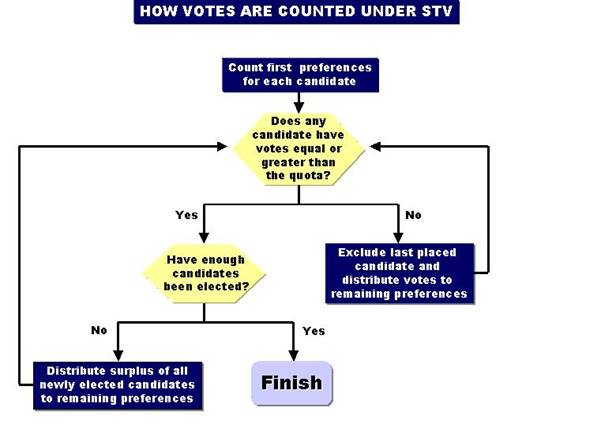
(source: Department of Internal Affairs
website www.dia.govt.nz)
First Past the Post
5.7 With
First Past the Post (FPP) electors tick their preferred candidate(s) up to the
number of vacancies. Candidates with the highest number of votes are elected.
FPP was used by 81% of local authorities in 2022 (63 of 78) including
Horowhenua District Council, Manawatu District Council, and Rangitekei District
Council.
5.8 Under
the FPP (First Past the Post) electoral system, the candidate with the most votes
wins. This is a very simple method of electing candidates and is widely used
throughout the world. It was used in New Zealand for Parliamentary elections up
until the introduction of MMP (Mixed Member Proportional) in the 1996 general
election.
5.9 The
following examples show how results of FPP elections may vary when counted.
Where one candidate has a clear majority of votes, it can be seen that the
majority of people did support the winning candidate.
|

|
Number of Votes
|
Percentage of Votes
|
|
Candidate One
|
140
|
70%
|
|
Candidate Two
|
20
|
10%
|
|
Candidate Three
|
20
|
10%
|
|
Candidate Four
|
20
|
10%
|
|
|
Total Votes = 200
|
Total = 100%
|
5.10 In this
example, the winning candidate received 70% of the total votes
However, the winning candidate might receive more votes than any other one
candidate, but receive fewer votes than the other candidates put together.
|
|
Number of Votes
|
Percentage of Votes
|
|
Candidate One
|
80
|
40%
|
|
Candidate Two
|
60
|
30%
|
|
Candidate Three
|
40
|
20%
|
|
Candidate Four
|
20
|
10%
|
|
|
Total Votes = 200
|
Total = 100%
|
5.11 In this example, the winning candidate got 40 percent of
the total votes, the other candidates received 60 percent of votes. It could be
said that the election result did not reflect the wishes of the majority. Some
people have also argued that even where the winning candidate gets the majority
of the votes, many people’s votes are “wasted”.
5.12 FPP has continued to be used by a majority of councils.
Only a relatively small number of councils have ever opted to use STV since it
was first introduced in 2004 and over the triennia a number of ‘STV
councils’ have moved between using FPP and STV.
5.13 The Horowhenua District has used the FPP system for every
local body election, and has not opted to use STV since the option became
available in 2004.
6. Analysis of Voting Systems
6.1 Both FPP and STV have advantages and disadvantages.
6.2 The advantages of FPP relate to the simplicity of the
process including the ways votes are cast, counted and announced.
6.3 The
disadvantages of FPP relate to:
• disproportional election
results, including the generally ‘less representative’ nature of
FPP councils
• the obstacles to minority candidate election
• the number of
wasted votes.
6.4 The
advantages of STV, relate to the people who get elected using STV. The system
potentially achieves:
• broad proportionality (in multi-member wards/constituencies)
• majority outcomes in single-member elections
• more equitable minority representation
• a reduction in the number of wasted
votes.
6.5 The
disadvantages of STV relate to:
• the public are less familiar with the system
and possibly find it harder to understand
• matters of process such as the
way votes are cast and counted (for example perceived complexity may discourage
some voters)
• the information conveyed in election results.
6.6 The
following table identifies further advantages and disadvantages of both
electoral systems:
|
First Past the Post (FPP)
|
Single Transferrable Vote (STV)
|
|
Casting Votes
FPP is a
straightforward system of voting. FPP is familiar to most people.
|
Casting Votes
STV is a less straightforward
system of voting.
There
is a need for more information for people to understand the STV ranking
system of candidates.
|
|
“Tactical” voting is
possible; votes can
be used with a view to preventing a candidate
from winning in certain
circumstances.
|
It
is virtually impossible to cast a “tactical” vote under STV. As a
result, voters are encouraged to express their true preferences by voting for
as many or as few candidates as they wish.
|
|
Counting Votes
FPP is a
straightforward system for counting votes.
|
Counting Votes
STV vote
counting requires a computer program (the STV calculator).
|
|
Votes can be
counted in different locations (by the two election providers) and then aggregated
by the Electoral Officer in one location..
|
Votes can be
recorded in different locations (by the two election providers) then
aggregated by the Electoral Officer in one location.
|
|
Election results
are usually announced soon after voting ends.
|
Election results
will usually take a little longer to produce, but not significant.
|
|
Election results
Official results
show exactly how many people voted for which candidates.
|
Election results
Official results will identify which candidates
have been
elected and which have not and in which order
in an iteration report which shows how many votes candidates have received.
|
|
Results are easy to understand.
|
Results easy are
to understand.
|
|
A
“block” of like-minded voters can determine the election of multiple
candidates in multi-member wards/ constituencies, without having a majority of the votes, thereby ‘over-representing’
themselves.
|
STV moderates “block” voting as each voter
casts only one single
vote, even
in multi-member wards/
constituencies.
|
|
The overall election results may not be proportional to voters’ wishes, and may not reflect the electoral wishes
of the majority of voters, only
the largest group of voters who may not be the majority.
|
The overall election results
reflect the wishes
of the majority of voters in proportion to their support for a
variety of candidates.
|
|
In single-member elections, the winner often
does not have the majority of
votes, just the largest group of votes.
|
In single-member wards/constituencies, the winner will have the majority of votes
(preferences).
|
|
There will be more “wasted” votes (votes that do not contribute
to the election of a candidate).
|
Every
vote is as effective as possible (depending on the number of preferences indicated) meaning there are fewer “wasted” votes and more
votes will contribute to the election of a candidate than under FPP.
|
|
Costs
FPP processing costs are lower than for STV.
|
Costs
STV
election processing costs are 10-15% higher than FPP procession costs
|
7. Options
Option 1: Note the report and take no further action.
7.1 If
the Council makes no decision on this issue, the public will be notified that
FPP will continue to be the electoral system for the 2025 election unless 5% of
the electors (approximately 1,280 electors) demand that a poll be held. To take
effect for the 2025 election, the valid demand must be received by 28 February
2024 with the last date for a poll to be held being 21 May 2024.
Option 2: Reaffirm Commitment to First Past the Post
7.2 Council
could make a resolution reaffirming its commitment to FPP. Such a resolution
would be consistent with Council's previous decisions. The decision will be
binding for the 2025 and 2028 elections and associated by-elections. The
decision will be publicly notified and subject to the same poll demand
provisions as in Option 1.
Option 3: Change Electoral System from FPP to STV
7.3 Should
the Council wish to change its electoral system for the next elections, a
decision must be made by 12 September 2023 for it to take effect at the 2025
election. Again the decision will be binding for the 2025 and 2028 elections
and associated by-elections. The decision will be publicly notified and
subject to the same poll demand provisions as in Option 1.
Option 4: Hold a Poll on the Electoral System
7.4 The
Council could resolve to conduct a poll on the electoral system to be used for
the 2025 election, effectively leaving it to the public to decide. The outcome
of the poll would dictate the electoral system for both the 2025 and 2028
elections with no change possible until the 2022 election.
7.5 The
estimated cost for a poll, based on 26,000 electors is $110,000 - $110,000
8. Cost
|
Option
|
Cost
|
|
Option 1:
Note the report and take no further action
|
There is no
cost to change the system.
|
|
Option 2:
Reaffirm Commitment to First Past the Post
|
There is no
cost to change the system.
|
|
Option 3:
Change Electoral System from FPP to STV
|
There is no
cost to change the system.
|
|
Option 4:
Hold a Poll on the Electoral System
|
The estimated
cost for a poll, based on 26,000 electors is $100,000 - $110,000 –
0.23% rates.
|
9. Rate Impact
9.1 There are no
additional rates impact for option 1, 2 or 3. There is a small rates impact of
0.23% for option 4.
10. Iwi Considerations
10.1 As noted in 6.4, the STV
system leads to more diversity amongst elected members. However, a decision to
change the electoral system will not affect current Governance arrangements
with mana whenua.
10.2 Any change to the
electoral system will not affect the number of Maori wards.
11. Legal
Considerations
11.1 The
relevant provisions of the Local Electoral Act 2001 for changing a local
authority’s electoral system are:
• a
local authority may, no later than 12 September two years before the next
triennial local election, resolve to change electoral system to take effect for
the next two triennial local elections (section 27)
• every
local authority must give public notice by 19 September two years before the
next triennial local election, of the right for electors to demand a poll on
the electoral system and that notice must include a statement that a poll is
required to countermand any local authority resolution made on the electoral
system (section 28)
• 5%
of electors may at any time demand a poll on a proposal that a specified
electoral system be used at the election of a local authority (section 29)
• a
local authority may, no later than 28 February in the year immediately before
the next triennial local election, resolve to hold a poll on the electoral
system (section 31)
• if, prior to 28
February in the year immediately before the next triennial local election,
either a valid demand for a poll is received (under section 29) or a local
authority resolves to hold a poll (under section 31) this is notified to the
electoral officer and the poll must be held not later than 82 days after the
notification i.e. not later than 21 May in that year, and the result of the
poll takes effect for the next two triennial local elections (section 33)
• if a valid
demand for a poll is received after 28 February in the year before the next
triennial local election, the poll must be held after 21 May in that year and
takes effect for the next but one triennial local election and the subsequent
election (section 30)
12. Financial
Considerations
12.1 If a
successful demand for a poll is received the estimated cost to undertake a poll
is approximately $100,000 - $110,000 which is unbudgeted in the 2023/24
financial year.
13. Other
Considerations
The Future for Local Government Review Panel’s
Recommendation
13.1 In its final report of
2023 (attached) - He mata whāriki, he matawhānui - the Review Panel
for the Future for Local Government encourages the use of STV across all
councils and that this be a legislative requirement, rather than the current
practice of local authorities being able to choose between systems. The
rationale behind this recommendation includes:
13.2 The ‘winner takes
all’ system (FPP) is poorly equipped to represent a population’s
diversity; whereas (STV) can improve representativeness by transferring votes
and avoiding ‘wasted ballots’;
13.3 Considered that STV
promotes greater diversity;
13.4 Potential conflict of
interest where elected members perceive they have an increased chance to win
under a particular system.
14. Community
Engagement
14.1 Timeframes
are as follows:
· 12 September 2023: A local authority MAY resolve
to retain or change the electoral system (from the system it used at the 2025
general election) for the next triennial election.
· 19 September 2023: A local authority MUST give
public notice of the right of 5% of the electors to demand a poll on the future
electoral system for the next two triennial elections and, if a resolution has
been made by a local authority by 12 September, then this must be included in
the notice.
· 18 December 2023: A 90-day period MUST be given
following the public notice allowing electors to gather sufficient signatures
to demand that a poll be held to change the electoral system for the next two
triennial elections.
· 22 February 2024: A local authority MAY resolve
to undertake a poll of electors on a proposal that a specified electoral system
be used for the next two triennial elections.
· 21 May 2024: If EITHER a successful demand has
been received by 21 February 2024 to hold a poll, OR a resolution has been made
by a local authority by 21 February 2024, then a poll MUST be held by 21 May
2024 to take effect for 2025 and 2028.
15. Next
Steps
15.1 Any
resolution passed by Council at this meeting with regards to the voting system
for the 2025 triennial election will be publicly notified as soon as possible
after the meeting, well in advance of the legal deadline of 19 September 2023.
|
Confirmation of statutory compliance
In accordance
with section 76 of the Local Government Act 2002, this report is approved as:
a. containing
sufficient information about the options and their advantages and
disadvantages, bearing in mind the significance of the decisions; and,
b. is
based on adequate knowledge about, and adequate consideration of, the views
and preferences of affected and interested parties bearing in mind the
significance of the decision.
|
· Appendices
There are no attachments for this
report.
|
Author(s)
|
Ashley Huria
Business Performance Manager
|
|
|
Approved by
|
Jacinta Straker
Group Manager Organisation Performance
|
|
|
|
Monique Davidson
Chief Executive Officer
|
|
|
Council
30 August 2023
|

|
7.3 Support for Petition Calling for Citizens
Initiated Referenda on State Highway Maintenance
File No.:
23/572
1. Purpose
1.1 The purpose
of this report is for Council to consider whether to allow copies of the New
Plymouth District Council’s petition calling for a Citizens Initiated
Referenda relating to the maintenance of state highways to be made available at
appropriate Council facilities.
This report does not directly
align with one of Council’s top 10 priorities.
2. Recommendation
2.1 That Report
23/572 Support for Petition Calling for Citizens Initiated Referenda on State
Highway Maintenance be received.
2.2 That this matter
or decision be recognised as not significant in terms of s76 of the Local
Government Act 2002.
2.3 That Council
authorise the Chief Executive to make copies of New Plymouth District
Council’s petition calling for a Citizens Initiated Referenda available
for members of the public to sign at appropriate Council facilities (Option 1).
OR
That Council note the initiative but decline to take part in
the gathering of signatures (Option 1).
3. Background
3.1 LGNZ members
recently agreed to support the following remit with around 98% of the
membership in agreement:
· That
LGNZ publicly lobby all political parties to increase Crown funding for state
highway and local road maintenance budgets.
· Consider
and pursue other avenues including the Office of the Auditor General to seek
resolution of the issues facing the country in relation to the systemic rundown
of our national roading infrastructure.
3.2 New Plymouth
District Council have developed a petition template which presents information
focused on the average remaining surface life of the State Highway Network and
calls for an increase in funding of maintenance and renewals of State Highways
3.3 The petition
claims that Waka Kotahi’s maintenance and renewal programme has clearly
been insufficient to maintain asset health measured via the average remaining
seal life. There are numerous media reports about the issues being faced across
New Zealand.
3.4 Average
remaining seal life is not a metric that can reasonably be used to draw the
above conclusion. Average remaining seal life is a metric based on the assumed
useful life of the surfacing component of a road, it is not a direct road
condition metric and can change drastically by simply altering assumed seal
lives in an asset data base. It is possible to have a road in excellent
condition with a negative value for the remaining seal life. Remaining seal
life is not a strong indicator of asset condition.
3.5 Unfortunately
Waka Kotahi do not publish any meaningful road condition indices on their
Funding and Transport Open Data portal, such as Smooth Travel Exposure,
Pavement Integrity Index, or Condition Index.
3.6 Waka
Kotahi do publish data on their expenditure and work completed.
3.7 As
of June 2022, the State Highway network comprised of a total of 24,510 lane
kilometres, and provided 19.88 billion vehicle kilometres travelled in the
2021/22 financial year.
3.8 In
2021/22 Waka Kotahi spent $771.76M on state highway maintenance, operations and
renewals. Resulting in expenditure of $31,487.56 per lane kilometre of state
highway and $0.039 per vehicle kilometres travelled on state highways in the
2021/22 financial year.
3.9 For
comparison, in 2021/22 Horowhenua District Council spent $4.3M on the same
activities on 1040 lane kilometres, and provided 93.7M vehicle kilometres
travelled on local roads, resulting in $4126.65 per lane kilometre, and $0.046
per vehicle kilometre travelled.
3.10 As
Waka Kotahi spend over 7 times as much money per lane kilometre on road
maintenance, operations and renewals, and only 18% less per vehicle kilometre
travelled compared to Horowhenua District Council, it is not reasonable to assert
that any potential state highway condition deterioration is due to budgetary
constraints. Waka Kotahi should be able to spend significantly less per vehicle
kilometres travelled on state highways, as asset deterioration from weathering
is a less significant factor on busier roads.
3.11 If
Council are concerned with the state highway network’s condition, a
better approach would be to call for a review of Waka Kotahi’s asset
management, contract management and operational management processes.
3.12 To accelerate and
facilitate this discussion, New Plymouth District Council (NPDC) has initiated
the process to trigger a Citizens Initiated Referenda, focused on New Zealand's
state highway network maintenance.
3.13 The wording, as approved
by the Clerk of the House of Parliament, is as follows:
"Should the New Zealand government fund road
maintenance at levels sufficient to reverse the current decline in the average
age and condition of our national state highway
network?"
3.14 The goal of the petition
is to ask the question and let New Zealanders and the political parties who
wish to lead the country through the next term of parliament answer
it.
3.15 NPDC is seeking to
collaborate with councils across the country. Asking Councils to discuss and
debate whether they wish to make the petition accessible in council service
centres and other facilities throughout Aotearoa.
3.16 The objective is to
provide as many Kiwis as possible with the opportunity to express their views
and send a clear message to all members of parliament about their stance on
this crucial aspect of our daily lives.
3.17 A copy of the NPDC
report is attached.
4. Options
Option 1
4.1 Authorise the
Chief Executive to make copies of New Plymouth District Council’s
petition calling for a Citizens Initiated Referenda available for members of
the public to sign at appropriate Council facilities.
Option 2
4.2 Note this
report and take no further action.
5. Next Steps
5.1 If
Council adopts Option 1 the Chief Executive is authorised to make the petition
available at Council service centres and appropriate facilities.
5.2 If
Council adopts Option 2 no further action is required.
Attachments
|
No.
|
Title
|
Page
|
|
a⇩
|
NPDC report - citizens initiated
referendum - 8 August 2023
|
50
|
|
Confirmation of statutory
compliance
In accordance with section 76 of the
Local Government Act 2002, this report is approved as:
a. containing sufficient information about the options
and their benefits and costs, bearing in mind the significance of the
decisions; and,
b. is based on adequate knowledge about, and adequate
consideration of, the views and preferences of affected and interested
parties bearing in mind the significance of the decision.
|
Signatories
|
Author(s)
|
Grayson Rowse
Principal Advisor - Democracy
|

|
|
|
James Wallace
Land Transport Manager
|

|
|
Approved by
|
Monique Davidson
Chief Executive Officer
|
|
|
Council
30 August 2023
|
|
File
No.: 23/565
7.4 Council's response to concerns raised over
the increase in vaping for young people and children
1. Purpose
1.1 This
report is in essence a discussion document that aims to get a decision from
Council on the direction Council Officers should take surrounding the reported
growing use and availability of vape products, in particular among young people
and children.
This report does not directly
align with one of Council’s top 10 priorities.
2. Recommendation
2.1 That
Report 23/565 Council's response to concerns raised over the increase in vaping
for young people and children be received.
2.2 That
this matter or decision is recognised as not significant in terms of S76 of the
Local Government Act.
2.3 That
Council notes the report but takes no further action at this point in time,
noting the existing work being undertaken within the Community Development work
programme (Option 1).
OR
That Council request the Chief
Executive prepare a further report detailing possible roles for Council and
resourcing implications (Option 2).
3. Background / Previous Council Decisions
3.1 Councillors
received an email from a representative of the Vape-free Kids Group on 11 July
2023. The email was asking Councillors to consider support two Vape-Free Kids
NZ petitions and also provide advocacy to central Government on a number of
areas, mainly in the regulatory management in the sale of vape products. A copy
of the email can be found as an attachment to this report.
3.2 The
email received also encouraged Councillors to sign two petitions. Broadly
speaking, the intention of the petitions was to ban the sale of vape products
from non-specialist stores such as local dairies. One of the petitions is
before Parliament and closed for signatures on 10 August 2023. That petition
will now be considered before Select Committee before being referred to the
Minister. The other petition is a Change.org petition and has also closed for
signatures.
3.3 In
receiving that email, Deputy Mayor Allan in his capacity as Acting Mayor at the
time, requested that the CE prepare a paper for Councillors to consider. Deputy
Mayor Allan noted that Council has shown good leadership with reducing the
effects of smoking in the past and this could be an opportunity for newer
Councillors around the table to address concerns raised over vaping.
3.4 It
should be noted that Council has, in the past done some work to promote
positive health outcomes for the community regarding vaping by way of a policy
it adopted in June 2022. The Smokefree and Vapefree Environment Policy
was updated to include vaping, aligning the policy with the Smokefree
Environments and Regulated Products (Vaping) Amendment Act 2020. A copy of this
policy is attached to this report.
4. Discussion
4.1 At
this point in time, Council Officers do not have any specific work programme
items relating to reducing the impacts of vaping within the community.
4.2 That
said, Council Officers do provide support to the Horowhenua Youth Services
Network through the work of the Community Development Team. Within that forum,
of which Councillor Tukapua is Chair has a dedicated work stream that focuses
on understanding the impact that vape products are having on our younger
communities. The work group, made up of key people from within our social
sector are keeping up to speed with legislative changes and what support is
needed here in Horowhenua.
4.3 In
preparing this report, Council Officers have not proactively sought a detailed
understanding of the law surrounding vaping including any incoming legislation.
4.4 Depending
on the direction that Council wishes to take, it is the opinion of Council
Officers, that if Council chose to play a role in reducing the impacts of
vaping, there are a number of high-level approaches that could potentially be
considered as listed below:
Community Education Approach
4.5 Council
Officers continue to work alongside our community networks and partners such as
the Horowhenua Youth Services Network who have already identified this as a
priority and support them with their work. Details are yet to be determined and
will be led by the community with support from Council.
Retailer Education Approach
4.6 Council
Officers prepare and launch a small campaign alongside community groups and
networks to assist vape product retailers to understand their obligations under
the legislation and in particular about the sale of products to children and
young people.
Council Advocacy Approach
4.7 Council
Officers will continue to monitor any legislative changes within Parliament and
perform an advocacy role upon the instruction and direction of Council when required.
This could include preparing letters to the Minister of Health on behalf of
Council.
Regulatory Approach
4.8 At
this point in time, Council’s Customer and Compliance Team are unaware of
any regulatory changes that warrant them to educate, restrict or change the way
that vape products are sold within businesses. The Team will continue to
monitor any legislative changes and report back to Council, if necessary.
4.9 Additionally,
Council could consider incorporating the intention of The Smokefree and
Vapefree Environment Policy into The Public Places Bylaw which is due for
review within the next 12 months. By doing so, Council would have the ability
to enforce those who do not adhere to the Policy and therefore the Bylaw.
Noting that Council Officers in the first instance, typically follow an
education-first approach.
5. Options
5.1 As
the purpose of this report is essentially a discussion document, the options
moving forward, largely sit with Council and the direction they instruct the CE
to take. However, to provide some guidance, Council Officers suggest that the
Council consider one of the two options listed below.
Option 1: Council takes no further action at this point
in time.
5.2 This
option would result in Council Officers not spending any additional time
directly on the topic or issue of vaping. Council Officers would continue to
support our community networks and groups who are working in this space as per
our normal Community Development work programme. Noting that with this option,
if any additional new information was made available to Council Officers and if
it was deemed necessary, this would be conveyed back to Council.
Option 2: Council prepares further detailed options for
Council to consider.
5.3 This
option would require Council Officers to spend some time to fully understand
what support it can offer to the community to help reduce the impact of vaping
in our younger population. Once done, Council Officers would feedback to
Council alongside the time commitment from Council and associated costs, if
any. Ideally, if this was the option that the Council agreed with, Council
Officers could communicate back to Councillors by the end of November 2023.
6. Cost
6.1 The
cost associated with either option is unknown, however, it would be the
intention that any costs would be absorbed within existing operational budgets
(Community Development).
Rate Impact
6.2 There
will be no Rate impacts arising.
7. Community Wellbeing
7.1 The
overall intention of this report is to consider how we can best support our
community regarding this issue and no matter what direction is chosen, the
community will be at the heart of any work undertaken.
7.2 Council’s
Strong Communities (Community Wellbeing Strategy 2021-24) identifies in its
action plan that Council will “continue to be an advocate for our
community” and the essence of this report, reflects this priority.
8. Consenting Issues
8.1 There
are no Consents required or consenting issues arising.
9. LTP Integration
9.1 There
is no LTP programme related to the options or proposals in this report. There
are no Special Consultative Processes required.
10. Consultation
10.1 There
was no consultation required to be undertaken.
11. Legal
Considerations
11.1 There
are no Legal Requirements or Statutory Obligations affecting options or
proposals at this stage in the discussion.
12. Financial
Considerations
12.1 There
is no financial impact at this stage in the discussion. In most of the
discussion points, identified in this report, any costs or financial
considerations would be absorbed in existing operational budgets (Community
Development) unless a more significant project is identified and supported by
the Council.
13. Iwi
Considerations
13.1 At
the time of writing this report, there are no known Iwi Considerations. For the
purposes of this report, views have not been sought.
13.2 If
Council wish to pursue some form of action in relation to this matter, Council
Officers will engage with our Iwi/hapu partners on the work they’re
already doing in this space and how we could potentially collaborate moving
forward.
14. Climate
Change Considerations
14.1
There is no Climate Change impact.
15. Environmental
Considerations
15.1 There
are no Environmental considerations.
16. Health
& Safety Considerations
16.1 There
is no Health & Safety impact.
17. Other
Considerations
17.1 There
are no other considerations.
18. Next
Steps
18.1 Council
need to consider the options and ideas discussed in this report. Following that
discussion and decision, if need be, Council Officers will share a timeframe
and plan on their suggested way forward.
18.2 If
Council choose to take no further action at this point, Council Officers will
not start any new work in this space but will continue to support community
networks and groups within their existing Community Development work programme.
1. Attachments
|
No.
|
Title
|
Page
|
|
a⇩
|
Vapefree Email to Councillors
|
62
|
|
b⇩
|
HDC Smokefree and Vapefree
Policy
|
65
|
|
Author(s)
|
Mark Hammond
Community Facilities and
Services Manager
|
|
|
Approved by
|
Brent Harvey
Group Manager -
Community Experience & Services
|
|
|
|
Monique Davidson
Chief Executive Officer
|
|
|
Council
30 August 2023
|
|
7.5 Housing Action Plan Review
File No.:
23/568
1. Purpose
1.1 The
purpose of this report is to inform Council of the establishment of a Housing
Action Plan Working Party to both review and oversee the ongoing direction and
delivery of the Housing Action Plan first established in 2019.
1.2 The
report seeks appointment from Council of two of its members to join the working
party to provide oversight and connection to the direction. Given the long
gestation timing and commercial sensitivity often attached to developments,
there would be benefit in enabling representative Councillors to have a level
of oversight and confidence around the ongoing direction and delivery of the
plan.
1.3 Consideration
was given to the current demands on elected member time and this gave rise to
the proposed focussed Working Party proposal.
This report directly aligns with
one of Council’s top 10 priorities “Enabling affordable housing
that meets the needs of a growing population through the implementation of the
Housing Action Plan”.
2. Recommendation
2.1 That Report
23/568 Housing Action Plan Review be received.
2.2 That this
matter or decision be recognised as not significant in terms of s76 of the
Local Government Act 2002.
2.3 That
Council appoint Cr [name] and Cr [name] to the Housing Action Plan Working
Party.
2.4 That
the working party Housing Action Plan refresh/review to be completed prior to
the end of 2023, targeting a return to Council for approval in November 2023.
3. Background/Previous Council Decisions
3.1 Council
adopted its Housing Action Plan on 2 October 2019.
3.2 Since then, a
number of national and global events have occurred. Most notably COVID 19
have changed the macro drivers of the affordable housing concept.
3.3 Many of the
key principles of the 2019 Housing Action Plan document are aspirational and
difficult to measure in absolute terms. It is hoped a review may enable greater
clarity around the outcomes sought and thus what levers are key in shifting the
dials in the housing space to deliver for those most in need in our community.
4. Issues for Consideration
4.1 The Housing
Action Plan review is one of the actions identified to meet the priority of
‘Enabling Affordable Housing’ of Councils Top Ten priorities for
2023/24, and is linked to ‘Enabling Affordable Housing/Housing Action
Plan’ deliverable in the CEs performance agreement.
4.2 There is a
need to progress this action in the short term to enable Council to take
advantage of emerging opportunities and to realign the plan with changed
economic and societal landscape. However, with the already very ambitious
plan of work for Council, in particular the 2024 Long Term Plan,
officer’s recommend a working party be formed, and include
representatives of the governance group and management be formed to review and
redevelop the plan. The suggestion of a working group reflects the existing workload of elected members, which means it would be
very difficult to bring the full Council together to work on this review. This
is a review only so the general direction of Council has already been set. The
working group will present the final revised plan to Council for adoption.
4.3 The Housing
Action Plan working party group will be made up of two Group Managers (GM
Housing & GM Community) and two nominated Elected Members. The
working party will refresh the intent of the 2019 plan with the view to
redefining the direction and reconsider the tools available to deliver in this
space ongoing.
4.4 It is
important that when refreshing the plan, the key principles are clearly scoped
and defined and measurable outcomes developed. Our delivery to our
community will be measured by our progress towards those outcomes,
4.5 In many cases
the answer to more affordable and social housing opportunities will sit with
the creation of additional housing stock, be those new builds, renovations to
code on existing dwellings or creating access to vacant (‘ghost’)
dwellings. Council’s primary role therefore will largely be as an
influencer and not as builder.
4.6 The intent is
to bring the revised and refreshed 2019 Housing Action Plan back to Council in
the near future. The revised plan will align to current market conditions
and clearly outline what the key deliverables are, along with how each of these
will be tangibly measured.
Attachments
There are no attachments for this
report.
|
Confirmation of statutory
compliance
In accordance with section 76 of the
Local Government Act 2002, this report is approved as:
a. containing sufficient information about the options
and their benefits and costs, bearing in mind the significance of the
decisions; and,
b. is based on adequate knowledge about, and adequate
consideration of, the views and preferences of affected and interested
parties bearing in mind the significance of the decision.
|
Signatories
|
Author(s)
|
Blair Spencer
Group Manager Housing & Business Development
|

|
|
Approved by
|
Monique Davidson
Chief Executive Officer
|
|
|
Council
30 August 2023
|
|
7.6 Final Capex Carry Forward to 2023-24
File No.:
23/573
1. Purpose
1.1 The
purpose of this report is to finalise the capex carry forward to the 2023/24
capital budget.
This report directly aligns with one of
Council’s top 10 priorities “Get the basics right and support
the customer focused delivery of core services”.
2. Recommendation
2.1 That Report
23/573 Final Capex Carry Forward to 2023-24 be received.
2.2 That
the Council approves the proposed changes to the capital projects that are
outlined in Appendix 1.
2.3 That this
matter or decision be recognised as not significant in terms of s76 of the
Local Government Act 2002.
3. Background/Previous Council Decisions
3.1 When
the 2023/24 Annual Plan was approved in June 2023, the total capital programme
of $61.7m included estimated carry forwards of $12.1m.
3.2 Now
that the actual capital spend of $35.3m has been finalised as of 30 June 2023,
a final wash up is required.
3.3 As
part of finalising the 2022/23 results, a total net change of $1.2m is
requested to the 2023/24 budget. Some projects included in the original
carry forward spent more than they forecast as of 30 June 2023 and it is
recommended to reduce their 2023/24 revised budget by the amount of the
overspend and some projects were completed as planned.
3.4 Please
note that this does not change the currently funded capital delivery of $35m.
4. Issues for Consideration
4.1 The
net requested carry forward is $1.2m. The effect of agreeing to the
requested carry forwards is $1.2m but is not expected to increase borrowings.
4.2 Conversations
will continue with Elected Members on the prioritisation of capital programme
for the 2023/2024 year.
Attachments
|
No.
|
Title
|
Page
|
|
a⇩
|
Capital Expenditure Carry Forward
Requests - August 2023
|
73
|
|
Confirmation of statutory
compliance
In accordance with section 76 of the
Local Government Act 2002, this report is approved as:
a. containing sufficient information about the options
and their benefits and costs, bearing in mind the significance of the
decisions; and,
b. is based on adequate knowledge about, and adequate
consideration of, the views and preferences of affected and interested
parties bearing in mind the significance of the decision.
|
Signatories
|
Author(s)
|
Abraham Chamberlain
Manager Financial Planning and Reporting
|
|
|
Approved by
|
Jacinta Straker
Group Manager Organisation Performance
|
|
|
|
Monique Davidson
Chief Executive Officer
|
|
|
Council
30 August 2023
|
|
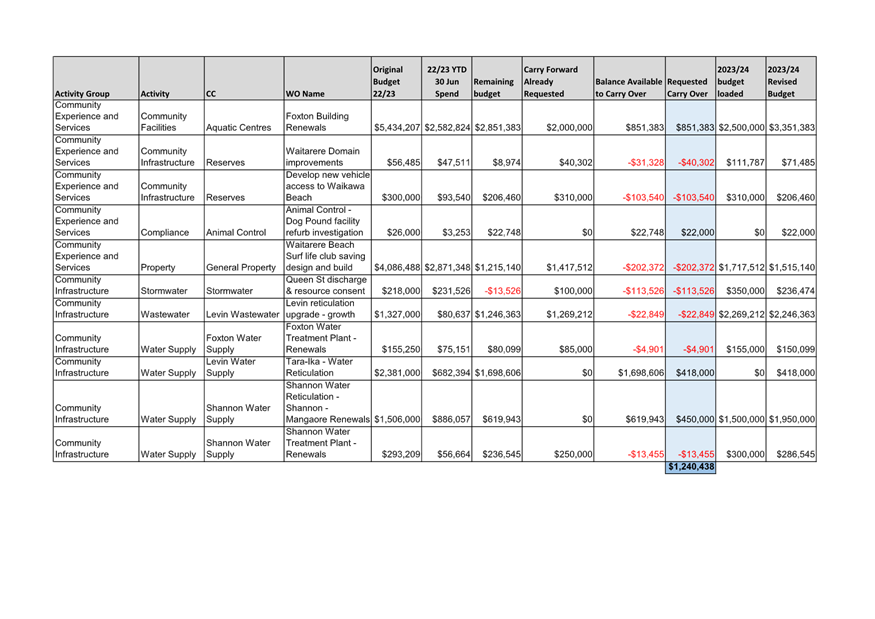
|
Council
30 August 2023
|
|
File
No.: 23/576
7.7 Wellington Regional Leadership Committee -
update to Terms of Reference to incorporate the Future Development Strategy
1. Purpose
1.1 The purpose of this report is to:
a) seek approval for the amended Terms of Reference
for the WRLC (WRLC) to incorporate the Future Development Strategy (FDS), and,
b) appoint one elected member, to be a member of the
Joint Committee Subcommittee for the FDS for the purposes of hearing submissions.
This report does not directly
align with one of Council’s top 10 priorities, however has strong
alignment with the priority “ Provide advocacy and leadership to
Ōtaki to North Levin Expressway Project”.
2. Executive
Summary
2.1 The WRLC is in the process of developing a FDS, which
updates the Wellington Regional Growth Framework (WRGF). The development of the
WRGF was supported by an Agreement and Terms of Reference (TOR) signed by all
councils involved in the process.
2.2 At the time that the Agreement and TOR was signed the
FDS was not anticipated. To address this, and to ensure that the WRLC has the
appropriate powers to sign off the FDS, an update is required to the Agreement
and TOR.
2.3 This report identifies the process that was undertaken
and options that were considered to enable a sign off process. This involved a
two-step process:
a)
Step 1: the WRLC agree which option for signoff of the draft FDS, signoff of
the final FDS and the establishment of a Hearings Panel it endorses.
b) Step 2: as required by the Local Government Act,
any changes to the WRLC Agreement and TOR, needs to be agreed by all ten
councils.
2.4 Step 1 is complete, and this
report seeks agreement from Council to approve the updated Agreement and TOR.
2.5. To ensure that there is equitable participation
for all Councils taking part in the process, the report also seeks that a
representative of each Council is appointed to the sub-committee of the WRLC to
specifically hear submissions on the FDS.
3. Recommendation
3.1 That Council notes that on 8 September 2021, the
Council resolved to establish the WRLC and for Council to become a member of
it. The matters that Joint Committee addresses now need updating and these
resolutions reflect those updates. These resolutions should be read as being in
addition to the original resolutions,
3.2 That Council agrees the WRLC continues as a joint
committee under clause 30(1)(b) of Schedule 7 of the Local Government Act 2002,
but on the amended terms set out in the Joint Committee Agreement (dated 2023),
with the amendments in effect from the date the WRLC Joint Committee Agreement
is signed by all local authority parties,
3.3 That Council notes the main amendments provide for the
WRLC to:
a) undertake the work necessary to inform, prepare and
finalise the FDS in accordance with the National Policy Statement for Urban
Development 2020 (NPS-UD),
b) establish a Joint Committee Subcommittee to hear
submissions on the draft FDS (and any updates) and make recommendations to the
WRLC on those submissions (which will make the final decision on the FDS),
c) undertake regular reviews of the FDS,
d) prepare the implementation plan in support of the
FDS, and,
e) implement the FDS.
3.4 That Council authorises the WRLC to appoint a Joint
Committee Subcommittee for the FDS to hear and make recommendations on
submissions received on the draft FDS to be developed under the NPD-UD (and any
updates to that Strategy),
3.5 That Council approves the amended WRLC Joint Committee
Agreement, including the amended Terms of Reference for the Joint Committee and
the new Terms of Reference for the Joint Committee Subcommittee for the FDS.
(Noting that as required by the existing Agreement, the WRLC Joint Committee
has endorsed the amendments to functions and powers of the Joint Committee),
3.6 That Council delegates all powers and functions to the
WRLC set out in the amended WRLC Joint Committee Agreement, including the
amended Terms of Reference for the Joint Committee and the new Terms of
Reference for the Joint Committee Subcommittee for the FDS,
3.7 That Council notes that the WRLC is a joint committee
of all local authorities that are parties to the WRLC Joint Committee
Agreement, and it includes members representing iwi and the Crown,
3.8 That Council authorises the Mayor to sign the amended
WRLC Joint Committee Agreement on behalf of the Council,
3.9 That Council appoints one elected member being
[Elected member name], to be a member of the Joint Committee Subcommittee for
the FDS for the purposes of hearing submissions on the draft FDS (or any
updates to it) and making recommendations on those submissions to the WRLC, and
3.10 That Council authorises
officers to make any consequential amendments to Attachment 1 of the report, based on direction provided at this
meeting and to correct any minor editorial, typographical, arithmetical, or
formatting errors that are identified.
4. Background / Previous Council Decisions
The Future Development Strategy
4.1 The FDS is an updated version of the Wellington Regional Growth
Framework. It is a statutory document, for “Tier 1 and 2” councils
who are required to prepare a FDS under the NPS-UD in time to inform the 2024
Council Long Term Plans (LTPs). This means we ideally need to complete and have
signed off at least a draft FDS by third quarter 2023 to enable councils to
include any financial and other implications in the early drafts of their LTP.
4.2 Wellington, Porirua, Kāpiti, Hutt City, Upper Hutt and Greater Wellington
are Tier 1 Councils and Horowhenua, South Wairarapa, Carterton and Masterton
are Tier 3 Councils. These categories based on growth projections, with Tier 1
councils considered “high growth”.
4.3 As a Tier 3 Council, there is no requirement to produce a FDS, and
HDC sits within the Horizons rohe. However with recent improvements to the
northern corridor and market changes, our future is becoming more closely
aligned with the Greater Wellington Region. The benefits to the
Horowhenua District of being included in the FDS for the Greater
Wellington Region include strengthening ties with the Wellington region, and
being able to capitalise on growth from there. The FDS will send a clear
signal that Horowhenua District is located in a strategic position in terms of
both regions, that we are open for business and planning for growth, and will
indicate where the regionally significant growth is to occur. Inclusion in the
Greater Wellington Region FDS will not prevent Horowhenua District from
being included in the Horizons FDS or any similar document.
4.4 Officers from local government and central government have been
working on the content of the FDS since August 2022 and the list below outlines
workshops and meetings that the WRLC, Councils, iwi and others have had on the
FDS including:
a) various presentations to incoming councils on the WRLC and the
FDS – though October to December 2023, in February 2023 and to the last
council in June 2023.
b) FDS workshop with the WRLC – 1 February 2023
c) FDS update paper to the WRLC at its meeting - 7 March 2023
d) combined Wellington City Council/Porirua City Council workshop
– 29 March 2023
e) combined Wairarapa councils workshop – 4 April 2023
f) combined Upper Hutt City Council/Hutt City Council workshop
– 5 April 2023
g) iwi workshop – 11 April 2023 and various one on meetings
with iwi
h) combined Horowhenua District Council/Kāpiti Coast District
Council workshop – 13 April 2023
i) three separate workshops in the Wairarapa, one with each Council
– 3 May 2023
j) workshop with iwi members on the statement of iwi/hapu
aspirations for urban development – 15 May 2023
k) workshop with the WRLC on elements of the Future Development - 15
May 2023
l) FDS update paper to the WRLC at its meeting - 13 June 2023
m) booth on the FDS and a workshop session on the FDS at the WRLC
Annual Partners Forum - 26 June 2023
n) separate workshop in Martinborough for SWDC – 5 July 2023
4.4 The
FDS team has also been working with developers and infrastructure providers on
the Strategy, as required under the NPS-UD.
4.5.
The FDS is nearing completion and is expected to be taken in draft
to the WRLC meeting on 19 September 2023 for approval for consultation. This,
however, cannot be done without signoff from all ten councils on changes to the
WRLC Agreement and TOR as discussed below.
The WRLC Agreement and Terms of Reference
4.6. The
current WRLC Agreement and TOR includes the development and implementation of
the Wellington Regional Growth Framework, as a spatial plan for the region. At
the time of developing the Agreement the FDS was not contemplated as a tool and
therefore, the WRLC Agreement and TOR do not give the WRLC the powers/functions
relating to a FDS.
4.7.
The WRLC includes both the Mayor from each council as the
substantive member and the Deputy Mayor from each council as the alternate
member.
4.8.
The WRLC Secretariat has received legal advice (see Attachment 1)
that states: “It is beyond the scope of the WRLC powers to approve the
FDS, draft or final, on behalf of the member Councils at present. Those
decisions on the FDS currently must be made by each individual Council.”
16. This is because the current WRLC Agreement and TOR identifies that the WRLC
is responsible for the WRGF specifically, rather than a more general
responsibility for regional spatial planning, which is and has always been the
intent for the WRLC.
4.9
As a comparison for instance the Agreement has the WRLC responsible for
“regional economic development” in a more general term, rather than
stating a specific document. 18. Therefore, for the WRLC to be involved in the
FDS process (in any manner), an update needs to be made to the WRLC Agreement
and TOR.
4.10 This
is being undertaken in two steps:
a)
Step 1: the WRLC agree which option for signoff of the draft FDS, signoff of
the final FDS and the establishment of a Hearings Panel it endorses. This
decision was made at the WRLC meeting on 13 June 2023 and discussion on the
process for this is covered in this paper.
b)
Step 2: as required by the Local Government Act, any changes to the WRLC
Agreement and TOR, needs to be agreed by all ten councils that are party to the
WRLC. This paper covers this step, and a similar paper is being considered
during August and September 2023 by the other nine councils who are party to
the WRLC.
4.11
This report seeks Council’s approval for Step 2. Similar papers are also
being presented to the other WRLC Councils, and a discussion on Step 1 is
included below.
5. Discussion
Step 1: WRLC consideration of the
options for signoff of the Future Development Strategy
5.1. The
WRLC was provided with a recommendation at its meeting in September 2022 as
follows: “Agrees to support the option a. as outlined in paragraph 20 of
this report and update the Agreement and Terms of Reference for the WRLC to
enable the Committee to sign off the draft and final of the FDS and form a
subcommittee to undertake hearings on the FDS.
5.2 No
decision was made at the September 2022 meeting due to the lack of local
government representatives at the meeting. This recommendation was proposed to
be raised at both the December 2022 and March 2023 WRLC meetings.
5.3. However,
making a decision on the FDS signoff and updated WRLC Agreement and TOR was put
on hold and not taken forward at the December 2022 and March 2023 meetings as:
a) the WRLC requested
in September 2022 that it be provided further information, regarding decision
making on the FDS and any proposed amendments to the WRLC Agreement and TOR.
b) there were five new Mayors and many new councillors across
the region following the local body elections in October 2022 and it was felt
that these people needed to be bought up to speed on what regional spatial
planning is, what a FDS is and options and implications for the FDS signoff by
the WRLC.
c) mana whenua had not had enough time (capacity related) to
engage in the FDS and signoff process as would be preferred.
5.4. To
assist in b) and c) above a number of workshops were undertaken as outlined
elsewhere in this paper. The workshops covered - what is regional spatial
planning, what is the FDS and the FDS signoff options.
5.5. At its
meeting on 13 June 2023 the WRLC was provided with a paper which outlined
options for approval of the FDS both draft and final and establishment of a
hearing subcommittee.
5.6. Four
options were considered by the WRLC. These options had previously been
explained and discussed at the workshops held with WRLC councils in March,
April, May and July 2023 as noted elsewhere in this paper.
5.7. The
four options are covered in the table below and Option 1 which was agreed to by
the WRLC at its meeting on 13 June 2023 is covered in more detail below.
|
Options
|
Ability to meet
statutory timeframes?
|
Iwi partners
involved?
|
Additional costs
(staff time or budget)?
|
FDS reflects a
joined-up vision for our region?
|
Alignment with
future Spatial Planning Act (SPA)
|
Rating (out of
10)
|
|
1. WRLC signoff
draft FDS and final FDS and undertake hearings
|
Yes - project
plan in place that reflects this option
|
Iwi part of WRLC
Central government part of WRLC
|
Budget allocated
and on track
|
Yes, through WRLC
|
Yes, SPA is
likely to require a joint committee with mana whenua
|
10/10
|
|
2. Set up a
subcommittee or new committee of just Tier 1 councils and iwi
|
Maybe/ unlikely
depending on time taken to set up new committee
|
Maybe -dependent
on being part of new committee
|
Slightly more
legal costs to craft new agreement, but not significant
|
Mostly through
new subcommittee representation
|
Somewhat i.e.
does not include whole region
|
7/10
|
|
3. WRLC signoff
the draft FDS and undertake hearings and each council signoff the final FDS
|
Delay likely if
agreement can’t be reached on final FDS (i.e. if 1 or more councils
don’t agree on content)
|
Not at final FDS
stage unless allowed for in council standing orders
|
Iwi will need to
attend multiple for final sign off meetings Individual council officers to
prepare and present reports for final FDS
|
Risk that
agreement may not be reached on FDS
May in effect
have 10 FDS documents
|
No
|
5/10
|
|
4. Each council
sign off the draft FDS, WRLC hold hearings and sign off the final FDS
|
Delays likely if
agreement can’t be reached on draft FDS (i.e. if 1 or more councils
don’t agree on content)
|
Worse than option
3 for iwi partners as key decisions will be made at the draft FDS stage
|
Slight increase
in work for each council and dedicated staff will need to be available
|
Risk that
agreement may not be reached on FDS. May in effect have 10 FDS documents.
|
Maybe
|
5/10
|
5.8 Option 1 (the option approved by the
WRLC and included in the changes to the WRLC Agreement and TOR) includes:
a) one on one workshops with each council and iwi
entity on the content of the FDS for their overview and comment – before
the draft goes to the WRLC – underway.
b) engagement with certain parties and consideration of
the matters as required by clauses 3.14 and 3.15 of the NPS-UD – before
the draft goes to the WRLC – underway.
c) the WRLC signing off the draft FDS.
d) the WRLC Secretariat and FDS Project lead managing
the submissions hearings and report back process.
e) a hearings panel consisting of one representative
from each local government and iwi entities on the WRLC (if they choose to).
f) workshops/briefings to provide councils and
iwi entities with an understanding of proposed changes from the submissions and
hearings to the FDS.
g) the
WRLC signing off the final FDS.
5.9 Assuming
all WRLC councils approve changes to the WRLC Agreement and TOR by
mid-September 2023 (the last likely council meeting timing) then the FDS is
likely to be finalised in early 2024 (i.e.Feb/March) with engagement and hearings
being undertaken in 2023.
5.10 Option 1 was selected because:
a) regional
spatial planning is a key function of the WRLC as it was initially set up. If
other options had been selected, it raises a question about why have the WRLC
in the first place. It should be noted that Ministers are on the WRLC for the
regional spatial planning aspects only;
b) this
option aligns strongly with the future direction given for the proposed Spatial
Planning Act (SPA). The SPA will be replacing the RMA and will require regional
level spatial strategies (called “RSS”) to be developed through
regional committees made up of central and local government and mana whenua.
Undertaking the FDS process jointly through the WRLC will put this region in a
good place to prepare future Regional Spatial Strategies which will be an
update of the FDS;
c) the
WRLC generally works on a consensus model, and it is expected that key
decisions are made on this basis. Therefore, in effect if alignment cannot be
achieved then decisions are brought back to the table for further discussion
– for instance if there is a lack of agreement on the draft FDS;
d) from an
efficiency perspective Option 1 would only require one resolution from each
Council at the start of the process rather than needing to obtain multiple
Council resolutions throughout the process (ie for the draft FDS and the final
FDS);
e) this is the
best option for iwi members on the WRLC;
f)
it is the preferred option of and has been endorsed by the WRLC Secretariat,
the FDS Core Team and Steering Group, the WRLC Senior Staff Group, the WRLC CEO
Group and iwi members on the WRLC.
5.11 Reflecting the statutory context for the FDS
(required under the NPS-UD), Central Government would not participate in the
hearings or formally signoff the FDS. This is the same for all the options.
5.12 The recommendation provided below was approved at
the 13 June 2023 WRLC meeting: “Agrees to support the progression of
Option 1 as outlined in paragraphs 20-23 of this report which includes the Committee
making decisions to commence the FDS consultation and preparation process,
approve the draft FDS (statement of proposal) and commence special consultative
procedure, to engage in consultation and set up a hearing panel to hear
submissions on the FDS, and approve the final FDS (with reporting to the
councils at relevant steps).”
5.13 Therefore
Step 1 is now complete.
Step 2: Changes to
the WRLC Agreement and TOR.
5.14 Each
of the ten councils has previously approved an initial WRLC Agreement and TOR
and then an updated one. This will be the second update to the WRLC Agreement
and TOR.
5.15 The
current WRLC Agreement and TOR has been updated to align with the
recommendation at the 13 June 2023 WRLC meeting. A clean copy and a track
changed copy of the updated WRLC Agreement and TOR can be seen in Attachment 2
and Attachment 3.
5.16. As required by the
Local Government Act, any changes to the WRLC Agreement and TOR, need to be
agreed by all ten councils that are party to the WRLC. This will be undertaken
at council meetings which will be occurring between July and September 2023.
5.17 A summary of
changes that related to the FDS are:
a) adding
the FDS as a “Specific Responsibility” of the WRLC including the
detailed actions of what this includes.
b) the
wording requirements, in a number of places, for the WRLC to set up a
subcommittee to hear submissions and the delegations to do so – including
what this means in terms of actions.
c) adding
the FDS and related activity such as the work to develop the FDS, hold hearings
and approve the FDS into the delegations of the WRLC.
d) the
ability for the subcommittee to have an independent chair if needed (the
subcommittee may decide not to do this, but the changes allow for this in
case).
e) a new
Appendix 2 which is the Terms of Reference for the Joint Committee Subcommittee
for the FDS (to undertake the hearings). This includes information on its
purpose, responsibilities, membership, and delegations.
5.18 As any
change to the WRLC Agreement and TOR requires all ten councils to agree the
changes and it a long and administratively heavy process, we are also taking
the opportunity to make some other changes to the WRLC Agreement and TOR. These
are:
a) some tidy
ups in the document. For example, the old version referred to both persons and
Ministers when talking about the Crown members, the Administering Authority was
noted but not explained.
b) removing reference
to an independent chair for the WRLC itself – there has been some
comments about perhaps not having an independent chair in the future. We
don’t know if this will happen yet but to avoid having to go back to ten
councils again if it was decided to not have an independent chair in the
future, the language in the WRLC Agreement and TOR has been softened e.g. now
an option rather than a must.
5.19 If one or more
councils do not pass the resolutions in this paper i.e. does not agree to the
changes to the WRLC Agreement and TOR to enable the WRLC to carry out the
stated activities for the FDS, or wants to make large changes to the Agreement,
then next steps would likely be:
a) hold an extraordinary meeting of the WRLC to
understand its next preference for the signoff of the FDS.
b) make any further relevant changes to the WRLC
Agreement and TOR.
c) set up dates for another ten council meetings.
d) prepare
a new pack of background information/analysis for council papers.
e) have ten councils consider
another paper with the new process.
f) we
estimate that this would take us to the end of 2023 which means engagement on
the draft FDS cannot be undertaken until at least February 2024 with the final
signed off mid-2024.
Hearings
subcommittee
5.20 The
updated WRLC Agreement and TOR provides for a Joint Committee Subcommittee for
the purpose of hearing submissions on the FDS. Some points about the
subcommittee are:
a) Appendix
2 of the updated WRLC Agreement and TOR provides all the information on the
hearings subcommittee.
b) the
new WRLC Agreement and TOR allows for each council and each iwi entity to have
a member on the hearings subcommittee. This is reflected in the recommendations
of this paper. It is not a must to appoint someone, but the option is provided
to enable all parties to continue to be part of the process if so chosen.
c) at
this stage we are not clear on how long the hearings will last. Our only
reference point so far is the Nelson/Tasman FDS where there was a week of
hearings.
d) we are
planning to hold hearings across the region e.g. Wellington city, the western
corridor, the Wairarapa to make it easier for those who are wanting to make an
oral submission. Those on the hearings subcommittee will need to attend all
hearings across the region.
e) the
hearings subcommittee will be provided with resource to manage submissions and
submitters who want to be heard, an expert to write up the findings from the
hearings and submissions and may have access to an independent chair for the
hearings if required.
f) the
hearings subcommittee will make recommendations for changes to the draft FDS
for the WRLC for consideration.
6. Options
6.1 The
high-level options with regards to the recommendations in this paper are:
(i) approve the recommendations as
written including nominating someone for the hearings subcommittee;
(ii) approve the recommendations as
written but do not nominate anyone for the hearings subcommittee;
(iii) do not approve the
recommendations.
Cost
6.2 No
additional costs involved in the updated Terms of Reference, it will be covered
by the current budget for by the WRLC
Rate
Impact
6.3 No
additional rates impact over and above funds already committed
Community
Wellbeing
6.4 There
are no negative impacts on Community Wellbeing arising.
Consenting
Issues
6.5 There
are no consenting issues arising.
LTP
Integration
6.6 There
is no LTP programme related to the options or proposals in this report.
There are no Special Consultative Processes required.
7. Consultation
7.1 There
is no consultation required to be undertaken.
8. Legal Considerations
8.1 Legal advice on this matter can be found
in Attachment 1. 51. Key points from this advice are:
a) it is beyond the scope of the WRLC powers to
approve the FDS, draft or final, on behalf of the member Councils at present.
All decisions on the FDS currently must be made by each individual Council.
a)
b) in order to streamline the process for the FDS
across all 10 Councils, the Agreement could be amended in order to include the
FDS within WRLC’s specific responsibilities. Such an amendment should
state that the WRLC has authority to make decisions to commence the FDS
consultation and preparation process, approve the draft FDS (statement of
proposal) and commence SCP, to engage in consultation and hear submissions on
the FDS as part of the SCP, and approve the final FDS (with reporting to the
Councils at relevant steps)
b)
c) together with amendment to the Agreement, each
Council would need to resolve to delegate its decisions on the FDS and its role
in consultation and the SCP to the WRLC.
c)
d) pursuant to clause 32 of Schedule 7 of the LGA, the
delegation of a decision on the FDS is not prevented.
9. Financial Considerations
9.1 There is no financial impact. The
costs of the FDS have been budgeted already, with these costs split between all
council partners, based upon population size. The costs for the WRLC signing
off the draft and final and undertaking hearings will be paid for from this
budget.
9.2. By undertaking the process regionally, we will be
able to stick to this budget and ensure that knowledge that is gained through
this process stays in house.
10. Iwi
Considerations
10.1 The
decision making and hearing subcommittee option endorsed by the WRLC for the
FDS will enable iwi partners to the WRLC to participate in the FDS decision
making. This is the best option for iwi partners as:
a) iwi members of the WRLC will have
an option just like councils do to put someone on the hearings subcommittee.
b) iwi members will be at the WLRC meetings
when the draft and final FDS is signed off.
c) other options considered by the WRLC
where councils only signed off either the draft or final FDS would rely on:
I. Council standing orders enabling iwi
members to sit at the council table and vote on either the draft and/or final
FDS.
11. II.
iwi partners having to go to multiple council meetings in their rohe to
participate in the signoff/s.Climate Change Considerations
11.1 The FDS being developed is consistent with many of the objectives in
the Sustainability Strategy in that the proposed strategy aims to:
a) reduce greenhouse
gas emissions;
b) build resilience;
c) address climate
change;
d) protect and
enhance the natural environment.
12. Environmental
Considerations
12.1 There
are no environmental considerations.
13. Health
& Safety Considerations
13.1 There
is no health and safety impact.
14. Other
Considerations
14.1 There
are no other considerations.
15. Next
Steps
15.1 If
the recommendations are accepted, the FDS will be able to continue on its
current trajectory – which will be for a completed report ready for
consultation in October 2023.
15.2 If
the recommendations are not accepted, this may mean delays in producing the
document, possible
16. Supporting
Information
|
Strategic Fit/Strategic Outcome
Accepting the recommendations of this
report will allow the FDS to continue and to be completed, which will ensure
that the Horowhenua District remains part of the strategic planning for the
Wellington Region.
|
|
Decision Making
This report has a medium degree of
significance.
The report does relate to a
transfer of decision making to the Wellington Region Leadership Committee but
does not represent a significant variation to the previous TOR.
Engagement and consultation has been
undertaken with developers and infrastructure providers as required to by the
NPS-UD. We need to engage with them as part of developing the FDS.
Internal engagement has included:
a) multiple discussions at WRLC
Senior Staff Group meetings from September 2022 through to now. In all these
discussions the preferred options as reflecting in the updated WRLC Agreement
and TOR has been endorsed.
b) multiple discussions at WRLC CEO
meetings from September 2022 through to now. In all these discussions the
preferred options as reflecting in the updated WRLC Agreement and TOR has
been endorsed.
c) discussion at workshops with WRLC
iwi members on the FDS with them endorsing the recommended changes and
approach.
d) explanation and discussion at
numerous council workshops as highlighted elsewhere in this report.
e) discussion at WRLC workshops since
September 2022.
|
|
Consistency with Existing Policy
|
|
Funding
Already funded through existing
budget.
|
|
Risk Area
|
Risk Identified
|
Consequence
|
Likelihood
|
Risk Assessment (Low to Extreme)
|
Managed how
|
|
Strategic
|
nil
|
|
|
|
|
|
Financial
|
nil
|
|
|
|
|
|
Service
Delivery
|
nil
|
|
|
|
|
|
Legal
|
Please see
legal advice in Attachment 1
|
If
recommendation to accept amended TOR not adopted, then the FDS will not be
able to proceed
|
medium
|
medium
|
By accepting
the change to the TOR
|
|
Reputational
|
nil
|
|
|
|
|
|
Confirmation of statutory compliance
In accordance
with section 76 of the Local Government Act 2002, this report is approved as:
a. containing
sufficient information about the options and their advantages and
disadvantages, bearing in mind the significance of the decisions; and,
b. is
based on adequate knowledge about, and adequate consideration of, the views
and preferences of affected and interested parties bearing in mind the
significance of the decision.
|
17. Attachments
|
No.
|
Title
|
Page
|
|
a⇩
|
Attachment 1 - Legal Advice on
decision-making on FDS
|
87
|
|
b⇩
|
Attachment 2 - WRLC Agreement
and TOR - updated post June 2023 meeting - track version - with amendments
from Councils
|
95
|
|
c⇩
|
Attachment 3 - WRLC agreement -
Clean version
|
123
|
|
Author(s)
|
Lisa Poynton
Senior Policy Planner
|
|
|
Approved by
|
David McCorkindale
Group Manager - Vision
& Delivery
|
|
|
|
Monique Davidson
Chief Executive Officer
|
|
|
Council
30 August 2023
|

|
File No.: 23/579
8.1 Interim Organisation Performance Report
1. Purpose
1.1 To
present the Interim Organisation Performance Report for July 2023 –
August 2023.
This report aligns will all of
Council’s top 10 priorities, and provides a snapshot progress report on
each priority.
2. Recommendation
2.1 That Report
23/579 Interim Organisation Performance Report be received.
2.2 That this matter or decision is recognised as not significant in terms
of S76 of the Local Government Act.
2.3 That having
considered all matters raised in the Organisation Performance Report April 2023
the report be noted.
3. Background
3.1 This report
is provided for information purposes only and seeks to update Council on a
number of key projects and priorities for Horowhenua District Council. This
report seeks to provide a snapshot of progress since the previous meeting.
Officers are happy to receive feedback on future improvements to this report.
4. Appendices
|
No.
|
Title
|
Page
|
|
a⇩
|
Interim Organisation Performance Report August 2023
|
153
|
|
Author(s)
|
Charlie Strivens
Senior Advisor - Organisation Performance
|
|
|
Approved by
|
Jacinta Straker
Group Manager Organisation Performance
|
|
|
|
Monique Davidson
Chief Executive Officer
|
|
|
Council
30 August 2023
|

|
8.2 Long Term Plan 2021-2041 Monitoring Report
File No.:
23/577
1. Purpose
The purpose of this report is to present to Council the
ongoing monitoring report, which reflects the progress of
those actions and recommendations from the Long Term Plan 2021-2041 and Long
Term Plan 2021-2041 Amendment deliberations.
|
2. Recommendation
2.1 That Report
23/577 Long Term Plan 2021-2041 Monitoring Report be received.
2.2 That
this matter or decision be recognised as not significant in terms of s76 of
the Local Government Act 2002.
|
3. Background/Previous Council Decisions
During deliberations
for the Long Term Plan 2021-2041 and its amendment, Council gave direction on a
number of actions and recommendations, which are recorded in the attached
monitoring report.
4. Issues for Consideration
It is intended that this monitoring report
be presented to Council on a quarterly basis.
Attachments
|
No.
|
Title
|
Page
|
|
a⇩
|
LTP 2021-2041 monitoring report -
August 2023
|
169
|
|
Confirmation of statutory
compliance
In accordance with section 76 of the
Local Government Act 2002, this report is approved as:
a. containing sufficient information about the options
and their benefits and costs, bearing in mind the significance of the
decisions; and,
b. is based on adequate knowledge about, and adequate
consideration of, the views and preferences of affected and interested
parties bearing in mind the significance of the decision.
|
Signatories
|
Author(s)
|
Grayson Rowse
Principal Advisor - Democracy
|
|
|
Approved by
|
Monique Davidson
Chief Executive Officer
|
|
|
Council
30 August 2023
|
|
8.3 Council Resolution and Actions Monitoring
Report August 2023
File No.:
23/555
1. Purpose
The purpose of this report is to present to Council the updated monitoring report covering resolutions
and requested actions from previous meetings of Council.
|
2. Recommendation
2.1 That
Report, Council Resolution and Actions Monitoring Report August 2023 be
received.
2.2 That
this matter or decision be recognised as not significant in terms of s76 of
the Local Government Act 2002.
|
Attachments
|
No.
|
Title
|
Page
|
|
a⇩
|
Council Actions Monitoring Report
2023 - August 2023
|
180
|
|
Confirmation of statutory
compliance
In accordance with section 76 of the
Local Government Act 2002, this report is approved as:
a. containing sufficient information about the options
and their benefits and costs, bearing in mind the significance of the
decisions; and,
b. is based on adequate knowledge about, and adequate
consideration of, the views and preferences of affected and interested
parties bearing in mind the significance of the decision.
|
Signatories
|
Author(s)
|
Grayson Rowse
Principal Advisor - Democracy
|
|
|
Approved by
|
Monique Davidson
Chief Executive Officer
|
|
|
Council
30 August 2023
|

|
9.1 Proceedings of the Risk and Assurance
Committee 16 August 2023
File No.:
23/597
1. Purpose
To present to the Council the
minutes of the Risk and Assurance Committee meeting
held on 16 August 2023.
2. Recommendation
2.1 That Report
23/597 Proceedings of the Risk and Assurance Committee 16 August 2023 be
received.
2.2 That the
Council receives the minutes of the Risk and Assurance Committee meeting held
on 16 August 2023.
3. Issues for Consideration
There are no items that require further
consideration.
Attachments
There are no attachments for this
report.
|
Confirmation of statutory
compliance
In accordance with section 76 of the
Local Government Act 2002, this report is approved as:
a. containing sufficient information about the options
and their benefits and costs, bearing in mind the significance of the decisions;
and,
b. is based on adequate knowledge about, and adequate
consideration of, the views and preferences of affected and interested
parties bearing in mind the significance of the decision.
|
Signatories
|
Author(s)
|
Grayson Rowse
Principal Advisor - Democracy
|
|
|
Approved by
|
Monique Davidson
Chief Executive Officer
|
|
|
Risk and
Assurance Committee
16 August 2023
|
|

|
Risk and Assurance Committee
OPEN MINUTES
UNCONFIRMED
|
Minutes of
a meeting of Risk and Assurance Committee held in the Council Chambers, 126-148
Oxford St, Levin on Wednesday 16 August 2023 at 1:00pm.
present
|
Chairperson
|
Cr Sam Jennings
|
|
|
Deputy Chairperson
|
Cr Paul Olsen
|
|
|
Members
|
Cr Alan Young
|
|
|
|
Cr Clint Grimstone
|
|
|
|
Cr Jonathan Procter
|
|
|
|
Cr Piri-Hira Tukapua
|
|
|
|
Mayor Bernie Wanden
|
|
|
|
Jenny Livschitz
|
Independent Member
|
|
|
Sarah Everton
|
Independent Member
|
IN ATTENDANCE
|
Reporting Officer
|
Monique Davidson
|
Chief Executive
|
|
|
Daniel Haigh
|
Group Manager - Community Infrastructure
|
|
|
Jacinta Straker
|
Group Manager - Organisation Performance
|
|
|
Brent Harvey
|
Group Manager - Community Experience and
Services
|
|
|
David McCorkindale
|
Group Manager – Community Vision
and Delivery
|
|
|
Blair Spencer
|
Group Manager – Housing &
Business Development
|
|
|
Nicki Brady
|
Procurement & Organisation
Transformation Manager
|
|
|
Rob Benefield
|
Risk Manager
|
|
|
Ashley Huria
|
Business Performance Manager
|
|
|
James Wallace
|
Roading Manager
|
|
|
Tanya Glavas
|
Health and Safety Lead
|
|
Meeting Secretary
|
Grayson Rowse
|
Principal Advisor – Democracy
|
1 Apologies
|
Apology
|
|
Resolution
number RAACC/2023/35
MOVED by Cr
Jennings, seconded Mayor Wanden:
That the
apology from Councillor Procter for lateness be accepted.
CARRIED
|
2 Public Participation
There was no
public participation.
3 Late Items
There were no late items.
4 Declaration
of Interest
There were no
declarations of interest.
5 Confirmation
of Minutes
|
Resolution Number
RAACC/2023/36
MOVED by Cr
Grimstone, seconded Cr Olsen:
That the
minutes of the meeting of the Risk and Assurance Committee held on Wednesday,
7 June 2023, be confirmed as a true and correct record.
Carried
|
|
Resolution Number
RAACC/2023/37
MOVED by Cr
Grimstone, seconded Cr Olsen:
That the
minutes of the meeting of the In Committee Meeting of Risk and Assurance
Committee held on Wednesday, 7 June 2023, be confirmed as a true and correct
record.
Carried
|
6 Reports
for Noting
|
6.1
|
PWC Tax Governance Presentation
|
|
|
The
PricewaterhouseCoopers (PwC) annual tax update was presented to the
Horowhenua District Council, as part of the tax governance framework
programme.
|
|
|
Resolution
Number RAACC/2023/38
MOVED by Cr Tukapua, seconded
Mrs Everton:
2.1 That Report
23/504 PWC Tax Governance Presentation be received.
2.2 That
this matter or decision be recognised as not significant in terms of s76 of
the Local Government Act 2002.
Carried
|
|
|
Michelle McDonald, Tax
Partner from PricewaterhouseCoopers presented to the Committee, and responded
to member’s questions.
In terms of this committee, an annual report back is
usually sufficient unless there is a particular issue that needs further
investigation.
|
|
6.4
|
Health, Safety and Wellbeing Quarterly Report - August 2023
|
|
|
The health, safety and wellbeing information and
insight from 1 May to 28 July 2023 was reported to update the Committee on
key health and safety critical risks and initiatives.
|
|
|
Resolution
Number RAACC/2023/39
MOVED by Cr Jennings, seconded
Mayor Wanden:
2.1 That Report
23/505 Health, Safety and Wellbeing Quarterly Report - August 2023 be
received.
2.2 That
this matter or decision be recognised as not significant in terms of s76 of
the Local Government Act 2002.
Carried
|
|
|
Councillor Procter joined the meeting
at 1:25 pm during consideration of item 6.4.
|
|
|
Officers to provide further information on trends in
reports on footpath maintenance requests.
Service Level agreement for immediate health and safety
issue s to make safe within 24 hours of notification; there has been no
failure of this service level.
Very poor or poor standard footpaths are made good though
the foot path renewal budget, but this budget only allows for approximately 2
kilometres of footpath renewal per year: there are 9.93km of poor or very
poor footpaths in the total 229 km of footpath.
Yellow tactile indicators are a treatment to indicate safe
pedestrian crossings for the visually impaired where safe crossings
are. There are specific technical details that must be implemented when
installing to ensure the indicators do not present a trip or fall hazard.
Maintenance budget used to minimise the risk posed by poor
or very poor footpaths, but even though the risk has been minimised this does
not change the quality rating of the footpath. The quality rating of
the a poor or very poor footpath is changed through the renewal budget.
|
|
6.5
|
Legislative Compliance Programme
|
|
|
This report familiarised the Risk and Assurance
Committee with Council officers' suggestions around advancing and
implementing a Legislative Compliance Programme. This program is designed
with the Council's Risk Management Policy and Framework. The programme
includes policy update, the identification of relevant legislation, and the
reporting of key legislation to promote effective risk management and
compliance practices.
|
|
|
Resolution
Number RAACC/2023/40
MOVED by Cr Jennings, seconded
Cr Young:
2.1 That Report
23/542 Legislative Compliance Programme be received.
2.2 That
this matter or decision be recognised as not significant in terms of s76 of
the Local Government Act 2002.
Carried
|
|
|
Updated conflict of interest policy for staff implemented,
and will be reported back on in future meetings.
A more targeted legislative compliance report will be
presented within the next six months.
|
|
6.2
|
Risk Management Status Quarterly Report - August 2023
|
|
|
The report updated the Risk and Assurance Committee of
the risk landscape, risk management work in progress and invited discussion
with the committee about risk.
|
|
|
Resolution
Number RAACC/2023/41
MOVED by Cr Jennings, seconded
Mrs Livschitz:
2.1 That Report
23/536 Risk Management Status Quarterly Report - August 2023 be received.
2.2 That
this matter or decision be recognised as not significant in terms of s76 of
the Local Government Act 2002.
Carried
|
|
|
Insurance a significant part of this month’s Risk
Report.
Significant progress in risk management framework and
workplan. Strong engagement with officers and elected
members. Initial focus has been at Executive Leadership Team and
Activity Manager level.
ELT meeting identify key risks.
Improved risk assessments are being included in
reports.
|
|
|
Resolution Number RAACC/2023/42
MOVED by Cr Jennings, seconded
Cr Procter:
2.3 That
the Risk and Assurance Committee endorse the Draft Insurance Strategy &
Workplan.
2.4 That
the Risk and Assurance Committee endorse the Draft Council Insurance Renewal
- Valuation Methodology & Asset Selection Policy 2023v3.
2.5 That
the D23/103663 Council Natural Disaster Risk Assessment – 2023 be
received.
Carried
|
|
6.8
|
Annual Insurance Renewal Process Update
|
|
|
1. Purpose
1.1 This memo has been submitted to the RAC agenda for
the Committee’s information.
|
|
|
Resolution
Number RAACC/2023/43
MOVED by Cr Jennings, seconded
Cr Olsen:
2.1 That Annual
Insurance Renewal Process Update be received.
2.2 That
this matter or decision be recognised as not significant in terms of s76 of
the Local Government Act 2002.
Carried
|
|
|
Once a proposal for insurance renewal has been negotiated
this will come back through Council for endorsement.
|
|
6.3
|
Treasury Report for the June 2023 Quarter
|
|
|
The
Bancorp Treasury Reporting Dashboard for the June 2023 quarter was presented
to the Risk and Assurance Committee.
|
|
|
Resolution
Number RAACC/2023/44
MOVED by Cr Jennings, seconded
Cr Olsen:
2.1 That Report
23/511 Treasury Report for the June 2023 Quarter be received.
2.2 That
this matter or decision be recognised as not significant in terms of s76 of
the Local Government Act 2002.
Carried
|
|
6.6
|
Standard and Poor's Report
|
|
|
The report informed the Risk
and Assurance Committee of the Horowhenua District Council’s credit
rating being affirmed by Standard and Poor’s (S&P) Global Ratings
in June 2023.
|
|
|
Resolution
Number RAACC/2023/45
MOVED by Cr Jennings, seconded
Cr Young:
2.1 That Report
23/506 Standard and Poor's Report be received.
2.2 That
this matter or decision be recognised as not significant in terms of s76 of
the Local Government Act 2002.
Carried
|
|
|
Independent Member Sarah Everton left the meeting at
3:01 pm during consideration of item 6.6.
|
|
6.7
|
LGFA Statement of Intent 2023-2026
|
|
|
1. Purpose
1.1 To
update the Risk and Assurance Committee on the Statement of Intent (SOI)
2023-2026 prepared by the New Zealand Local Government Funding Agency (LGFA).
|
|
|
Resolution
Number RAACC/2023/46
MOVED by Cr Jennings, seconded
Cr Olsen:
2.1 That Report
23/509 LGFA Statement of Intent 2023-2026 be received.
2.2 That
this matter or decision be recognised as not significant in terms of s76 of
the Local Government Act 2002.
Carried
|
|
6.9
|
Continuous Improvement and Audit Actions Monitoring Report
|
|
|
1. Purpose
1.1 To
report to the Risk and Assurance Committee on progress of the action items
from previous resolutions.
|
|
|
Resolution
Number RAACC/2023/47
MOVED by Cr Jennings, seconded
Mayor Wanden:
2.1 That Report
23/507 Continuous Improvement and Audit Actions Monitoring Report be
received.
2.2 That
this matter or decision be recognised as not significant in terms of s76 of
the Local Government Act 2002.
Carried
|
|
|
|
|
|
Resolution Number RAACC/2023/48
MOVED by Cr Jennings, seconded
Cr Olsen:
2.3 That
the Risk & Assurance Committee notes the Risk & Assurance Committee
resolution and actions monitoring report.
Carried
|
|
6.10
|
Risk and Assurance Committee Work Programme
|
|
|
This report
provided the Risk and Assurance Committee with an outline of the Draft Work
Programme.
|
|
|
Resolution
Number RAACC/2023/49
MOVED by Cr Jennings, seconded
Cr Young:
2.1 That Report
23/541 Risk and Assurance Committee Work Programme be received.
2.2 That
this matter or decision be recognised as not significant in terms of s76 of
the Local Government Act 2002.
Carried
|
|
|
Resolution Number RAACC/2023/50
MOVED by Cr Jennings, seconded
Cr Tukapua:
2.3 That
the Risk and Assurance Committee notes the Finance, Audit and Risk Committee
Work Programme.
Carried
|
|
7 Procedural
motion to exclude the public
|
|
Resolution Number
RAACC/2023/51
MOVED by Cr Jennings, seconded
Mayor Wanden:
That the public be excluded from the
following part(s) of the proceedings of this meeting.
The general subject of each matter to
be considered while the public is excluded, the reason for passing this
resolution in relation to each matter, and the specific grounds under section
48(1) of the Local Government Official Information and Meetings Act 1987 for
the passing of this resolution follows.
This resolution is made in reliance on
section 48(1)(a) of the Local Government Official Information and Meetings
Act 1987 and the particular interest or interests protected by section 6 or
section 7 of that Act which would be prejudiced by the holding of the whole
or relevant part of the proceedings of the meeting in public, as follows:
C1 Health
and Safety Investigation
|
Reason for passing this resolution in
relation to each matter
|
Particular interest(s) protected (where
applicable)
|
Ground(s) under section 48(1) for the
passing of this resolution
|
|
The public conduct of the part of the
meeting would be likely to result in the disclosure of information for
which good reason for withholding exists under section 7.
|
s7(2)(a) - The withholding of the
information is necessary to protect the privacy of natural persons,
including that of a deceased person.
|
s48(1)(a)
The public conduct of the part of the
meeting would be likely to result in the disclosure of information for
which good reason for withholding exists under section 7.
|
The text of
these resolutions is made available to the public who are present at the
meeting and form part of the minutes of the meeting.
Carried
|
3.23 pm The
public were excluded.
Resolutions in relation to the confidential
items are recorded in the confidential section of these minutes and are not
publicly available.
4.12 pm There being no further business, the Chairperson declared the
meeting closed.
CONFIRMED AS A TRUE AND CORRECT RECORD AT A MEETING OF Risk and Assurance Committee HELD ON
DATE: ...........................
CHAIRPERSON:
|
Council
30 August 2023
|
|
9.2 Proceedings of Te Awahou Foxton Community
Board 7 August 2023
File No.:
23/600
1. Purpose
To present to the Council the
minutes of Te Awahou Foxton Community Board meeting
held on 07 August 2023.
2. Recommendation
2.1 That Report
23/600 Proceedings of Te Awahou Foxton Community Board 7 August 2023 be
received.
2.2 That the
Council receives the minutes of Te Awahou Foxton Community Board meeting held
on 07 August 2023.
2.3 That Council
approve the change in name from ‘Shest Lane’ to ‘Hest
Lane’ for the new road to service a 14 Lot residential
subdivision off Norbiton Road, Foxton, which has been approved by Horowhenua
District Council and held under Council reference SUB/502/2020/324/2
2.4 That Council approve the road name Koa Rise as the name of the road to
access the lots in the subdivision SUB/502/2020/374.
2.5 That Council approve the name Kilmister Way for the private right of way
accessing Lots 1 and 2 of SUB/502/2020/374.
2.6 That Council approve the name Rangeview Rise for the private right of way
accessing Lots 11, 12, 13 and 14 of SUB/502/2020/374.
3. Issues for Consideration
3.1 The
following items considered by Te Awahou Foxton Community Board meeting held on
the 15 May 2023 require further consideration by the Horowhenua District
Council:
3.2 A
report titled “Road Name Proposal - Hest Lane”
was considered by the Board. The report is included as Attachment
A. The Board passed the following resolution:
|
|
Resolution Number TAFCB/2023/73
MOVED by Mr Girling, seconded
Mr Roache:
2.3 That
Te Awahou Foxton Community Board recommend Council approve the change in name
from ‘Shest Lane’ to ‘Hest Lane’ for the new road to service a 14 Lot residential subdivision off Norbiton Road,
Foxton, which has been approved by Horowhenua District Council and held under
Council reference SUB/502/2020/324/2
Carried
|
3.3 A
report titled “Road Name Proposal - Koa Rise, Kilmister
Way and Rangeview Rise” was considered by the Board. The
report is included as Attachment B. The Board passed the following
resolution:
|
|
Resolution Number TAFCB/2023/75
MOVED by Mr Girling, seconded
Mrs Fox:
2.3 That
Te Awahou Foxton Community Board recommend Council approve the road name Koa
Rise as the name of the road to access the lots in the subdivision
SUB/502/2020/374.
2.4 That
Te Awahou Foxton Community Board recommend Council approve the name Kilmister
Way for the private right of way accessing Lots 1 and 2 of SUB/502/2020/374.
2.5 That
Te Awahou Foxton Community Board recommend Council approve the name Rangeview
Rise for the private right of way accessing Lots 11, 12, 13 and 14 of
SUB/502/2020/374.
Carried
|
3.4
Attachments
|
No.
|
Title
|
Page
|
|
a⇩
|
Te Awahou Foxton Community Board
Report Road Name Proposal - Hest Lane 7 August 2023
|
197
|
|
b⇩
|
Te Awahou Foxton Community Board
Report Road Name Proposal - Koa Rise, Kilmister Way and Rangeview Rise 7
August 2023
|
202
|
|
Confirmation of statutory
compliance
In accordance with section 76 of the
Local Government Act 2002, this report is approved as:
a. containing sufficient information about the options
and their benefits and costs, bearing in mind the significance of the
decisions; and,
b. is based on adequate knowledge about, and adequate
consideration of, the views and preferences of affected and interested
parties bearing in mind the significance of the decision.
|
Signatories
|
Author(s)
|
Grayson Rowse
Principal Advisor - Democracy
|
|
|
Approved by
|
Monique Davidson
Chief Executive Officer
|
|
|
Te Awahou Foxton
Community Board
07 August 2023
|
|
|
Te Awahou Foxton Community Board
OPEN MINUTES
UNCONFIRMED
|
Minutes of
a meeting of the Te Awahou Foxton Community Board held in the Te Awahou Nieuwe
Stroom, 92 Main Street, Foxton on Monday 7 August 2023 at 6:00pm.
present
|
Chairperson
|
Mr John Girling
|
|
|
Deputy Chairperson
|
Mr Trevor Chambers
|
|
|
Members
|
Mrs Nola Fox
|
|
|
|
Mr David Roache
|
|
|
|
Deputy Mayor David Allan
|
|
IN ATTENDANCE
|
|
Monique Davidson
|
Chief Executive
|
|
|
Bella Blenkin
|
Resource Management Planner
|
|
Meeting Secretary
|
Grayson Rowse
|
Principal Advisor - Democracy
|
1 Apologies
|
Resolution Number
TAFCB/2023/64
MOVED by Mr
Chambers, seconded Mr Roache:
That an
apology from Community Board Member Brett Russell be received and accepted.
Carried
|
2 Public Participation
There was no public participation.
3 Late Items
There were no late items.
4 Declaration
of Interest
Members were
reminded of their obligation to declare any conflicts of interest they might
have in respect of the items on this Agenda.
5 Confirmation
of Minutes
|
Resolution Number
TAFCB/2023/65
MOVED by Mrs
Fox, seconded Mr Roache:
That the
minutes of the meeting of the Te Awahou Foxton Community Board held on
Monday, 26 June 2023, be confirmed as a true and correct record.
Carried
|
6 Presentations
|
6.1
|
Address by NZ Police, Sgt Bernie O'Brien
|
|
|
Sgt O’Brien confirmed he had been appointed as Offoer in
Charge, and along wioth his team was committed to making this area the best
place to live, work and play.
The Police have been working along side Community Camera Trust,
which has proved to be very beneficial.
Encourage community to report incidents to Police, as it helps
police build a bigger picture of activity in the area.
|
|
|
Resolution
Number TAFCB/2023/66
MOVED by Mr
Girling, seconded Mr Chambers:
That the
Board notes the presentation from Sgt Bernie O’Brien
That the
Board thank Sgt O’Brien for his presentation,
Carried
|
|
6.2
|
Presentation by Horowhenua Community Camera Trust
|
|
|
The Horowhenua Community Camera Trust
presented to the Board on the activities of the Trust in the Foxton area.
|
|
|
Resolution
Number TAFCB/2023/67
MOVED by Mr Girling, seconded
Mr Roache:
2.1 That
the Presentation by Horowhenua Community Camera Trust be received and noted.
2.2 That
the Board thank the Trust for their presentation
Carried
|
|
|
Ted Melton introduced the Trust’s report,
Stage 1 coverage of Foxton town complimenting Foxton Beach
cameras, looking to link in Himatangi through to Sanson.
Consultation with numerous parties including Police around
placement of camera.
ANPR a computer analysis of number plates.
Purpse to update and seek endorsement to contued.
6 cameras, mains street, moving out of Foxton, Union
Street intersection to cover SH1, and traffic from Shannon.
Ladys Mile intersection, wide angel camera to capture
fourbincoming roads, and camera at north Foton , near Mobil capturing
vehicles form the north.
Small scale development – well planned.
Questions rised around privacy of individuals. Trust
is strict on who sees data coming in, images only held for 60 days, data held
by Police. Follows guidance from Privacy Commissioner.
Questions: Funding Sources – letter to Minister in
funding criteria – the funding criteria does not apply to
cameras. Trust currently looking at various opportubties. Looking
for sponsorship, and other avenues of funding. Approximately
$50-$60k.
|
|
|
Resolution Number TAFCB/2023/68
MOVED by Cr Allan, seconded Mr
Roache:
The Board supports the direction outlined in the
presentation and thanks the trust for its ongoing commitment to ensuring the
wellbeing of our community.
.Carried
|
|
6.3
|
Sam
Ferguson - Horizon’s Regional Councillor
|
|
|
Update on activities from Horizons in
relation to transport, and Manawatu River and Esturary. HRC working with DoC
and GDC on Manawatu River Estuary Management Plan.
In transport space Capital Connection
refurbished. Running to same timetable, but have commitment more
services.
Interregional transport review
launched. About how to connect wider – for example Wanganui to
Waikanae. Looking at what connections Foxton would like to see.
HRC and HDC review of public transport
for our community. For e.g Foxton beach has one bus a week for
residents – what is an appropriate level of service for our local beach
communities.
What planning is there for flood
protection. River, beach, rainfall – there is an affordability issue,
and complexity. In the past strong engineering response but that
effects ecosystems. High expectations but complex issues with
affordability issues. Reviewing rating models, ad what are reasonable
expectations around protesting land and livelihoods.
Shannon train – station beng
addressed by KiwiRail.
Whatis the right level of ervoce for
Foxton/Foxton Beach
|
|
|
|
7 Elected
Members Reports
|
7.1
|
Chairperson's Report
|
|
|
1. Purpose
1.1 To receive the Chairperson’s report
highlighting matters of interest to the Te Awahou Foxton Community Board
|
|
|
Resolution
Number TAFCB/2023/69
MOVED by Mr Girling, seconded
Mrs Fox:
2.1 That Report
23/523 Chairperson's Report be received and noted.
Carried
|
|
|
The Board were able to view the progress of the pool
refurbishment.
|
|
7.2
|
Community Board Member Report - Brett Russell
|
|
|
1. Purpose
1.1. To
report back on liaison activity with:
· Horowhenua
Community Camera Trust
· Manawatu
Estuary Trust
· Wildlife
Foxton Trust
|
|
|
Resolution
Number TAFCB/2023/70
MOVED by Mr Girling, seconded
Mrs Fox:
2.1. That Report
23/522 Community Board Member Report - Brett Russell be received and noted.
Carried
|
|
7.3
|
Community Board Member Report - Nola Fox
|
|
|
1. Purpose
1.1 To
report back on liaison activity in relation to:
· MAVtech
· Foxton Beach Community Centre
· Foxton Beach Progressive Association Inc.
|
|
|
Resolution
Number TAFCB/2023/71
MOVED by Mr Roache, seconded
Mr Chambers:
2.1 That Report
23/524 Community Board Member Report - Nola Fox be received and noted.
Carried
|
|
|
Invite association to workshop with Board in preparation
for LTP,
|
8 Reports
|
8.1
|
Road Name Proposal - Hest Lane
|
|
|
1. Purpose
1.1 To
present a prosed road name for Te Awahou Foxton Community Board to consider.
|
|
|
Resolution
Number TAFCB/2023/72
MOVED by Mr Girling, seconded
Mr Roache:
2.1 That
Report 23/519 Road Name Proposal - Hest Lane be received.
2.2 That
this matter or decision is recognised as not
significant in terms of S76 of the Local Government Act.
Carried
|
|
|
Bella Blinken presented her report, name has been assessed
against Council policy, and compliamnce with LINZ.
|
|
|
Resolution Number TAFCB/2023/73
MOVED by Mr Girling, seconded
Mr Roache:
2.3 That
Te Awahou Foxton Community Board recommend Council approve the change in name
from ‘Shest Lane’ to ‘Hest Lane’ for the new road to service a 14 Lot residential subdivision off Norbiton Road,
Foxton, which has been approved by Horowhenua District Council and held under
Council reference SUB/502/2020/324/2
Carried
|
|
8.2
|
Road Name Proposal - Koa Rise, Kilmister Way and Rangeview Rise
|
|
|
1. Purpose
1.1 To
present three proposed road names for the Te Awahou Foxton Community Board to
consider.
|
|
|
Resolution
Number TAFCB/2023/74
MOVED by Mr Girling, seconded
Mrs Fox:
2.1 That
Report 23/527 Road Name Proposal - Koa Rise, Kilmister Way and Rangeview Rise
be received.
2.2 That
this matter or decision is recognised as not
significant in terms of S76 of the Local Government Act.
Carried
|
|
|
The report was taken as read.
|
|
|
Resolution Number TAFCB/2023/75
MOVED by Mr Girling, seconded
Mrs Fox:
2.3 That
Te Awahou Foxton Community Board recommend Council approve the road name Koa
Rise as the name of the road to access the lots in the subdivision
SUB/502/2020/374.
2.4 That
Te Awahou Foxton Community Board recommend Council approve the name Kilmister
Way for the private right of way accessing Lots 1 and 2 of SUB/502/2020/374.
2.5 That
Te Awahou Foxton Community Board recommend Council approve the name Rangeview
Rise for the private right of way accessing Lots 11, 12, 13 and 14 of
SUB/502/2020/374.
Carried
|
|
8.3
|
Foxton Beach Freeholding Account Update
|
|
|
1. Purpose
1.1 This
report updates Te Awahou Foxton Community Board on progress of the Policy and
Strategy Review, and provide the most recent account statement
|
|
|
Resolution
Number TAFCB/2023/76
MOVED by Mr Girling, seconded
Mr Roache:
2.1 That Report
23/512 Foxton Beach Freeholding Account Update be received.
2.2 That
this matter or decision be recognised as not significant in terms of s76 of
the Local Government Act 2002.
Carried
|
|
8.4
|
Te Awahou Foxton Community Board - Actions Monitoring Report
- July 2023
|
|
|
1. Purpose
1.1 To
present to Te Awahou Foxton Community Board the updated monitoring report
covering requested actions from previous meetings of the Board. This
report incorporates updates related to the Foxton and Foxton Beach areas from
the Long Term Plan Monitoring Report presented to Council on 19 July 2023
|
|
|
Resolution
Number TAFCB/2023/77
MOVED by Cr Allan, seconded Mr
Roache:
2.1 That Report
23/514 Te Awahou Foxton Community Board - Actions Monitoring Report -
July 2023 be received.
2.2 That
this matter or decision be recognised as not significant in terms of s76 of
the Local Government Act 2002.
Carried
|
7.12 pm There being no further business, the Chairperson declared the
meeting closed.
CONFIRMED AS A TRUE AND CORRECT RECORD AT A MEETING OF Te Awahou Foxton Community Board HELD
ON
DATE: ...........................
CHAIRPERSON:
|
Council
30 August 2023
|
|
Exclusion of the Public : Local Government Official
Information and Meetings Act 1987
The following motion is submitted for consideration:
That the
public be excluded from the following part(s) of the proceedings of this
meeting.
The general
subject of each matter to be considered while the public is excluded, the
reason for passing this resolution in relation to each matter, and the specific
grounds under section 48(1) of the Local Government Official Information and
Meetings Act 1987 for the passing of this resolution follows.
This
resolution is made in reliance on section 48(1)(a) of the Local Government
Official Information and Meetings Act 1987 and the particular interest or
interests protected by section 6 or section 7 of that Act which would be
prejudiced by the holding of the whole or relevant part of the proceedings of
the meeting in public, as follows:
C1 Housing Outcomes for Lincoln Place Reserve -
Levinable
|
Reason for passing this
resolution in relation to each matter
|
Particular interest(s)
protected (where applicable)
|
Ground(s) under section 48(1)
for the passing of this resolution
|
|
The public conduct of the part
of the meeting would be likely to result in the disclosure of information for
which good reason for withholding exists under section 7.
|
s7(2)(h) - The withholding of
the information is necessary to enable the local authority to carry out,
without prejudice or disadvantage, commercial activities.
s7(2)(i) - The withholding of
the information is necessary to enable the local authority to carry on,
without prejudice or disadvantage, negotiations (including commercial and
industrial negotiations).
|
s48(1)(a)
The public conduct of the part
of the meeting would be likely to result in the disclosure of information for
which good reason for withholding exists under section 7.
|
C2 Affordable Housing Consideration - Western
Park
|
Reason for passing this
resolution in relation to each matter
|
Particular interest(s)
protected (where applicable)
|
Ground(s) under section 48(1)
for the passing of this resolution
|
|
The public conduct of the part
of the meeting would be likely to result in the disclosure of information for
which good reason for withholding exists under section 7.
|
s7(2)(h) - The withholding of
the information is necessary to enable the local authority to carry out,
without prejudice or disadvantage, commercial activities.
s7(2)(i) - The withholding of
the information is necessary to enable the local authority to carry on,
without prejudice or disadvantage, negotiations (including commercial and
industrial negotiations).
|
s48(1)(a)
The public conduct of the part
of the meeting would be likely to result in the disclosure of information for
which good reason for withholding exists under section 7.
|
C3 Tara-Ika Queen Street Stage 1 Stormwater
Private Developer Agreement
|
Reason for passing this
resolution in relation to each matter
|
Particular interest(s)
protected (where applicable)
|
Ground(s) under section 48(1)
for the passing of this resolution
|
|
The public conduct of the part
of the meeting would be likely to result in the disclosure of information for
which good reason for withholding exists under section 7.
|
s7(2)(h) - The withholding of
the information is necessary to enable the local authority to carry out,
without prejudice or disadvantage, commercial activities.
s7(2)(i) - The withholding of
the information is necessary to enable the local authority to carry on,
without prejudice or disadvantage, negotiations (including commercial and
industrial negotiations).
|
s48(1)(a)
The public conduct of the part
of the meeting would be likely to result in the disclosure of information for
which good reason for withholding exists under section 7.
|
C4 Property Purchase Brief – Tara Ika East
/ West Arterial
|
Reason for passing this
resolution in relation to each matter
|
Particular interest(s)
protected (where applicable)
|
Ground(s) under section 48(1)
for the passing of this resolution
|
|
The public conduct of the part
of the meeting would be likely to result in the disclosure of information for
which good reason for withholding exists under section 7.
|
s7(2)(a) - The withholding of
the information is necessary to protect the privacy of natural persons,
including that of a deceased person.
s7(2)(h) - The withholding of
the information is necessary to enable the local authority to carry out,
without prejudice or disadvantage, commercial activities.
s7(2)(i) - The withholding of the
information is necessary to enable the local authority to carry on, without
prejudice or disadvantage, negotiations (including commercial and industrial
negotiations).
|
s48(1)(a)
The public conduct of the part
of the meeting would be likely to result in the disclosure of information for
which good reason for withholding exists under section 7.
|
C5 Delegation for Variation of contracts - York
Street / Stafford Street
|
Reason for passing this
resolution in relation to each matter
|
Particular interest(s) protected
(where applicable)
|
Ground(s) under section 48(1)
for the passing of this resolution
|
|
The public conduct of the part
of the meeting would be likely to result in the disclosure of information for
which good reason for withholding exists under section 7.
|
s7(2)(b)(ii) - The withholding
of the information is necessary to protect information where the making
available of the information would be likely unreasonably to prejudice the
commercial position of the person who supplied or who is the subject of the
information.
s7(2)(h) - The withholding of
the information is necessary to enable the local authority to carry out,
without prejudice or disadvantage, commercial activities.
|
s48(1)(a)
The public conduct of the part
of the meeting would be likely to result in the disclosure of information for
which good reason for withholding exists under section 7.
|
C6 Muhunoa West Road Reserve Lease
|
Reason for passing this
resolution in relation to each matter
|
Particular interest(s)
protected (where applicable)
|
Ground(s) under section 48(1)
for the passing of this resolution
|
|
The public conduct of the part
of the meeting would be likely to result in the disclosure of information for
which good reason for withholding exists under section 7.
|
s7(2)(a) - The withholding of
the information is necessary to protect the privacy of natural persons,
including that of a deceased person.
s7(2)(i) - The withholding of
the information is necessary to enable the local authority to carry on,
without prejudice or disadvantage, negotiations (including commercial and
industrial negotiations).
|
s48(1)(a)
The public conduct of the part
of the meeting would be likely to result in the disclosure of information for
which good reason for withholding exists under section 7.
|
C7 Poplar Partners Lease
|
Reason for passing this
resolution in relation to each matter
|
Particular interest(s)
protected (where applicable)
|
Ground(s) under section 48(1)
for the passing of this resolution
|
|
The public conduct of the part
of the meeting would be likely to result in the disclosure of information for
which good reason for withholding exists under section 7.
|
s7(2)(h) - The withholding of
the information is necessary to enable the local authority to carry out,
without prejudice or disadvantage, commercial activities.
|
s48(1)(a)
The public conduct of the part
of the meeting would be likely to result in the disclosure of information for
which good reason for withholding exists under section 7.
|
C8 Update on potential rating sales
|
Reason for passing this resolution
in relation to each matter
|
Particular interest(s)
protected (where applicable)
|
Ground(s) under section 48(1)
for the passing of this resolution
|
|
The public conduct of the part
of the meeting would be likely to result in the disclosure of information for
which good reason for withholding exists under section 7.
|
s7(2)(a) - The withholding of
the information is necessary to protect the privacy of natural persons,
including that of a deceased person.
|
s48(1)(a)
The public conduct of the part
of the meeting would be likely to result in the disclosure of information for
which good reason for withholding exists under section 7.
|
C9 Proceedings
of the In-Committee Chief Executive Employment and Performance Committee 16
August 2023
|
Reason for passing this resolution
in relation to each matter
|
Particular interest(s)
protected (where applicable)
|
Ground(s) under section 48(1)
for the passing of this resolution
|
|
The public conduct of the part
of the meeting would be likely to result in the disclosure of information for
which good reason for withholding exists under section 7.
|
s7(2)(a) - The withholding of
the information is necessary to protect the privacy of natural persons,
including that of a deceased person.
|
s48(1)(a)
The public conduct of the part
of the meeting would be likely to result in the disclosure of information for
which good reason for withholding exists under section 7.
|