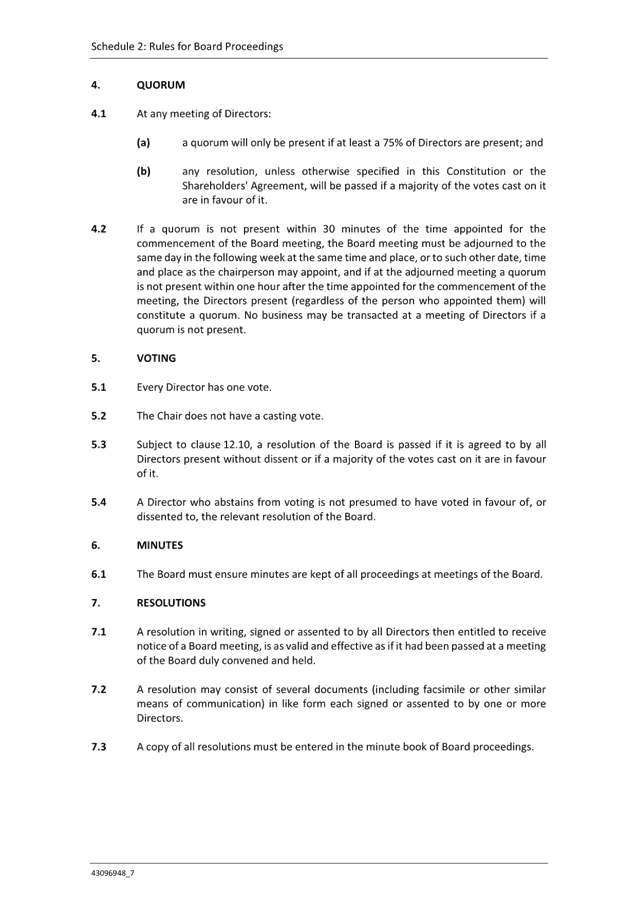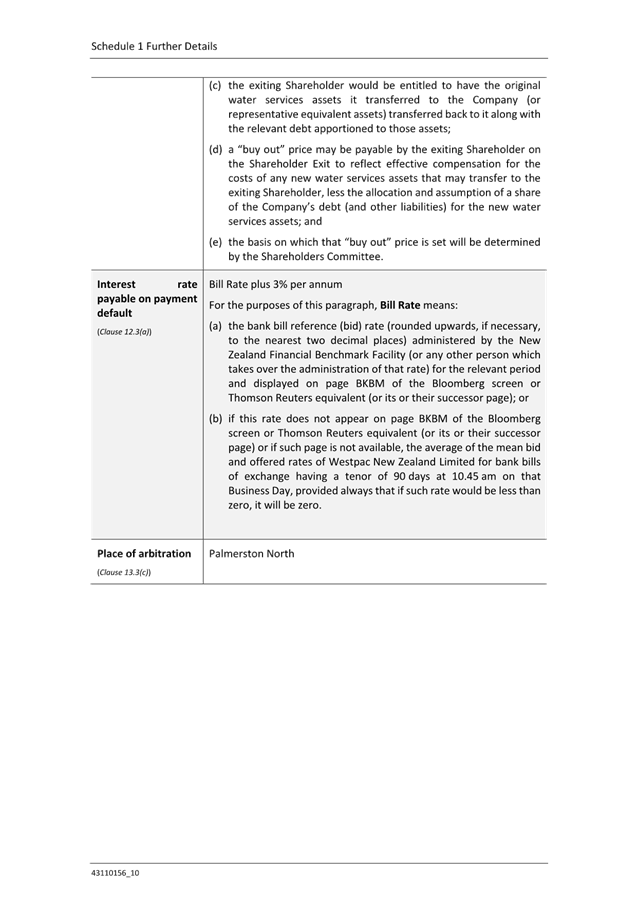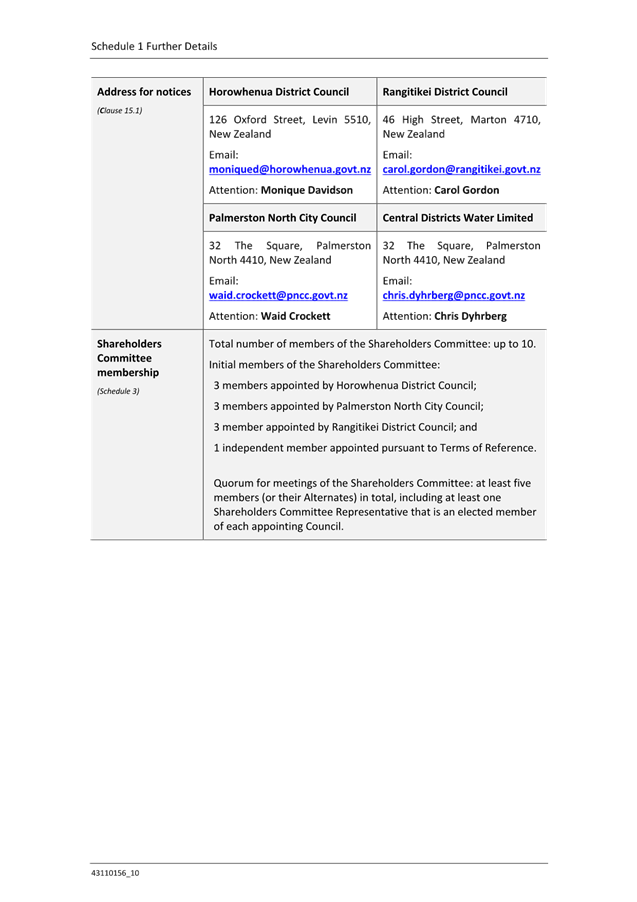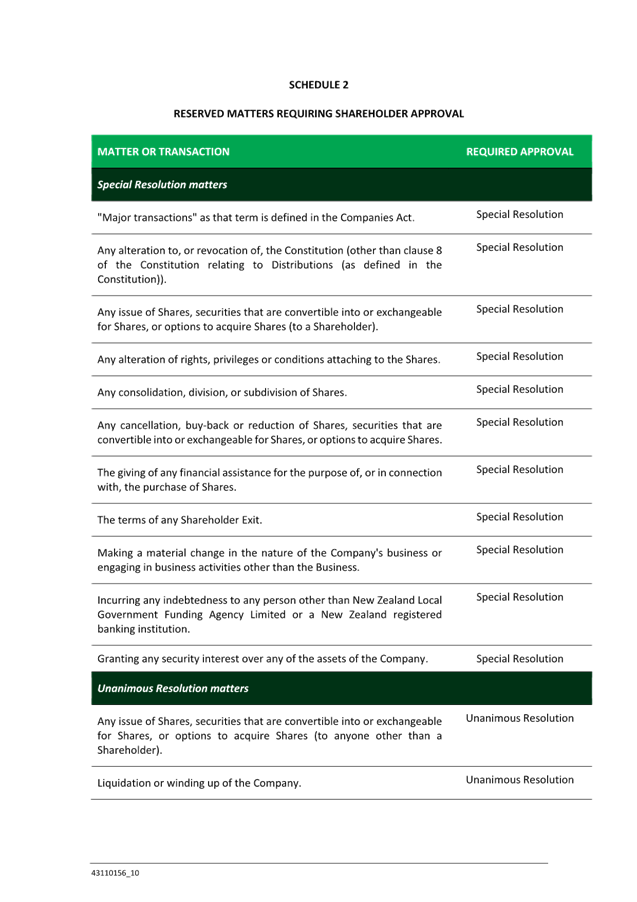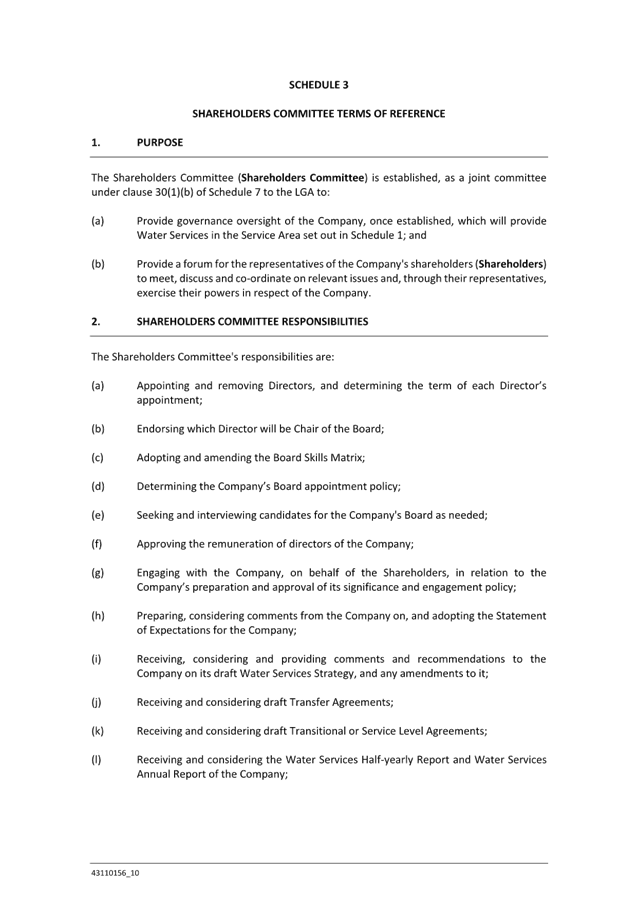
Notice is hereby given that an ordinary meeting of the Horowhenua District Council will be held on:
|
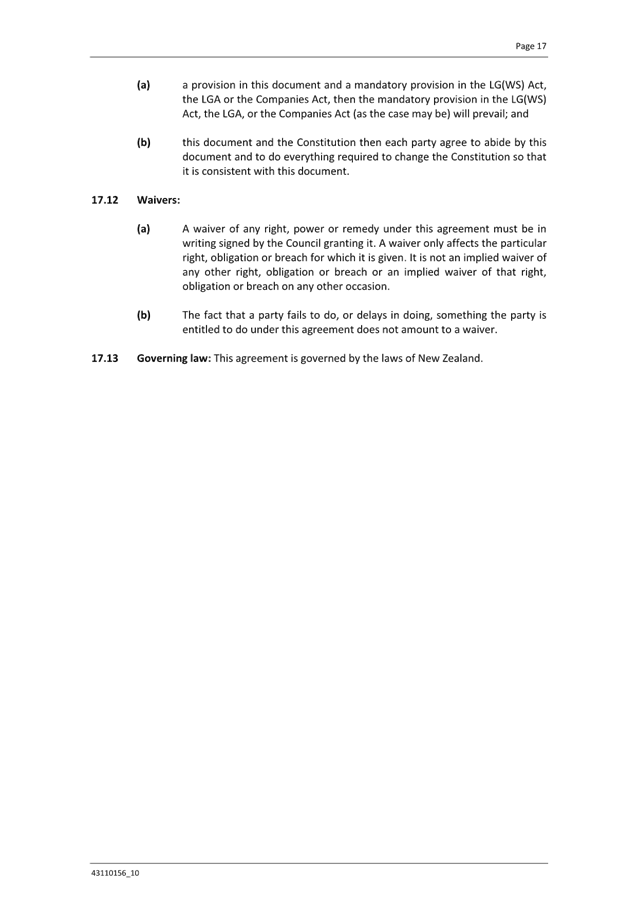
Date:
Time:
Meeting Room:
Venue:
|
Wednesday 10
December 2025
11:00 am
Council
Chambers
126-148 Oxford St
Levin
|
|
Council
OPEN AGENDA
|
MEMBERSHIP
|
Mayor
|
His Worship The Mayor Bernie Wanden
|
|
|
Councillors
|
Councillor David Allan
|
|
|
|
Councillor Mike Barker
|
|
|
|
Councillor Nola Fox
|
|
|
|
Councillor Morgan Gray
|
|
|
|
Councillor Clint Grimstone
|
|
|
|
Councillor Nina Hori Te Pa
|
|
|
|
Councillor Sam Jennings
|
|
|
|
Councillor Lani Te Raukura Ketu
|
|
|
|
Councillor Jo Mason
|
|
|
|
Councillor Katrina Mitchell - Kouttab
|
|
|
|
Councillor Paul Olsen
|
|
|
|
Councillor Alan Young
|
|
|
Contact
Telephone: 06 366 0999
Postal
Address: Private Bag 4002, Levin 5540
Email:
enquiries@horowhenua.govt.nz
Website:
www.horowhenua.govt.nz
Full Agendas are available on Council’s website
www.horowhenua.govt.nz
Full Agendas are also available to be collected from:
Horowhenua District Council Service Centre, 126 Oxford Street,
Levin
Te Awahou Nieuwe Stroom, Foxton,
Shannon Service Centre/Library, Plimmer Terrace, Shannon
and Te Takeretanga o Kura-hau-pō, Bath Street, Levin
|
|
Council
10 December 2025
|

|
ITEM TABLE OF CONTENTS PAGE
KARAKIA TIMATANGA
|
Whakataka te hau
ki te uru
Whakataka te hau
ki te tonga
Kia
mākinakina ki uta
Kia
mātaratara ki tai
E hī ake
ana te atakura
He tio, he huka,
he hau hū
Tīhei mauri
ora!
|
Cease the winds
from the west
Cease the winds
from the south
Let the breeze
blow over the land
Let the breeze
blow over the ocean
Let the
red-tipped dawn come with a sharpened air.
A touch of
frost, a promise of a glorious day.
|
PROCEDURAL
1 Apologies 5
2 Public
Participation 5
3 Late Items 5
4 Declarations
of Interest 5
5 Confirmation
of Minutes 5
REPORTS
6 Announcements
6.1 Acknowledgment of Retiring
Elected Memebrs 6
7 Elected
Members Reports
7.1 Mayoral Report 7
8 Reports
for Decision
8.1 Adoption of Meeting
Schedule 13
8.2 Adoption of Committee
Structure, Terms of Reference and Appointments to Committees and External
Organisations 17
8.3 Adoption of Standing
Orders 47
8.4 Adoption of Code of
Conduct 139
8.5 Confirmation of Elected
Member Remuneration 177
8.6 Local Water Done Well -
Foundation Documents for the Joint Water Services Council-Controlled
Organisation known as Central Districts Water 183
8.7 Waikawa Beach Vehicle
Access 257
8.8 Council Direction Setting 269
9 Reports
for Noting
9.1 Organisation Performance
Report - December 2025 277
9.2 Council Resolution and
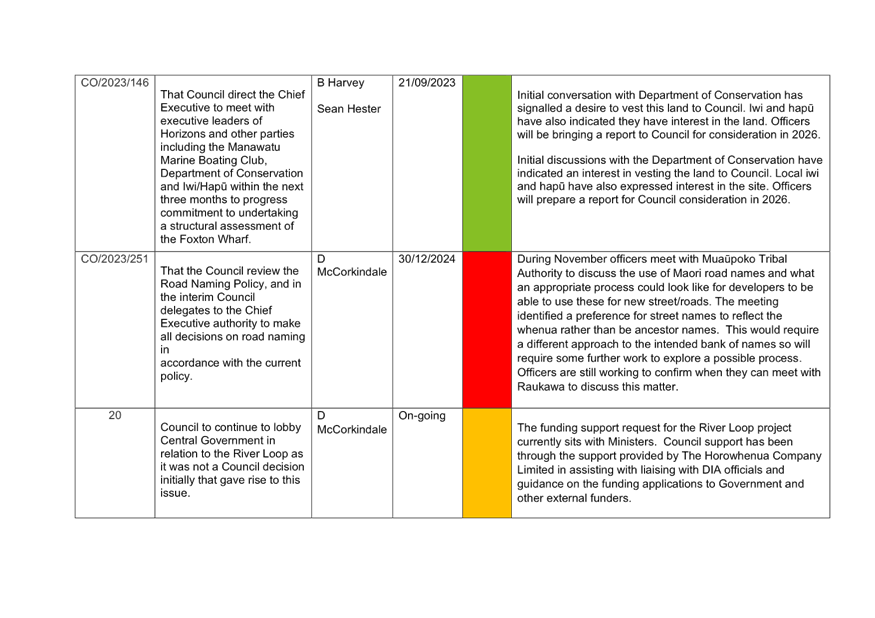
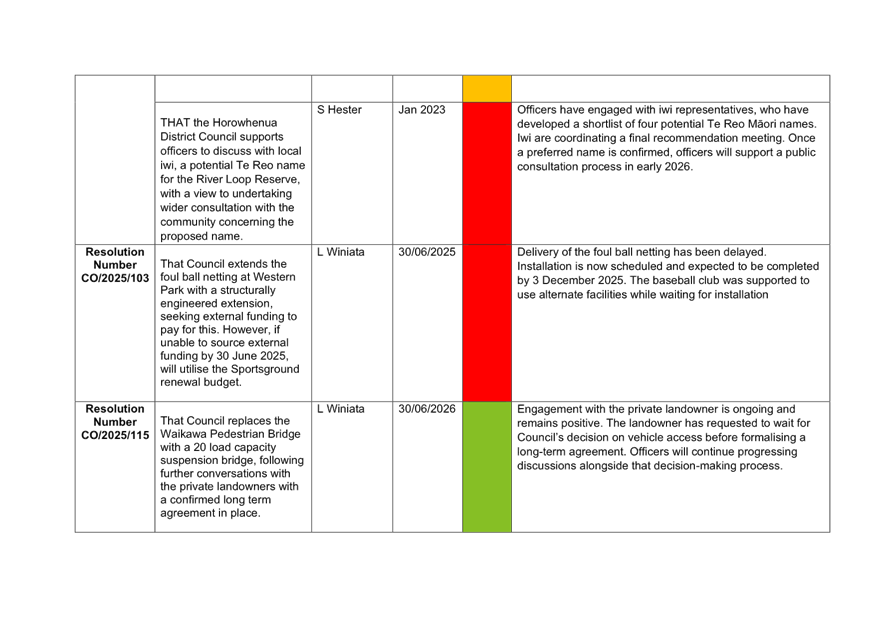
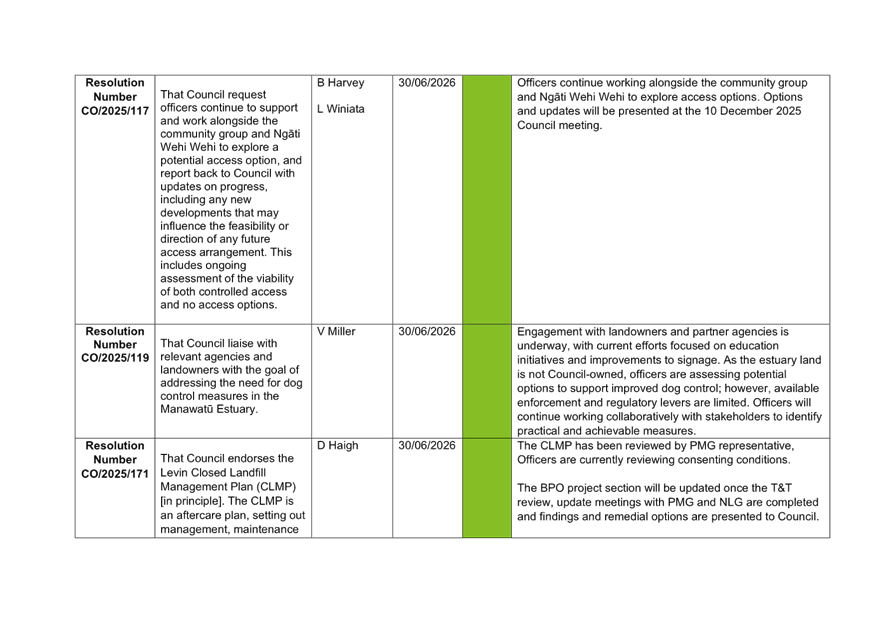
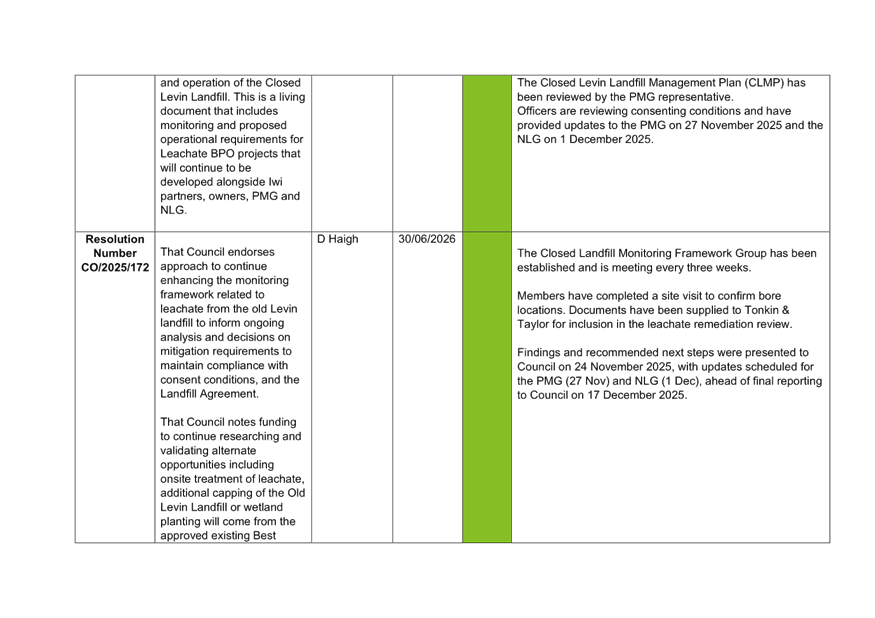
Actions Monitoring Report December 2025 395
9.3 Long Term Plan 2024-44
Actions Monitoring Report 403
PUBLIC EXCLUDED
10 Procedural
motion to exclude the public 407
C1 Levin Town Centre
Transformation - Expressions of Interest - Redevelopment of the Levin Bath
Street/Salisbury Street Carpark 407
C2 Okarito-Magnolia Stormwater
Connection - Procurement 407
C3 Tara-Ika - North South
Wastewater Connection - Procurement 407
C4 Consideration of
Applications to the Horowhenua Major Events Fund 408
C5 Youth Empowerment Fund
2025/26 – Round 3 408
C6 Council Resolution and
Actions Monitoring Report December 2025 408
KARAKIA WHAKAMUTUNGA
|
Kia whakairia te
tapu
Kia wātea
ai te ara
Kia turuki
whakataha ai, kia turuki whakataha ai
Haumi e, hui e,
taiki e!
|
Restrictions are
moved aside
so the
pathway is clear
To return
to everyday activities
Draw together,
affirm!
|
|
Council
10 December 2025
|

|
Karakia
1 Apologies
2 Public Participation
Notification of a
request to speak is required by 12 noon on the day before the meeting by
phoning 06 366 0999 or emailing public.participation@horowhenua.govt.nz.
3 Late
Items
To consider, and if thought fit, to pass a resolution to permit the
Council to consider any further items which do not appear on the Agenda of this
meeting and/or the meeting to be held with the public excluded.
Such resolution is required to be made pursuant to Section 46A(7) of
the Local Government Official Information and Meetings Act 1987, and the
Chairperson must advise:
(i) The reason why the
item was not on the Agenda, and
(ii) The reason why the
discussion of this item cannot be delayed until a subsequent meeting.
4 Declarations of Interest
Members are
reminded of their obligation to declare any conflicts of interest they might
have in respect of the items on this Agenda.
5 Confirmation of Minutes
5.1 Meeting minutes Council, 29 October 2025
|
6.1 Acknowledgment
of Retiring Elected Memebrs
|
|
Council
10 December 2025
|

|
File No.:
25/669
7.1 Mayoral
Report
|
Author(s)
|
Bernie Wanden JP
Mayor | Kahika
|
|
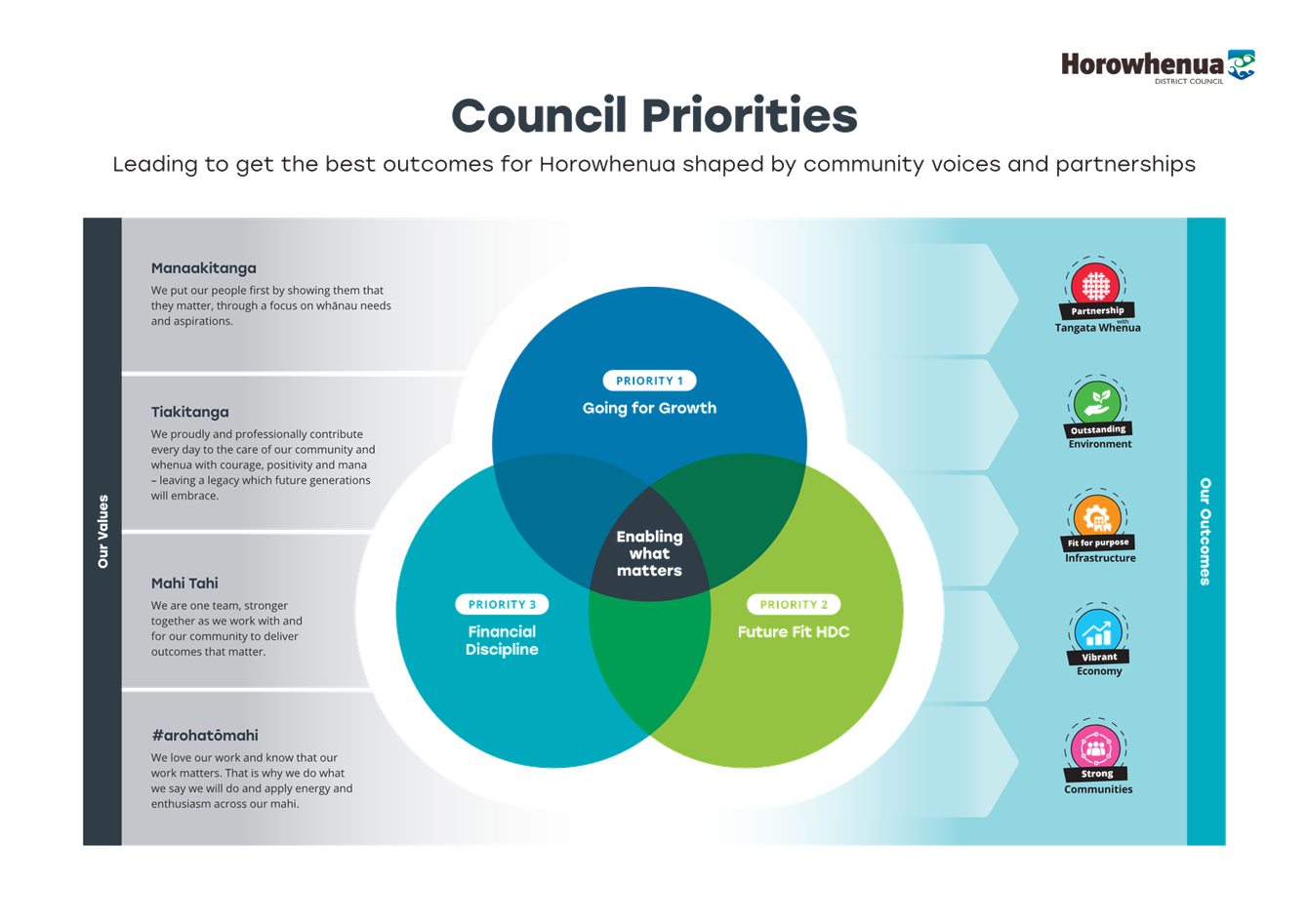
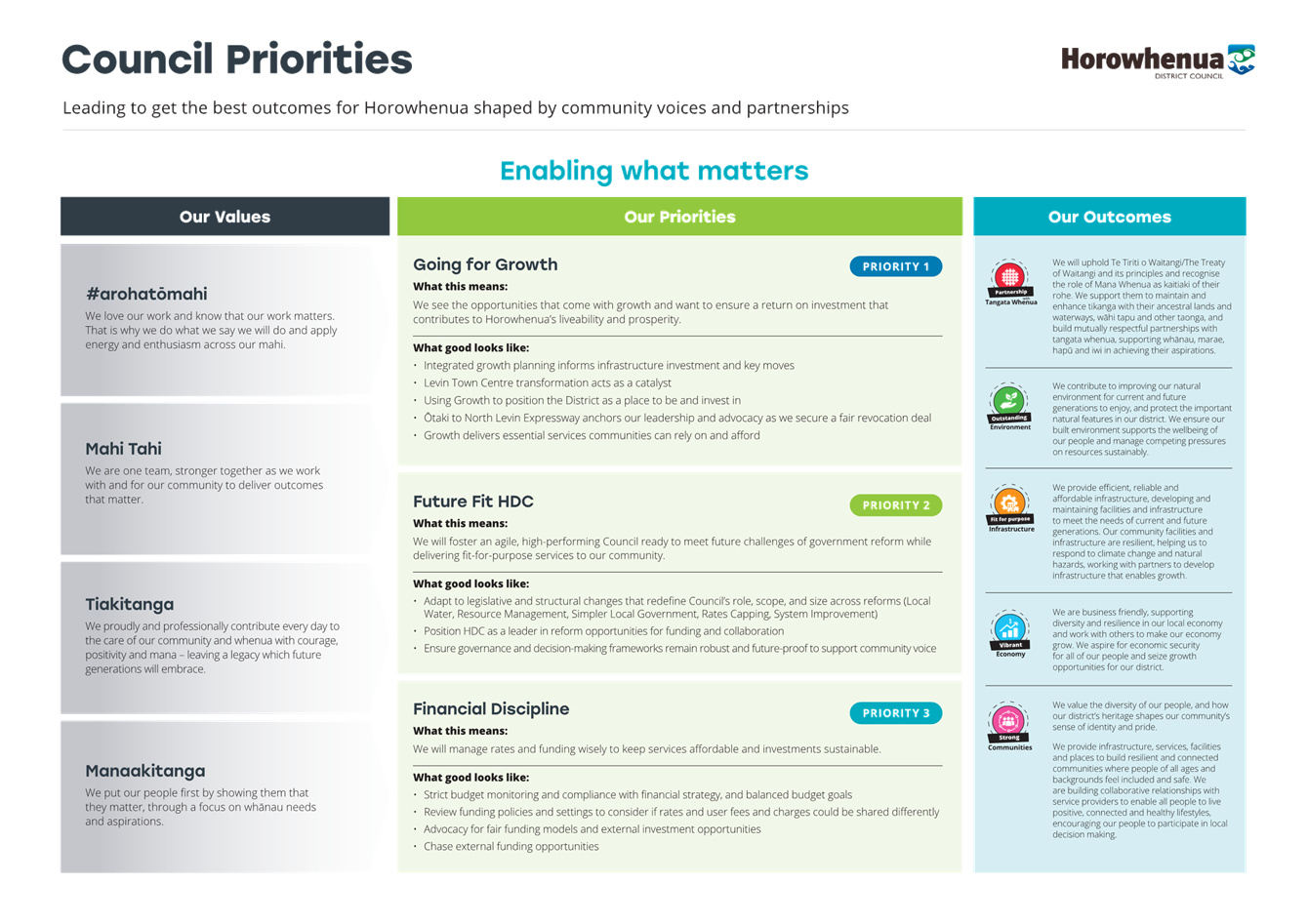
Approved by
|
Bernie Wanden JP
Mayor | Kahika
|
Purpose | TE PŪTAKE
1. The
purpose of this report is to inform Council and the community about events and
functions and Council-related meetings that I attended from 13 October –
30 November 2025, and to provide an update on items of interest such as
submissions made on behalf of Council.
RECOMMENDATION | NGĀ TAUNAKITANGA
A. That Council receive and note Report 25/539 Mayoral Report.
MATTERS OF INTEREST |
NGĀ
TAKE HIRAHIRA
2. The
following meetings, functions and events were attended from 13 October –
30 November 2025.
Meetings, Functions and Events Attended
|
13 October – 30 November 2025
|
|
New Triennium
meeting with the Chief Executive
|
|
New Triennium
meetings with all Councillors
|
|
Local Water
Done Well Hui – Iwi, Mayors and Chief Executives
|
|
Oral
submission to the Antisocial Road Use Legislation Amendment Bill
|
|
New Zealand
Food Awards Gala Dinner
|
|
Powhiri for
the new Council and Te Awahou Foxton Community Board
|
|
Mayor’s
Taskforce for Jobs Governance Group meeting
|
|
LGNZ –
Mayor’s School
|
|
Dawn Ceremony
and Blessing of the new Health & Wellbeing Hub
|
|
Council
Induction session #1
|
|
Electra
Business & Innovation Awards
|
|
Mayor’s
Taskforce for Jobs Programme Update – October (in-house meeting)
|
|
Mayor’s
Taskforce for Jobs Lower North Island meet up
|
|
Levin
Wastewater Discharge Engagement & Review Panel (ERP) Meeting
|
|
Council
Induction session #2
|
|
Inaugural
Meeting of Council and Te Awahou Foxton Community Board
|
|
Taitoko
Health - Official Opening
|
|
Older
Person’s Network
|
|
Horowhenua
Lake Domain Board meeting
|
|
Waiopehu
College Senior Prizegiving
|
|
Horowhenua
College Services Academy Award Ceremony
|
|
Ōhau
Community Hall – 125th Jubilee
|
|
Foxton
Volunteer Fire Brigade - Brigade honours Night
|
|
Electra
Business After 5
|
|
Tertiary
Scholarship – shortlisting
|
|
Making Good
Decisions training course
|
|
Local Water
Done Well – Three Councils function for Councillors
|
|
Local Water
Done Well - Joint Council Workshop
|
|
Repair
Café – 5th Anniversary celebration
|
|
Diwali 2025
at Gladys Taylor Park
|
|
HDC and NZTA
Regional Relationship meeting
|
|
Local Water
Done Well – Project Oversight Group meeting
|
|
Remembrance
Day commemoration service
|
|
Age Friendly
Certificate presentation to Mitre 10 Levin
|
|
Tertiary
Scholarship – interviews x4
|
|
Council
Induction session #3
|
|
National Day
of Reflection for Survivors of Abuse in Care
|
|
LGNZ
Networking function in Wellington
|
|
Rural &
Provincial Sector meeting in Wellington
|
|
Mayor : Chief
Executive weekly catch-up
|
|
Mayor’s
Taskforce for Jobs Governance Group meeting in Wellington
|
|
Foxton Beach
Volunteer Fire Brigade - Honours & Awards Night
|
|
Local Water
Done Well – Project Oversight Group meeting
|
|
Civic &
Youth Excellence Awards Ceremony
|
|
Council Expo
at Te Takeretanga o Kura-hau-pō
|
|
Council
Induction session #4
|
|
Zone Three
Meeting in Palmerston North – ½ day 1
|
|
Zone Three
Meeting in Palmerston North – ½ day 2
|
|
Mayor’s
Taskforce for Jobs Programme Update – November (in-house meeting)
|
|
Mayor’s
Taskforce for Jobs mid-year check-in with LGNZ Team
|
|
Swearing-in
of David Roache, Te Awahou Foxton Community Board member
|
|
Council
Induction session #5
|
|
HDC : NZ
Police liaison meeting with Inspector Ross Grantham
|
|
HDC :
Horowhenua Lake Trust hui
|
|
Local Water
Done Well – Project Oversight Group meeting
|
Council Submissions
3.
Making submissions on Central Government
consultations is an important way to represent the interests of Council and our
community. It ensures local perspectives and on-the-ground knowledge are
considered in national decision-making, and helps protect local priorities and
services. I would like to share the following submission made by Council in
September 2025:
Antisocial Road Use Legislation
Amendment Bill
Council
strongly supports the Antisocial Road Use Legislation Amendment Bill. We
consider this Bill to be a necessary and pragmatic step toward improving public
safety, supporting the Police, and ensuring communities like ours are not
subjected to the fear and disruption caused by unlawful and dangerous road
behaviour.
The
full submission is attached to this report.
Attachments | NGĀ
TĀPIRINGA KŌRERO
|
No.
|
Title
|
Page
|
|
a⇩

|
Submission - Antisocial Road
Use Legislation Amendment Bill - Sept 2025
|
10
|
|
Council
10 December 2025
|

|
File No.:
25/597
8.1 Adoption
of Meeting Schedule
|
Author(s)
|
Alice Petersen
Support Officer
- Democracy | Āpiha Tautoko - Manapori
|
|
Approved by
|
Monique Davidson
Chief Executive
Officer | Tumuaki
|
Purpose | TE PŪTAKE
1. To
seek Council’s approval of the proposed meeting schedule of Council and
its committees for the period from 11 December 2025 to 31 December 2026.
This matter
relates to Pursuing Organisation Excellence
Continuing the
journey of organisational transformation by enabling a culture of service,
excellence and continuous improvement.
RECOMMENDATION | NGĀ TAUNAKITANGA
A. That Council adopts the schedule of meetings for Council Committee
Meetings as set out in Appendix A.
B. That Council notes that additional ordinary, extraordinary and
multi-day meetings may be scheduled from time to time in consultation with the
Mayor and Chief Executive and in line with standing orders.
C. That Council notes that meeting times for Council, its committees,
and subcommittees will be formally notified when they are required in
accordance with the Local Government Official Information and Meetings Act 1987
and Local Government Act 2002.
bACKGROUND | hE
KŌRERO TŪĀPAPA
2. Council
is required to hold meetings as outlined in Schedule 7, Clause 19(1) of the
Local Government Act 2002. This report outlines the proposed meeting schedule
for 2026.
DISCUSSION | HE MATAPAKINGA
3. As
outlined in Schedule 7, Clause 19(1) of Local Government Act 2002, Horowhenua
District Council must hold meetings that are necessary for the good governance
of Horowhenua District.
4. It
is good practice for Council to adopt a schedule of meetings for the following
calendar year. This will allow the business of the Council to be conducted in
an orderly and transparent manner, thus enabling an open democratic process,
and to allow public notification of meetings to be given in compliance with the
Local Government Official Information and Meetings Act 1987.
5. A
schedule also allows for elected members to plan their commitments over the
year.
6. The
commencement time for Council meetings will be 10.00am unless otherwise stated.
7. The
commencement time for Committee meetings will be 10.00am unless otherwise
stated.
8. Attached
in Appendix A is the meeting schedule to be adopted.
9. Additional
meetings may be called from time to time.
10. The Mayor or
Chairperson, or Council by resolution, may call an extraordinary meeting if
there is business that that needs to be dealt with before the
next scheduled meeting. Such request or resolution must set out
the business to be considered
11. The Chief Executive must call an extraordinary meeting if requested
in writing by the Mayor or Chairperson or by a majority of members.
Only those matters contained in the request can be considered at the
extraordinary meeting.
·
|
Confirmation of statutory compliance
In accordance
with sections 76 – 79 of the Local Government Act 2002, this report is
approved as:
a. containing
sufficient information about the options and their advantages and
disadvantages, bearing in mind the significance of the decisions; and,
b. is
based on adequate knowledge about, and adequate consideration of, the views
and preferences of affected and interested parties bearing in mind the
significance of the decision.
|
Attachments | NGĀ
TĀPIRINGA KŌRERO
|
No.
|
Title
|
Page
|
|
a⇩

|
Council and committee meeting
schedule - 2026
|
15
|
|
Council
10 December 2025
|
|
This page is a placeholder for a single
page of a PDF attachment. It will be replaced by the actual PDF page when the
PDF version of this document is generated.
Report: Adoption of Meeting Schedule
Attachment: Council and committee meeting
schedule - 2026
Page: 1
|
Council
10 December 2025
|
|
File No.:
25/596
8.2 Adoption
of Committee Structure, Terms of Reference and Appointments to Committees and
External Organisations
|
Author(s)
|
Grayson Rowse
Principal
Advisor - Democracy | Kaitohutohu Mātāmua - Manapori
|
|
Approved by
|
Monique Davidson
Chief Executive
Officer | Tumuaki
|
Purpose | TE PŪTAKE
1. The report sets out the Council’s committee structure for the
2025-28 triennium, and the appointments to those committees for the first 18
months of this triennium.
2. The terms of reference a presented for Council’s endorsement
as are the initial appointment to external bodies.
Executive summary |
TE WHAKARĀPOPOTOTANGA MATUA
3. Following
each triennial election the Mayor establishes the committee structure for
Council and appoints the Chairs of these committees.
4. Council
is required to agree on the membership of each committee, apart from the Chair,
, and make appointments to Statutory Bodies, Community Groups/Associations and
other organisations.
5. The
appointments committees, including their Chairs, are for an 18 month period,
after which the Mayor will seek to review those appointments. The
rationale for this change in approach is in recognition of the skills and
experience that exist around the Council table, and a desire for those skills
and experiences to be used for the benefit of the community over the full term
of Council
6. It
is also considered best practice for the Terms of Reference and Delegations for
these committees to be adopted by Council.
RECOMMENDATION | NGĀ TAUNAKITANGA
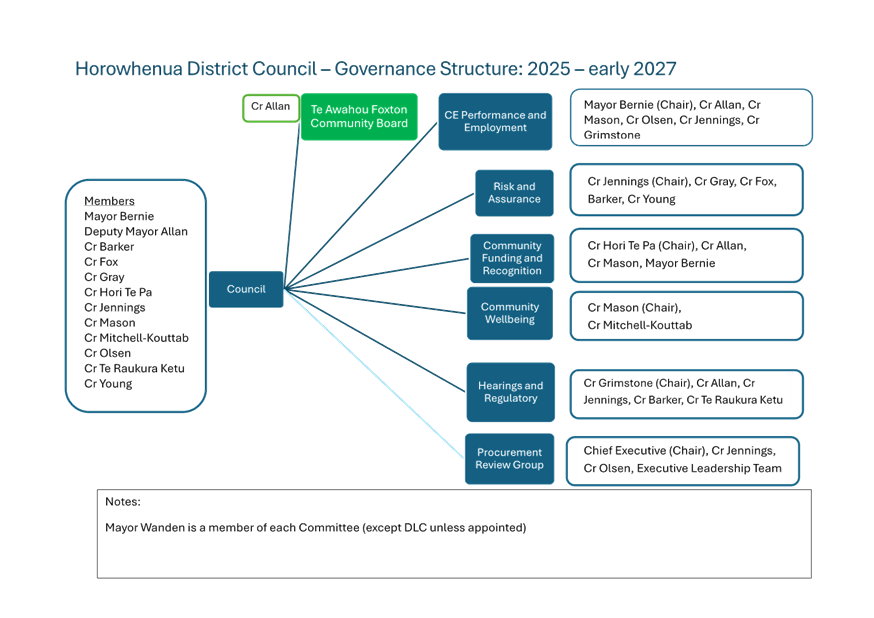
A. That Council notes the Mayor’s establishment of the following
committee structure under powers pursuant to Section 41A of the Local
Government Act 2002 Amendment Act 2012:
· Risk and Assurance
Committee;
· Community Wellbeing
Committee;
· Hearings and
Regulatory Committee;
· Chief Executive
Employment and Performance Committee;
· Community Funding
and Recognition Committee.
B. That Council adopts the appointments of Chair and members of all
committees as outlined in Attachment A of this report.
C. That Council appoints Kere Kere Ward Councillor David Allan to the
Te Awahou Foxton Community Board.
D. That Council notes that any elected member is welcome to attend the
Te Awahou Foxton Community Board, and with the permission of its Chair may have
speaking rights during the meeting.
E. That Council adopts the Terms of Reference and Delegations for these
committees as outlined in Attachment B of this report.
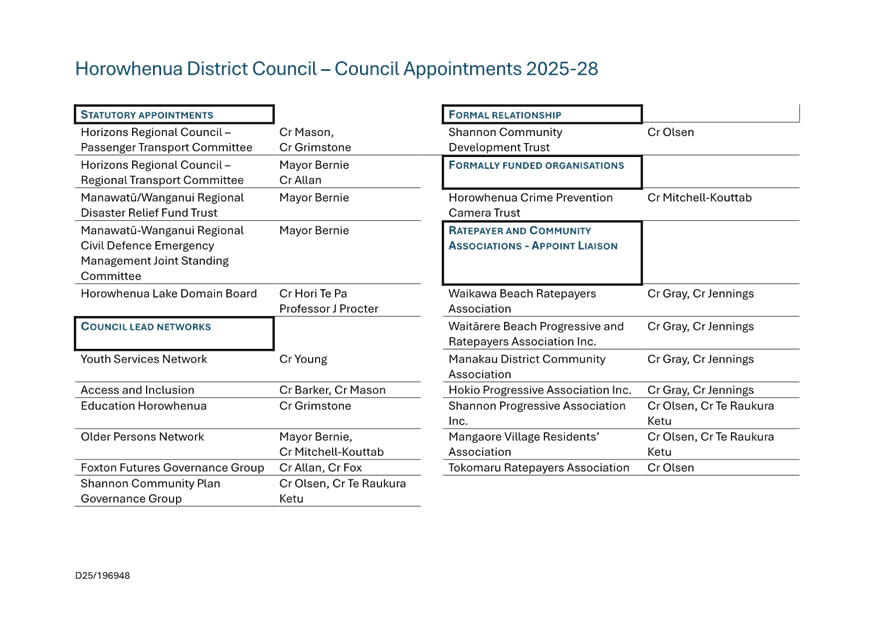
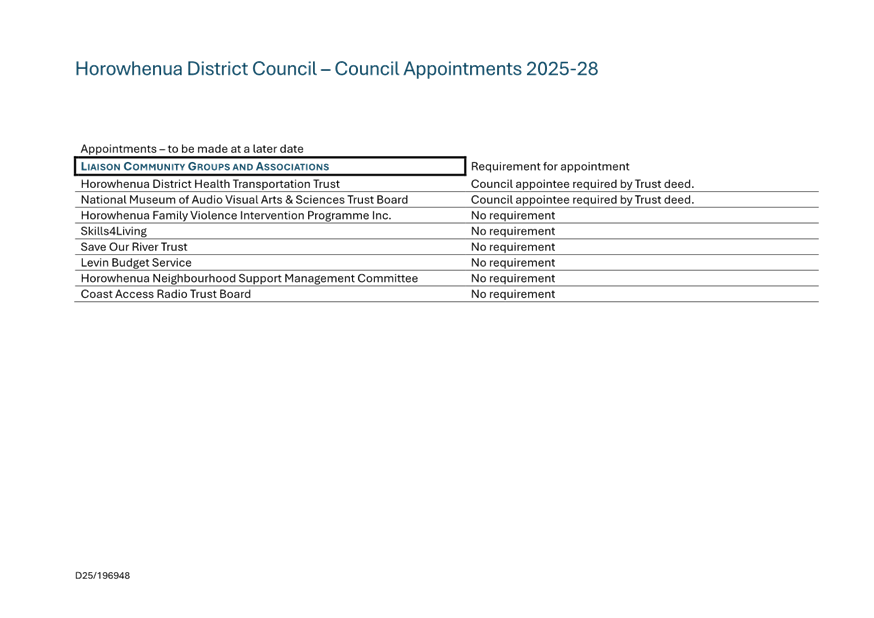
F. That Council adopts the Appointments to Statutory Bodies, Community
Groups and Associations as outlined in Attachment C of this report, noting
further appointments are to be considered in the New Year.
DISCUSSION | HE MATAPAKINGA
7. Section
41A of the Local Government Act 2002 Amendment Act 2012 sets out Mayoral powers
by which the Mayor can:
· 3(b) establish committees of the territorial authority;
· 3(c) appoint the Chairperson of each committee.
8. Following
discussion with elected members the Mayor has exercised this power.
9. The
committee structure separates Council’s regulatory functions from its
non-regulatory functions, and to improve Council’s decision-making
processes through the use of committees focusing on specific functional
areas. Through the use of delegations to these committees, Council is
able to effect an efficient and robust decision-making process. A copy of
this Committee Structure and the Chairs and memberships are outlined in
Attachment A of this report.
10. Appointments
of Chairs and committee memberships are for 18 months after which time the
Mayor will seek to relocate Chairs and membership. This will enable the
Mayor to utilise, for the benefit of the community, the full range of skills
and experience around the Council table to their fullest extent of the course
of this triennium.
11. The
Terms of Reference and Delegations for committees are presented at Attachment
C. These terms of references set out the functions and powers of the each
committee of council. The addition inclusion of the Procurement Review
Group, a joint officer/councillor committee, is included to provide and extra
layer of assurance and oversight of Council’s major procurement
decisions.
12. Council is
also required to appoint one of the Kere Kere Ward Councillors as a member of
the Te Awahou Foxton Community.
13. In
making this appointment, it is noted that any Councillor is welcome to attend
the Te Awahou Foxton Community Board meetings, and with the permission of the
Chair, speak to the board during the meetings.
14. The
District Licensing Committee and its Chair and Deputy Chair are not established
under the Local Government Act 2002, but under the Sale and Supply of Alcohol
Act 2012. Officer will bring further advice on the composition of the
District Licensing Committee in the first quarter of 2026.
15. This
committee will continue its functions under Commissioners appointed by the
previous Council. The provisions of Part 7 of the Local Government
Official Information and Meetings Act 1987 do not apply to the District
Licensing Committee.
·
|
Confirmation of statutory compliance
In accordance
with sections 76 – 79 of the Local Government Act 2002, this report is
approved as:
a. containing
sufficient information about the options and their advantages and
disadvantages, bearing in mind the significance of the decisions; and,
b. is
based on adequate knowledge about, and adequate consideration of, the views
and preferences of affected and interested parties bearing in mind the
significance of the decision.
|
Attachments | NGĀ
TĀPIRINGA KŌRERO
|
No.
|
Title
|
Page
|
|
a⇩
|
Governance Structure 2025 -
2027
|
20
|
|
b⇩
|
Council and Committee Terms of
Reference - updated 1 December 2025
|
21
|
|
c⇩
|
Council appointments 2025-28
|
45
|
|
Council
10 December 2025
|

|
|
Council
10 December 2025
|
|
This page is a placeholder for a single
page of a PDF attachment. It will be replaced by the actual PDF page when the
PDF version of this document is generated.
Report: Adoption of Committee Structure,
Terms of Reference and Appointments to Committees and External Organisations
Attachment: Council and Committee Terms of
Reference - updated 1 December 2025
Page: 1
This page is a placeholder for a single
page of a PDF attachment. It will be replaced by the actual PDF page when the
PDF version of this document is generated.
Report: Adoption of Committee Structure,
Terms of Reference and Appointments to Committees and External Organisations
Attachment: Council and Committee Terms of
Reference - updated 1 December 2025
Page: 2
This page is a placeholder for a single
page of a PDF attachment. It will be replaced by the actual PDF page when the
PDF version of this document is generated.
Report: Adoption of Committee Structure,
Terms of Reference and Appointments to Committees and External Organisations
Attachment: Council and Committee Terms of
Reference - updated 1 December 2025
Page: 3
This page is a placeholder for a single
page of a PDF attachment. It will be replaced by the actual PDF page when the
PDF version of this document is generated.
Report: Adoption of Committee Structure,
Terms of Reference and Appointments to Committees and External Organisations
Attachment: Council and Committee Terms of
Reference - updated 1 December 2025
Page: 4
This page is a placeholder for a single
page of a PDF attachment. It will be replaced by the actual PDF page when the
PDF version of this document is generated.
Report: Adoption of Committee Structure,
Terms of Reference and Appointments to Committees and External Organisations
Attachment: Council and Committee Terms of
Reference - updated 1 December 2025
Page: 5
This page is a placeholder for a single
page of a PDF attachment. It will be replaced by the actual PDF page when the
PDF version of this document is generated.
Report: Adoption of Committee Structure,
Terms of Reference and Appointments to Committees and External Organisations
Attachment: Council and Committee Terms of
Reference - updated 1 December 2025
Page: 6
This page is a placeholder for a single
page of a PDF attachment. It will be replaced by the actual PDF page when the
PDF version of this document is generated.
Report: Adoption of Committee Structure,
Terms of Reference and Appointments to Committees and External Organisations
Attachment: Council and Committee Terms of
Reference - updated 1 December 2025
Page: 7
This page is a placeholder for a single
page of a PDF attachment. It will be replaced by the actual PDF page when the
PDF version of this document is generated.
Report: Adoption of Committee Structure,
Terms of Reference and Appointments to Committees and External Organisations
Attachment: Council and Committee Terms of
Reference - updated 1 December 2025
Page: 8
This page is a placeholder for a single
page of a PDF attachment. It will be replaced by the actual PDF page when the
PDF version of this document is generated.
Report: Adoption of Committee Structure,
Terms of Reference and Appointments to Committees and External Organisations
Attachment: Council and Committee Terms of
Reference - updated 1 December 2025
Page: 9
This page is a placeholder for a single
page of a PDF attachment. It will be replaced by the actual PDF page when the
PDF version of this document is generated.
Report: Adoption of Committee Structure,
Terms of Reference and Appointments to Committees and External Organisations
Attachment: Council and Committee Terms of
Reference - updated 1 December 2025
Page: 10
This page is a placeholder for a single
page of a PDF attachment. It will be replaced by the actual PDF page when the
PDF version of this document is generated.
Report: Adoption of Committee Structure,
Terms of Reference and Appointments to Committees and External Organisations
Attachment: Council and Committee Terms of
Reference - updated 1 December 2025
Page: 11
This page is a placeholder for a single
page of a PDF attachment. It will be replaced by the actual PDF page when the
PDF version of this document is generated.
Report: Adoption of Committee Structure,
Terms of Reference and Appointments to Committees and External Organisations
Attachment: Council and Committee Terms of
Reference - updated 1 December 2025
Page: 12
This page is a placeholder for a single
page of a PDF attachment. It will be replaced by the actual PDF page when the
PDF version of this document is generated.
Report: Adoption of Committee Structure,
Terms of Reference and Appointments to Committees and External Organisations
Attachment: Council and Committee Terms of
Reference - updated 1 December 2025
Page: 13
This page is a placeholder for a single
page of a PDF attachment. It will be replaced by the actual PDF page when the
PDF version of this document is generated.
Report: Adoption of Committee Structure,
Terms of Reference and Appointments to Committees and External Organisations
Attachment: Council and Committee Terms of
Reference - updated 1 December 2025
Page: 14
This page is a placeholder for a single
page of a PDF attachment. It will be replaced by the actual PDF page when the
PDF version of this document is generated.
Report: Adoption of Committee Structure,
Terms of Reference and Appointments to Committees and External Organisations
Attachment: Council and Committee Terms of
Reference - updated 1 December 2025
Page: 15
This page is a placeholder for a single
page of a PDF attachment. It will be replaced by the actual PDF page when the
PDF version of this document is generated.
Report: Adoption of Committee Structure,
Terms of Reference and Appointments to Committees and External Organisations
Attachment: Council and Committee Terms of
Reference - updated 1 December 2025
Page: 16
This page is a placeholder for a single
page of a PDF attachment. It will be replaced by the actual PDF page when the
PDF version of this document is generated.
Report: Adoption of Committee Structure,
Terms of Reference and Appointments to Committees and External Organisations
Attachment: Council and Committee Terms of
Reference - updated 1 December 2025
Page: 17
This page is a placeholder for a single
page of a PDF attachment. It will be replaced by the actual PDF page when the
PDF version of this document is generated.
Report: Adoption of Committee Structure,
Terms of Reference and Appointments to Committees and External Organisations
Attachment: Council and Committee Terms of
Reference - updated 1 December 2025
Page: 18
This page is a placeholder for a single
page of a PDF attachment. It will be replaced by the actual PDF page when the
PDF version of this document is generated.
Report: Adoption of Committee Structure,
Terms of Reference and Appointments to Committees and External Organisations
Attachment: Council and Committee Terms of
Reference - updated 1 December 2025
Page: 19
This page is a placeholder for a single
page of a PDF attachment. It will be replaced by the actual PDF page when the
PDF version of this document is generated.
Report: Adoption of Committee Structure,
Terms of Reference and Appointments to Committees and External Organisations
Attachment: Council and Committee Terms of
Reference - updated 1 December 2025
Page: 20
This page is a placeholder for a single
page of a PDF attachment. It will be replaced by the actual PDF page when the
PDF version of this document is generated.
Report: Adoption of Committee Structure,
Terms of Reference and Appointments to Committees and External Organisations
Attachment: Council and Committee Terms of
Reference - updated 1 December 2025
Page: 21
This page is a placeholder for a single
page of a PDF attachment. It will be replaced by the actual PDF page when the
PDF version of this document is generated.
Report: Adoption of Committee Structure,
Terms of Reference and Appointments to Committees and External Organisations
Attachment: Council and Committee Terms of
Reference - updated 1 December 2025
Page: 22
This page is a placeholder for a single
page of a PDF attachment. It will be replaced by the actual PDF page when the
PDF version of this document is generated.
Report: Adoption of Committee Structure,
Terms of Reference and Appointments to Committees and External Organisations
Attachment: Council and Committee Terms of
Reference - updated 1 December 2025
Page: 23
This page is a placeholder for a single
page of a PDF attachment. It will be replaced by the actual PDF page when the
PDF version of this document is generated.
Report: Adoption of Committee Structure,
Terms of Reference and Appointments to Committees and External Organisations
Attachment: Council and Committee Terms of
Reference - updated 1 December 2025
Page: 24
|
Council
10 December 2025
|

|
File No.:
25/689
8.3 Adoption
of Standing Orders
|
Author(s)
|
Grayson Rowse
Principal
Advisor - Democracy | Kaitohutohu Mātāmua - Manapori
|
|
Approved by
|
Monique Davidson
Chief Executive
Officer | Tumuaki
|
Purpose | TE PŪTAKE
1. Council is required to adopt its Standing Orders at the beginning of
each triennium. This report presents the existing Horowhenua District Council
Standing Orders (LGNZ Model 2023, with no substantive amendments) for adoption.
Executive Summary | TE WHAKARĀPOPOTOTANGA
MATUA
2. Under the Local
Government Act 2002 (LGA 2002), Council is required to adopt Standing Orders to
govern the conduct of its meetings and the meetings of its committees,
subcommittees, local boards, and any subordinate decision-making bodies.
3. Standing
Orders provide a rules-based framework that supports open, transparent,
inclusive, fair, and legally sound decision-making.
4. The
existing Standing Orders remain fully compliant with legislation and sector
best practice, based on the LGNZ Model Standing Orders (2023 Edition), which
Council has utilised for the previous triennium without compliance issues.
5. The
Local Government (System Improvements) Amendment Bill is currently progressing
through Parliament and is expected to introduce mandatory national model
Standing Orders, which will supersede local versions once enacted.
6. Legal
advice confirms that substantive amendments at this time would deliver limited
benefit and represent a short-lived use of Council resource, given the imminent
reform. Officers therefore recommend adopting the existing Standing Orders
without change and continuing to use the current Code of Conduct framework to
support interim governance expectations where required.
7. Council
retains the ability to consider alternative procedural selections within the
current 2023 LGNZ Model if it chooses not to adopt the officer recommendation.
These options are limited to the legislatively prescribed areas identified in
this report.
8. Adoption
of Standing Orders, and any future amendments, requires a ≥75% majority
vote of members present, in accordance with Schedule 7, Clause 27 of the LGA
2002
DELEGATION OR AUTHORITY TO ACT | TE MANA WHAKATAU I
NGĀ KAWENGA
9. Council
has authority to adopt Standing Orders under Schedule 7, Clause 27 of the Local
Government Act 2002.
10. Although Council may elect alternative options within the current
model, officers recommend no amendment at this time due to impending
legislative reform, which is expected to replace local Standing Orders with a
mandatory national model and reduce local discretion
11. The
Bill’s progress is being actively monitored. As at the time of writing,
the bill has completed its Select Committee process and is awaiting its Second
Reading in the House, after which further stages will follow. Final enactment
timing has not yet been confirmed but is expected within the 2025/26
Parliamentary sitting calendar.
SIGNIFICANCE ASSESSMENT | He Aromatawai Matua
12. This matter does not meet
the requirement as significant under the Signficance and Engagement Policy.
13. This is a legislative
requirement.
RECOMMENDATION | NGĀ TAUNAKITANGA
A. That Council adopts the Horowhenua District Council Standing Orders
for the 2025–2028 triennium in their current form, without amendment.
Discussion | HE MATAPAKINGA
14. Council has utilised Local Government New Zealand for Standing
Orders for the past triennium. These are fully compliant with legislation and
best practice in the conduct of meetings, they are also easy to use and can be
tailored to meet each Council’s specific requirements.
15. The Council is required to adopt a set of standing orders for the
conduct of its meetings and those of its committees.
16. Standing Orders contain rules for the conduct of the proceedings of
local authorities, committees, subcommittees and subordinate decision-making
bodies, and local and community boards. Their purpose is to enable local
authorities to exercise their decision making responsibilities in a
transparent, inclusive and lawful manner. All members of a local authority must
abide by standing orders.
17. During
the elected member induction period for the 2025–2028 triennium, Council
asked officers to explore potential options to strengthen the management of
meeting attendance expectations, either through:
· including
attendance expectations or compliance mechanisms in Standing Orders, or
· alternatively,
addressing attendance matters through the Code of Conduct framework.
18. This
request was forward-looking in nature, intended to support good governance and
public confidence in elected member participation.
19. Officers
sought legal advice on this request. Legal confirmed that it is not a prudent
or worthwhile investment to make substantive local amendments at this time, due
to the impending System Improvements Bill, which is likely to replace or
materially displace local Standing Orders provisions once enacted.
20. Legal advised that Council should instead continue applying existing
mechanisms within current Standing Orders and the Code of Conduct to set
expectations in the interim, rather than re-drafting new attendance rules that
may soon be superseded.
21. Therefore there are no changes
to the Standing Orders from the 2022-2025 Triennium.
22. The Horowhenua District Council Standing is attached as Attachment
A.
Options | Ngā
Kōwhiringa
23. Changes
to Standing Orders requires a minimum majority of votes cast of 75% of members
present. If that majority is not received the extant Standing Orders
remain.
24. While
officers recommend retaining the Standing Orders in their current form for the
reasons outlined above, Council may still consider alternative procedural
selections under the LGNZ 2023 Model if it chooses not to adopt the
recommendation. These options are limited to the legislative selection areas
and include:
25. Standing
Order 5.6 - Voting system for Deputy Mayors and committee Chairs and deputy
Chairs – (The current standing orders Council adopted System B –
the person with the most votes is appointed even if they do not receive an
absolute majority of votes).
26. Standing
Order 19.3 – Chairperson has a casting vote – (The current standing
orders Council adopted the option that the Mayor or Chairperson, or any other
person presiding at a meeting, only has a deliberative vote, and that in the
event of an equality of votes for any question, that question would be lost).
27. Standing
Order 22 – General Procedures for speaking and moving motions.
– (The current standing orders Council adopted Option C).
28. Under
current standing orders, the Mayor does not have a casting vote, and Option B
is used for speaking and moving motions.
Standing Order
5.6
29. While
the Mayor has exercised his authority to appoint the Deputy Mayor and will
shortly appoint the Chairs of committees, there may be times thorough out the
course of the this term that it is necessary for Council or a committee finds
its self without a Chair or a Deputy. This could occur due to conflicts of
interest or illness. When this occurs standing orders empower the Council or
committee to elect a Chair form amongst their own.
Council currently
Standing order 5.6 sets out two options to choose from; System A and System B.
This meeting may choose to confirm neither option and leave it to each meeting
to determine if the situation arises where a Chair needs to be elected. Alternatively,
this meeting can choose one of the options to adopt for Council and all
committees to follow if the need to elect a Chair occurs.
30. System
A provides that a candidate is elected if they receive the votes of the
majority of all the members who are present and voting. In this system, there
is first round of voting for all candidates, if no candidate receives a
majority of votes, then the lowest polling candidate is removed from the second
round of voting. This continues until one candidate receives a majority of
voted.
31. System
B provides that a candidate is elected if they receive more votes than any
other candidate. There is only one round of voting.
32. In
both systems, in the event of a tie, the tie is resolved by lost.
33. The
current standing orders Council adopted System B.
Standing Order
19.3
34. This
standing order sets out the default position should there be an equality of
votes when deciding a question. It provides that the Mayor or Chairperson, or
any other person presiding at a meeting, has a deliberative vote, and, in the
case of an equality of votes, has a casting vote.
35. However,
the Local Government Act 2002 allows for a different approach to a tied vote if
expressly provided for in a Council’s standing orders.
36. Council
may choose to amend the standing orders so that the Mayor or Chairperson, or
any other person presiding at a meeting, only has a deliberative vote. This
would mean that in the event of an equality of votes for any question, that
question would be lost. Any question could only be carried by a clear majority
in favour.
37. The
current standing orders Council adopted the option that the Mayor or
Chairperson, or any other person presiding at a meeting, only has a
deliberative vote, and that in the event of an equality of votes for any
question, that question would be lost.
Standing Order 22
38. This
standing order sets out the three possible options for moving and voting on
motions during a meeting, Option A, Option B and Option C.
39. This
meeting may choose to confirm none of options which would mean that Option A is
adopted unless, on the recommendation of the chairperson at the beginning of
the meeting, that one of the other options be adopted for the meeting, or for
particular items. This would need to be resolved by a simple majority of the
meeting.
40. Alternatively,
this meeting could choose to adopt a default Option other than A to apply for
all Council and committee meetings.
The Options are set
out below:
41. Option A/Kōwhiringa A
· The mover and seconder of a motion cannot move or second an
amendment. (This does not apply when the mover or seconder of a motion to adopt
a report of a committee wants to amend an item in the report. In this case the
original mover or seconder may also propose or second the suggested amendment).
· Only members who have not spoken to the original, or substituted,
motion may move or second an amendment to it.
· The mover or seconder of an amendment, whether it is carried (in
which case it becomes the substantive motion) or lost, cannot move or second a
subsequent amendment.
· Members can speak to any amendment and, provided they have not
spoken to the motion or moved or seconded an amendment, they can move or second
further amendments.
· The meeting, by agreement of the majority of members present, may
amend a motion with the agreement of the mover and seconder.
42. Option B/Kōwhiringa B
· The mover and seconder of a motion cannot move or second an
amendment. (This does not apply when the mover or seconder of a motion to adopt
a report of a committee wants to amend an item in the report. In this case the
original mover or seconder may also propose or second the suggested amendment).
· Any members, regardless of whether they have spoken to the original
or substituted motion, may move or second an amendment to it.
· The mover or
seconder of an amendment that is carried can move or second a subsequent
amendment. A mover or seconder of an amendment which is lost cannot move or
second a subsequent amendment.
· Members can speak to any amendment. The meeting by agreement of the
majority of members present may amend a motion with the agreement of the mover
and seconder.
43. Kōwhiringa C/Option C
· The mover and seconder of a motion can move or second an amendment.
· Any members,
regardless of whether they have spoken to the original or substituted motion,
may move or second an amendment to it.
· The mover or
seconder of an amendment whether it is carried or lost can move or second
further amendments.
· Members can speak
to any amendment. The meeting by agreement of the majority of members present
may amend a motion with the agreement of the mover and seconder.
44. Regardless
of the option chosen the meeting may resolve by simple majority, based on the
recommendation of the Chair, to adopt another option for the duration of the
meeting or for a particular item.
45. The
current standing orders Council adopted Option C.
Options | Ngā Kōwhiringa
|
Benefits | Ngā Whiwhinga
|
Risks | Ngā Mōrearea
|
|
Option A (recommended)
Recommendation A
- Retain and adopt current 2023 LGNZ
Model.
- Standing Order 5.6 – System B
(one-round majority voting for Chairs)
- Standing Order 19.3 – no casting
vote (tied votes are lost)
- Standing Order 22 – Option C
(flexible speaking and amendment rules)
|
·
Statutory compliance achieved for current
triennium.
·
No duplication of effort or cost prior to
reform.
·
Maintains sector-aligned best practice
framework.
·
Legal supports interim use of existing
mechanisms.
|
- Future mandatory review required once
national model is enacted.
|
|
Option B
- Adopt an amended 2023 LGNZ Model
Standing Orders, with alternative settings applied to Standing Orders
5.6, 19.3, and 22, differing from the current provisions.
|
·
Statutory compliance achieved for current
triennium.
·
Maintains sector-aligned best practice
framework.
|
- Future mandatory review required once
national model is enacted.
|
|
Option C (not recommended)
- Invest in substantive local amendments
now (including attendance controls)
|
·
Statutory compliance achieved for current
triennium.
|
- Poor value for money and short lifespan
before replacement.
|
Options Commentary | He
Tāpiringa Kōrero Mō ngā Kōwhiringa
46. Officers
recommend Option A (Recommendation A), as it provides the best balance of:
· Statutory
compliance,
· Governance
stability in the interim,
· No reword
required, and
· Alignment
to sector reform timing and legal guidance.
FINAnCIAL AND RESOURCING | TE TAHUA PŪTEA ME
NGĀ RAUEMI
47. There are no direct financial or resourcing
impacts arising from the adoption of the existing Standing Orders at this time.
Redrafting substantive amendments prior to national reform has been assessed as
not representing good value for council resource or expenditure.
Legal and Risk | Te Ture me ngā
Mōreareatanga
48. Officers
sought legal advised which advised that Council should wait until the System
Improvements Bill is passed before considering substantive amendments, as the
legislation is expected to introduce mandatory national model Standing Orders.
49. Legal
advised that Council should use existing interim mechanisms (including current
Standing Orders and the Code of Conduct) rather than redrafting new local
provisions that may soon be superseded.
50. There
is no legal risk in adopting the current model now.
POLICY IMPACT | NGĀ PĀTANGA I NGĀ
KAUPAPA HERE
51. The
System Improvements Bill is expected to have a direct policy impact on Council
Standing Orders by displacing locally developed orders with a mandatory
national model.
52. Until
the Bill is enacted, councils must continue to operate under existing statutory
requirements, including adoption at the start of a triennium and any local
elections of specified procedural options.
53. Adoption now ensures Council remains statutorily compliant during
the pre-reform period.
COMMUNICATIONS AND ENGAGEMENT | TE WHAKAWHITI
PĀRONGO ME TE MAHI
54. Given
the procedural nature of this decision and its non-significant status, external
public consultation is not required for interim adoption.
55. Public
communication will be limited to statutory notification of adoption through
normal Council channels and website update once confirmed.
Next Steps | HEI MAHI
·
56. Following adoption of Standing Orders, officers will - update the
Council website where required, confirm elected member local procedural option
selections and brief elected members on key Standing Order rules through the
induction process.
57. Officers will continue monitoring the System Improvements Bill
through remaining Parliamentary stages.
|
Confirmation of statutory compliance
In accordance
with sections 76 – 79 of the Local Government Act 2002, this report is
approved as:
a. containing
sufficient information about the options and their advantages and
disadvantages, bearing in mind the significance of the decisions; and,
b. is
based on adequate knowledge about, and adequate consideration of, the views
and preferences of affected and interested parties bearing in mind the
significance of the decision.
|
Attachments | NGĀ
TĀPIRINGA KŌRERO
|
No.
|
Title
|
Page
|
|
a⇩
|
Standing Orders Horowhenua
District Council
|
54
|
|
Council
10 December 2025
|
|
This page is a placeholder for a single
page of a PDF attachment. It will be replaced by the actual PDF page when the
PDF version of this document is generated.
Report: Adoption of Standing Orders
Attachment: Standing Orders Horowhenua
District Council
Page: 1
This page is a placeholder for a single
page of a PDF attachment. It will be replaced by the actual PDF page when the
PDF version of this document is generated.
Report: Adoption of Standing Orders
Attachment: Standing Orders Horowhenua
District Council
Page: 2
This page is a placeholder for a single
page of a PDF attachment. It will be replaced by the actual PDF page when the
PDF version of this document is generated.
Report: Adoption of Standing Orders
Attachment: Standing Orders Horowhenua
District Council
Page: 3
This page is a placeholder for a single
page of a PDF attachment. It will be replaced by the actual PDF page when the
PDF version of this document is generated.
Report: Adoption of Standing Orders
Attachment: Standing Orders Horowhenua
District Council
Page: 4
This page is a placeholder for a single
page of a PDF attachment. It will be replaced by the actual PDF page when the
PDF version of this document is generated.
Report: Adoption of Standing Orders
Attachment: Standing Orders Horowhenua
District Council
Page: 5
This page is a placeholder for a single
page of a PDF attachment. It will be replaced by the actual PDF page when the
PDF version of this document is generated.
Report: Adoption of Standing Orders
Attachment: Standing Orders Horowhenua
District Council
Page: 6
This page is a placeholder for a single
page of a PDF attachment. It will be replaced by the actual PDF page when the
PDF version of this document is generated.
Report: Adoption of Standing Orders
Attachment: Standing Orders Horowhenua
District Council
Page: 7
This page is a placeholder for a single
page of a PDF attachment. It will be replaced by the actual PDF page when the
PDF version of this document is generated.
Report: Adoption of Standing Orders
Attachment: Standing Orders Horowhenua
District Council
Page: 8
This page is a placeholder for a single
page of a PDF attachment. It will be replaced by the actual PDF page when the
PDF version of this document is generated.
Report: Adoption of Standing Orders
Attachment: Standing Orders Horowhenua
District Council
Page: 9
This page is a placeholder for a single
page of a PDF attachment. It will be replaced by the actual PDF page when the
PDF version of this document is generated.
Report: Adoption of Standing Orders
Attachment: Standing Orders Horowhenua
District Council
Page: 10
This page is a placeholder for a single
page of a PDF attachment. It will be replaced by the actual PDF page when the
PDF version of this document is generated.
Report: Adoption of Standing Orders
Attachment: Standing Orders Horowhenua
District Council
Page: 11
This page is a placeholder for a single
page of a PDF attachment. It will be replaced by the actual PDF page when the
PDF version of this document is generated.
Report: Adoption of Standing Orders
Attachment: Standing Orders Horowhenua
District Council
Page: 12
This page is a placeholder for a single
page of a PDF attachment. It will be replaced by the actual PDF page when the
PDF version of this document is generated.
Report: Adoption of Standing Orders
Attachment: Standing Orders Horowhenua
District Council
Page: 13
This page is a placeholder for a single
page of a PDF attachment. It will be replaced by the actual PDF page when the
PDF version of this document is generated.
Report: Adoption of Standing Orders
Attachment: Standing Orders Horowhenua
District Council
Page: 14
This page is a placeholder for a single
page of a PDF attachment. It will be replaced by the actual PDF page when the
PDF version of this document is generated.
Report: Adoption of Standing Orders
Attachment: Standing Orders Horowhenua
District Council
Page: 15
This page is a placeholder for a single
page of a PDF attachment. It will be replaced by the actual PDF page when the
PDF version of this document is generated.
Report: Adoption of Standing Orders
Attachment: Standing Orders Horowhenua
District Council
Page: 16
This page is a placeholder for a single
page of a PDF attachment. It will be replaced by the actual PDF page when the
PDF version of this document is generated.
Report: Adoption of Standing Orders
Attachment: Standing Orders Horowhenua
District Council
Page: 17
This page is a placeholder for a single
page of a PDF attachment. It will be replaced by the actual PDF page when the
PDF version of this document is generated.
Report: Adoption of Standing Orders
Attachment: Standing Orders Horowhenua
District Council
Page: 18
This page is a placeholder for a single
page of a PDF attachment. It will be replaced by the actual PDF page when the
PDF version of this document is generated.
Report: Adoption of Standing Orders
Attachment: Standing Orders Horowhenua
District Council
Page: 19
This page is a placeholder for a single
page of a PDF attachment. It will be replaced by the actual PDF page when the
PDF version of this document is generated.
Report: Adoption of Standing Orders
Attachment: Standing Orders Horowhenua
District Council
Page: 20
This page is a placeholder for a single
page of a PDF attachment. It will be replaced by the actual PDF page when the
PDF version of this document is generated.
Report: Adoption of Standing Orders
Attachment: Standing Orders Horowhenua
District Council
Page: 21
This page is a placeholder for a single
page of a PDF attachment. It will be replaced by the actual PDF page when the
PDF version of this document is generated.
Report: Adoption of Standing Orders
Attachment: Standing Orders Horowhenua
District Council
Page: 22
This page is a placeholder for a single
page of a PDF attachment. It will be replaced by the actual PDF page when the
PDF version of this document is generated.
Report: Adoption of Standing Orders
Attachment: Standing Orders Horowhenua
District Council
Page: 23
This page is a placeholder for a single
page of a PDF attachment. It will be replaced by the actual PDF page when the
PDF version of this document is generated.
Report: Adoption of Standing Orders
Attachment: Standing Orders Horowhenua
District Council
Page: 24
This page is a placeholder for a single
page of a PDF attachment. It will be replaced by the actual PDF page when the
PDF version of this document is generated.
Report: Adoption of Standing Orders
Attachment: Standing Orders Horowhenua
District Council
Page: 25
This page is a placeholder for a single
page of a PDF attachment. It will be replaced by the actual PDF page when the
PDF version of this document is generated.
Report: Adoption of Standing Orders
Attachment: Standing Orders Horowhenua
District Council
Page: 26
This page is a placeholder for a single
page of a PDF attachment. It will be replaced by the actual PDF page when the
PDF version of this document is generated.
Report: Adoption of Standing Orders
Attachment: Standing Orders Horowhenua
District Council
Page: 27
This page is a placeholder for a single
page of a PDF attachment. It will be replaced by the actual PDF page when the
PDF version of this document is generated.
Report: Adoption of Standing Orders
Attachment: Standing Orders Horowhenua
District Council
Page: 28
This page is a placeholder for a single
page of a PDF attachment. It will be replaced by the actual PDF page when the
PDF version of this document is generated.
Report: Adoption of Standing Orders
Attachment: Standing Orders Horowhenua
District Council
Page: 29
This page is a placeholder for a single
page of a PDF attachment. It will be replaced by the actual PDF page when the
PDF version of this document is generated.
Report: Adoption of Standing Orders
Attachment: Standing Orders Horowhenua
District Council
Page: 30
This page is a placeholder for a single
page of a PDF attachment. It will be replaced by the actual PDF page when the
PDF version of this document is generated.
Report: Adoption of Standing Orders
Attachment: Standing Orders Horowhenua
District Council
Page: 31
This page is a placeholder for a single
page of a PDF attachment. It will be replaced by the actual PDF page when the
PDF version of this document is generated.
Report: Adoption of Standing Orders
Attachment: Standing Orders Horowhenua
District Council
Page: 32
This page is a placeholder for a single
page of a PDF attachment. It will be replaced by the actual PDF page when the
PDF version of this document is generated.
Report: Adoption of Standing Orders
Attachment: Standing Orders Horowhenua
District Council
Page: 33
This page is a placeholder for a single
page of a PDF attachment. It will be replaced by the actual PDF page when the
PDF version of this document is generated.
Report: Adoption of Standing Orders
Attachment: Standing Orders Horowhenua
District Council
Page: 34
This page is a placeholder for a single
page of a PDF attachment. It will be replaced by the actual PDF page when the
PDF version of this document is generated.
Report: Adoption of Standing Orders
Attachment: Standing Orders Horowhenua
District Council
Page: 35
This page is a placeholder for a single
page of a PDF attachment. It will be replaced by the actual PDF page when the
PDF version of this document is generated.
Report: Adoption of Standing Orders
Attachment: Standing Orders Horowhenua
District Council
Page: 36
This page is a placeholder for a single
page of a PDF attachment. It will be replaced by the actual PDF page when the
PDF version of this document is generated.
Report: Adoption of Standing Orders
Attachment: Standing Orders Horowhenua
District Council
Page: 37
This page is a placeholder for a single
page of a PDF attachment. It will be replaced by the actual PDF page when the
PDF version of this document is generated.
Report: Adoption of Standing Orders
Attachment: Standing Orders Horowhenua
District Council
Page: 38
This page is a placeholder for a single
page of a PDF attachment. It will be replaced by the actual PDF page when the
PDF version of this document is generated.
Report: Adoption of Standing Orders
Attachment: Standing Orders Horowhenua
District Council
Page: 39
This page is a placeholder for a single
page of a PDF attachment. It will be replaced by the actual PDF page when the
PDF version of this document is generated.
Report: Adoption of Standing Orders
Attachment: Standing Orders Horowhenua
District Council
Page: 40
This page is a placeholder for a single
page of a PDF attachment. It will be replaced by the actual PDF page when the
PDF version of this document is generated.
Report: Adoption of Standing Orders
Attachment: Standing Orders Horowhenua
District Council
Page: 41
This page is a placeholder for a single
page of a PDF attachment. It will be replaced by the actual PDF page when the
PDF version of this document is generated.
Report: Adoption of Standing Orders
Attachment: Standing Orders Horowhenua
District Council
Page: 42
This page is a placeholder for a single
page of a PDF attachment. It will be replaced by the actual PDF page when the
PDF version of this document is generated.
Report: Adoption of Standing Orders
Attachment: Standing Orders Horowhenua
District Council
Page: 43
This page is a placeholder for a single
page of a PDF attachment. It will be replaced by the actual PDF page when the
PDF version of this document is generated.
Report: Adoption of Standing Orders
Attachment: Standing Orders Horowhenua
District Council
Page: 44
This page is a placeholder for a single
page of a PDF attachment. It will be replaced by the actual PDF page when the
PDF version of this document is generated.
Report: Adoption of Standing Orders
Attachment: Standing Orders Horowhenua
District Council
Page: 45
This page is a placeholder for a single
page of a PDF attachment. It will be replaced by the actual PDF page when the
PDF version of this document is generated.
Report: Adoption of Standing Orders
Attachment: Standing Orders Horowhenua
District Council
Page: 46
This page is a placeholder for a single
page of a PDF attachment. It will be replaced by the actual PDF page when the
PDF version of this document is generated.
Report: Adoption of Standing Orders
Attachment: Standing Orders Horowhenua
District Council
Page: 47
This page is a placeholder for a single
page of a PDF attachment. It will be replaced by the actual PDF page when the
PDF version of this document is generated.
Report: Adoption of Standing Orders
Attachment: Standing Orders Horowhenua
District Council
Page: 48
This page is a placeholder for a single
page of a PDF attachment. It will be replaced by the actual PDF page when the
PDF version of this document is generated.
Report: Adoption of Standing Orders
Attachment: Standing Orders Horowhenua
District Council
Page: 49
This page is a placeholder for a single
page of a PDF attachment. It will be replaced by the actual PDF page when the
PDF version of this document is generated.
Report: Adoption of Standing Orders
Attachment: Standing Orders Horowhenua
District Council
Page: 50
This page is a placeholder for a single
page of a PDF attachment. It will be replaced by the actual PDF page when the
PDF version of this document is generated.
Report: Adoption of Standing Orders
Attachment: Standing Orders Horowhenua
District Council
Page: 51
This page is a placeholder for a single
page of a PDF attachment. It will be replaced by the actual PDF page when the
PDF version of this document is generated.
Report: Adoption of Standing Orders
Attachment: Standing Orders Horowhenua
District Council
Page: 52
This page is a placeholder for a single
page of a PDF attachment. It will be replaced by the actual PDF page when the
PDF version of this document is generated.
Report: Adoption of Standing Orders
Attachment: Standing Orders Horowhenua
District Council
Page: 53
This page is a placeholder for a single
page of a PDF attachment. It will be replaced by the actual PDF page when the
PDF version of this document is generated.
Report: Adoption of Standing Orders
Attachment: Standing Orders Horowhenua
District Council
Page: 54
This page is a placeholder for a single
page of a PDF attachment. It will be replaced by the actual PDF page when the
PDF version of this document is generated.
Report: Adoption of Standing Orders
Attachment: Standing Orders Horowhenua
District Council
Page: 55
This page is a placeholder for a single
page of a PDF attachment. It will be replaced by the actual PDF page when the
PDF version of this document is generated.
Report: Adoption of Standing Orders
Attachment: Standing Orders Horowhenua
District Council
Page: 56
This page is a placeholder for a single
page of a PDF attachment. It will be replaced by the actual PDF page when the
PDF version of this document is generated.
Report: Adoption of Standing Orders
Attachment: Standing Orders Horowhenua
District Council
Page: 57
This page is a placeholder for a single
page of a PDF attachment. It will be replaced by the actual PDF page when the
PDF version of this document is generated.
Report: Adoption of Standing Orders
Attachment: Standing Orders Horowhenua
District Council
Page: 58
This page is a placeholder for a single
page of a PDF attachment. It will be replaced by the actual PDF page when the
PDF version of this document is generated.
Report: Adoption of Standing Orders
Attachment: Standing Orders Horowhenua
District Council
Page: 59
This page is a placeholder for a single
page of a PDF attachment. It will be replaced by the actual PDF page when the
PDF version of this document is generated.
Report: Adoption of Standing Orders
Attachment: Standing Orders Horowhenua
District Council
Page: 60
This page is a placeholder for a single
page of a PDF attachment. It will be replaced by the actual PDF page when the
PDF version of this document is generated.
Report: Adoption of Standing Orders
Attachment: Standing Orders Horowhenua
District Council
Page: 61
This page is a placeholder for a single
page of a PDF attachment. It will be replaced by the actual PDF page when the
PDF version of this document is generated.
Report: Adoption of Standing Orders
Attachment: Standing Orders Horowhenua
District Council
Page: 62
This page is a placeholder for a single
page of a PDF attachment. It will be replaced by the actual PDF page when the
PDF version of this document is generated.
Report: Adoption of Standing Orders
Attachment: Standing Orders Horowhenua
District Council
Page: 63
This page is a placeholder for a single
page of a PDF attachment. It will be replaced by the actual PDF page when the
PDF version of this document is generated.
Report: Adoption of Standing Orders
Attachment: Standing Orders Horowhenua
District Council
Page: 64
This page is a placeholder for a single
page of a PDF attachment. It will be replaced by the actual PDF page when the
PDF version of this document is generated.
Report: Adoption of Standing Orders
Attachment: Standing Orders Horowhenua
District Council
Page: 65
This page is a placeholder for a single
page of a PDF attachment. It will be replaced by the actual PDF page when the
PDF version of this document is generated.
Report: Adoption of Standing Orders
Attachment: Standing Orders Horowhenua
District Council
Page: 66
This page is a placeholder for a single
page of a PDF attachment. It will be replaced by the actual PDF page when the
PDF version of this document is generated.
Report: Adoption of Standing Orders
Attachment: Standing Orders Horowhenua
District Council
Page: 67
This page is a placeholder for a single
page of a PDF attachment. It will be replaced by the actual PDF page when the
PDF version of this document is generated.
Report: Adoption of Standing Orders
Attachment: Standing Orders Horowhenua
District Council
Page: 68
This page is a placeholder for a single
page of a PDF attachment. It will be replaced by the actual PDF page when the
PDF version of this document is generated.
Report: Adoption of Standing Orders
Attachment: Standing Orders Horowhenua
District Council
Page: 69
This page is a placeholder for a single
page of a PDF attachment. It will be replaced by the actual PDF page when the
PDF version of this document is generated.
Report: Adoption of Standing Orders
Attachment: Standing Orders Horowhenua
District Council
Page: 70
This page is a placeholder for a single
page of a PDF attachment. It will be replaced by the actual PDF page when the
PDF version of this document is generated.
Report: Adoption of Standing Orders
Attachment: Standing Orders Horowhenua
District Council
Page: 71
This page is a placeholder for a single
page of a PDF attachment. It will be replaced by the actual PDF page when the
PDF version of this document is generated.
Report: Adoption of Standing Orders
Attachment: Standing Orders Horowhenua
District Council
Page: 72
This page is a placeholder for a single
page of a PDF attachment. It will be replaced by the actual PDF page when the
PDF version of this document is generated.
Report: Adoption of Standing Orders
Attachment: Standing Orders Horowhenua
District Council
Page: 73
This page is a placeholder for a single
page of a PDF attachment. It will be replaced by the actual PDF page when the
PDF version of this document is generated.
Report: Adoption of Standing Orders
Attachment: Standing Orders Horowhenua
District Council
Page: 74
This page is a placeholder for a single
page of a PDF attachment. It will be replaced by the actual PDF page when the
PDF version of this document is generated.
Report: Adoption of Standing Orders
Attachment: Standing Orders Horowhenua
District Council
Page: 75
This page is a placeholder for a single
page of a PDF attachment. It will be replaced by the actual PDF page when the
PDF version of this document is generated.
Report: Adoption of Standing Orders
Attachment: Standing Orders Horowhenua
District Council
Page: 76
This page is a placeholder for a single
page of a PDF attachment. It will be replaced by the actual PDF page when the
PDF version of this document is generated.
Report: Adoption of Standing Orders
Attachment: Standing Orders Horowhenua
District Council
Page: 77
This page is a placeholder for a single
page of a PDF attachment. It will be replaced by the actual PDF page when the
PDF version of this document is generated.
Report: Adoption of Standing Orders
Attachment: Standing Orders Horowhenua
District Council
Page: 78
This page is a placeholder for a single
page of a PDF attachment. It will be replaced by the actual PDF page when the
PDF version of this document is generated.
Report: Adoption of Standing Orders
Attachment: Standing Orders Horowhenua
District Council
Page: 79
This page is a placeholder for a single
page of a PDF attachment. It will be replaced by the actual PDF page when the
PDF version of this document is generated.
Report: Adoption of Standing Orders
Attachment: Standing Orders Horowhenua
District Council
Page: 80
This page is a placeholder for a single
page of a PDF attachment. It will be replaced by the actual PDF page when the
PDF version of this document is generated.
Report: Adoption of Standing Orders
Attachment: Standing Orders Horowhenua
District Council
Page: 81
This page is a placeholder for a single
page of a PDF attachment. It will be replaced by the actual PDF page when the
PDF version of this document is generated.
Report: Adoption of Standing Orders
Attachment: Standing Orders Horowhenua
District Council
Page: 82
This page is a placeholder for a single
page of a PDF attachment. It will be replaced by the actual PDF page when the
PDF version of this document is generated.
Report: Adoption of Standing Orders
Attachment: Standing Orders Horowhenua
District Council
Page: 83
This page is a placeholder for a single
page of a PDF attachment. It will be replaced by the actual PDF page when the
PDF version of this document is generated.
Report: Adoption of Standing Orders
Attachment: Standing Orders Horowhenua
District Council
Page: 84
|
Council
10 December 2025
|

|
File No.:
25/646
8.4 Adoption
of Code of Conduct
|
Author(s)
|
Grayson Rowse
Principal
Advisor - Democracy | Kaitohutohu Mātāmua - Manapori
|
|
Approved by
|
Monique Davidson
Chief Executive
Officer | Tumuaki
|
Purpose | TE PŪTAKE
1. The
purpose of this report is for Council to consider the re-adoption of the
Horowhenua District Council Code of Conduct.
This matter does not relate
to a current Council priority.
Executive Summary | TE WHAKARĀPOPOTOTANGA
MATUA
2. Council is
required under Clause 15 of Schedule 7 of the Local Government Act 2002 to
adopt a Code of Conduct for its members as soon as practical after the
commencement of this Act.
3. The Code of
Conduct presented today is the same Code that was in effect for the last
triennium. That Code was based on the updated LGNZ template in 2022
4. The
Local Government (System Improvements) Amendment Bill is progressing through
Parliament and proposes to introduce mandatory national model Code of Conduct,
which are expected to replace the current Code of Conduct once enacted. For
this reason, no redrafting is proposed at this time.
5. Legal
advice has confirmed that, Council should not invest in substantive amendments
prior to enactment of the Bill, and Council should continue using existing Code
mechanisms in the interim, rather than drafting new provisions that may soon be
superseded.
6. Adoption
(and any future amendment) of Code of Conduct requires a vote of not less than
75% of members present.
DELEGATION OR AUTHORITY TO ACT | TE MANA WHAKATAU I
NGĀ KAWENGA
7. Council is
required under Clause 15 of Schedule 7 of the Local Government Act 2002 to
adopt a Code of Conduct.
8. While councils may currently amend the Code of Conduct, it is not
recommendated. Legislative reform is underway that is expected to introduce
standardised mandatory national Code of Conduct, significantly reducing local
discretion over structure, content, and procedural settings once enacted.
9. The
Bill’s progress is being actively monitored. As at the time of writing,
the bill has completed its Select Committee process and is awaiting its Second
Reading in the House, after which further stages will follow. Final enactment
timing has not yet been confirmed but is expected within the 2025/26
Parliamentary sitting calendar.
SIGNIFICANCE ASSESSMENT | He Aromatawai Matua
10. This
matter does not meet the threshold for significance under the Significance and
Engagement Policy.
11. This is a legislative
requirement.
RECOMMENDATION | NGĀ TAUNAKITANGA
A. That Council adopt the Horowhenua District Council Code of Conduct.
Background | HE KŌRERO TŪĀPAPA
12. Clause
15 of Schedule 7 of the Local Government Act 2002 requires a local authority to
adopt a Code of Conduct for its members "as soon as practicable after the
commencement of this Act”.
13. The
Code of Conduct may not be revoked without replacement.
14. Any
amendment to, or a replacement of, the Code of Conduct requires a vote in
support by 75% of the members present.
15. There
is no statutory requirement for review or confirmation following an election,
but given changes in the membership of Council, and changes to the Local
Government Act 2002 and various amendments, it is considered timely to consider
adopting a version more aligned to current best practice.
16. The
key elements of the Code of Conduct are details of understanding and
expectations adopted by the local authority about the manner in which members
may conduct themselves while acting in the capacity as members, including
behaviour towards one another, staff and their public, and disclosure of
information, including the provision of any document to elected members, and a
general explanation of the Local Government Official Information & Meetings
Act and any other enactment or rule of law applicable to members.
17. A copy of the
Code of Conduct 2025-2028 is attached as Attachment A.
Discussion | HE MATAPAKINGA
18. The
Code of Conduct 2025-2028 attached (the Code) sets out the standards of
behavior expected from elected members in the exercise of their duties.
It is modelled on the 2022 Code of Conduct Template was developed by LGNZ. Its
purpose is to:
· enhance the
effectiveness of the local authority and the provision of good local government
of the community, city, district or region;
· promote effective
decision-making and community engagement;
· enhance the
credibility and accountability of the local authority to its communities; and
· develop a culture
of mutual trust, respect and tolerance between the members of the local
authority and between the members and management.
19. The above
purpose is given effect through the values, roles, responsibilities and
specific behaviours documented in Code.
20. The
Code is designed to deal with the behavior of members towards:
· each other;
· the chief
executive and staff;
· the media; and
· the general
public.
21. The Code is
also concerned with the disclosure of information that members receive in their
capacity as elected members and information which impacts on the ability of the
local authority to give effect to its statutory responsibilities.
22. As above the
Code can only be amended by a vote of at least 75 per cent of members present
at a meeting when amendment to the Code is being considered. The Code
should be read in conjunction with the Council’s Standing Orders.
23. During the elected member induction period for the 2025–2028
triennium, Council asked officers to explore potential options to strengthen
the management of meeting attendance expectations, either through:
· including
attendance expectations or compliance mechanisms in Standing Orders, or
· alternatively,
addressing attendance matters through the Code of Conduct framework.
24. This
request was forward-looking in nature, intended to support good governance and
public confidence in elected member participation.
25. Officers
sought legal advice on this request. Legal confirmed that it is not a prudent
or worthwhile investment to make substantive local amendments at this time, due
to the impending System Improvements Bill, which is likely to replace or
materially displace local Code of Conduct provisions once enacted.
26. Legal
advised that Council should instead continue applying existing mechanisms
within current Standing Orders and the Code of Conduct to set expectations in
the interim, rather than re-drafting new attendance rules that may soon be
superseded.
27. Therefore,
there are no changes to the Code of Conduct from the 2022-2025 Triennium.
28. It
is important to note that Part 7 of the Local Government Official Information
and Meetings Act applies to all meetings of the Council and Community Boards,
as well as to committees and sub-committees of those bodies. For that reason,
it is considered appropriate that once approved by Council the Code be referred
to the Te Awahou Foxton Community Board for consideration and adoption.
|
Confirmation of statutory compliance
In accordance
with sections 76 – 79 of the Local Government Act 2002, this report is
approved as:
a. containing
sufficient information about the options and their advantages and
disadvantages, bearing in mind the significance of the decisions; and,
b. is
based on adequate knowledge about, and adequate consideration of, the views
and preferences of affected and interested parties bearing in mind the
significance of the decision.
|
Attachments | NGĀ
TĀPIRINGA KŌRERO
|
No.
|
Title
|
Page
|
|
a⇩
|
Code of Conduct
|
142
|
|
Council
10 December 2025
|
|
This page is a placeholder for a single
page of a PDF attachment. It will be replaced by the actual PDF page when the
PDF version of this document is generated.
Report: Adoption of Code of Conduct
Attachment: Code of Conduct
Page: 1
This page is a placeholder for a single
page of a PDF attachment. It will be replaced by the actual PDF page when the
PDF version of this document is generated.
Report: Adoption of Code of Conduct
Attachment: Code of Conduct
Page: 2
This page is a placeholder for a single
page of a PDF attachment. It will be replaced by the actual PDF page when the
PDF version of this document is generated.
Report: Adoption of Code of Conduct
Attachment: Code of Conduct
Page: 3
This page is a placeholder for a single
page of a PDF attachment. It will be replaced by the actual PDF page when the
PDF version of this document is generated.
Report: Adoption of Code of Conduct
Attachment: Code of Conduct
Page: 4
This page is a placeholder for a single
page of a PDF attachment. It will be replaced by the actual PDF page when the
PDF version of this document is generated.
Report: Adoption of Code of Conduct
Attachment: Code of Conduct
Page: 5
This page is a placeholder for a single
page of a PDF attachment. It will be replaced by the actual PDF page when the
PDF version of this document is generated.
Report: Adoption of Code of Conduct
Attachment: Code of Conduct
Page: 6
This page is a placeholder for a single
page of a PDF attachment. It will be replaced by the actual PDF page when the
PDF version of this document is generated.
Report: Adoption of Code of Conduct
Attachment: Code of Conduct
Page: 7
This page is a placeholder for a single
page of a PDF attachment. It will be replaced by the actual PDF page when the
PDF version of this document is generated.
Report: Adoption of Code of Conduct
Attachment: Code of Conduct
Page: 8
This page is a placeholder for a single
page of a PDF attachment. It will be replaced by the actual PDF page when the
PDF version of this document is generated.
Report: Adoption of Code of Conduct
Attachment: Code of Conduct
Page: 9
This page is a placeholder for a single
page of a PDF attachment. It will be replaced by the actual PDF page when the
PDF version of this document is generated.
Report: Adoption of Code of Conduct
Attachment: Code of Conduct
Page: 10
This page is a placeholder for a single
page of a PDF attachment. It will be replaced by the actual PDF page when the
PDF version of this document is generated.
Report: Adoption of Code of Conduct
Attachment: Code of Conduct
Page: 11
This page is a placeholder for a single
page of a PDF attachment. It will be replaced by the actual PDF page when the
PDF version of this document is generated.
Report: Adoption of Code of Conduct
Attachment: Code of Conduct
Page: 12
This page is a placeholder for a single
page of a PDF attachment. It will be replaced by the actual PDF page when the
PDF version of this document is generated.
Report: Adoption of Code of Conduct
Attachment: Code of Conduct
Page: 13
This page is a placeholder for a single
page of a PDF attachment. It will be replaced by the actual PDF page when the
PDF version of this document is generated.
Report: Adoption of Code of Conduct
Attachment: Code of Conduct
Page: 14
This page is a placeholder for a single
page of a PDF attachment. It will be replaced by the actual PDF page when the
PDF version of this document is generated.
Report: Adoption of Code of Conduct
Attachment: Code of Conduct
Page: 15
This page is a placeholder for a single
page of a PDF attachment. It will be replaced by the actual PDF page when the
PDF version of this document is generated.
Report: Adoption of Code of Conduct
Attachment: Code of Conduct
Page: 16
This page is a placeholder for a single
page of a PDF attachment. It will be replaced by the actual PDF page when the
PDF version of this document is generated.
Report: Adoption of Code of Conduct
Attachment: Code of Conduct
Page: 17
This page is a placeholder for a single
page of a PDF attachment. It will be replaced by the actual PDF page when the
PDF version of this document is generated.
Report: Adoption of Code of Conduct
Attachment: Code of Conduct
Page: 18
This page is a placeholder for a single
page of a PDF attachment. It will be replaced by the actual PDF page when the
PDF version of this document is generated.
Report: Adoption of Code of Conduct
Attachment: Code of Conduct
Page: 19
This page is a placeholder for a single
page of a PDF attachment. It will be replaced by the actual PDF page when the
PDF version of this document is generated.
Report: Adoption of Code of Conduct
Attachment: Code of Conduct
Page: 20
This page is a placeholder for a single
page of a PDF attachment. It will be replaced by the actual PDF page when the
PDF version of this document is generated.
Report: Adoption of Code of Conduct
Attachment: Code of Conduct
Page: 21
This page is a placeholder for a single
page of a PDF attachment. It will be replaced by the actual PDF page when the
PDF version of this document is generated.
Report: Adoption of Code of Conduct
Attachment: Code of Conduct
Page: 22
This page is a placeholder for a single
page of a PDF attachment. It will be replaced by the actual PDF page when the
PDF version of this document is generated.
Report: Adoption of Code of Conduct
Attachment: Code of Conduct
Page: 23
This page is a placeholder for a single
page of a PDF attachment. It will be replaced by the actual PDF page when the
PDF version of this document is generated.
Report: Adoption of Code of Conduct
Attachment: Code of Conduct
Page: 24
This page is a placeholder for a single
page of a PDF attachment. It will be replaced by the actual PDF page when the
PDF version of this document is generated.
Report: Adoption of Code of Conduct
Attachment: Code of Conduct
Page: 25
This page is a placeholder for a single
page of a PDF attachment. It will be replaced by the actual PDF page when the
PDF version of this document is generated.
Report: Adoption of Code of Conduct
Attachment: Code of Conduct
Page: 26
This page is a placeholder for a single
page of a PDF attachment. It will be replaced by the actual PDF page when the
PDF version of this document is generated.
Report: Adoption of Code of Conduct
Attachment: Code of Conduct
Page: 27
This page is a placeholder for a single
page of a PDF attachment. It will be replaced by the actual PDF page when the
PDF version of this document is generated.
Report: Adoption of Code of Conduct
Attachment: Code of Conduct
Page: 28
This page is a placeholder for a single
page of a PDF attachment. It will be replaced by the actual PDF page when the
PDF version of this document is generated.
Report: Adoption of Code of Conduct
Attachment: Code of Conduct
Page: 29
This page is a placeholder for a single
page of a PDF attachment. It will be replaced by the actual PDF page when the
PDF version of this document is generated.
Report: Adoption of Code of Conduct
Attachment: Code of Conduct
Page: 30
This page is a placeholder for a single
page of a PDF attachment. It will be replaced by the actual PDF page when the
PDF version of this document is generated.
Report: Adoption of Code of Conduct
Attachment: Code of Conduct
Page: 31
This page is a placeholder for a single
page of a PDF attachment. It will be replaced by the actual PDF page when the
PDF version of this document is generated.
Report: Adoption of Code of Conduct
Attachment: Code of Conduct
Page: 32
This page is a placeholder for a single
page of a PDF attachment. It will be replaced by the actual PDF page when the
PDF version of this document is generated.
Report: Adoption of Code of Conduct
Attachment: Code of Conduct
Page: 33
This page is a placeholder for a single
page of a PDF attachment. It will be replaced by the actual PDF page when the
PDF version of this document is generated.
Report: Adoption of Code of Conduct
Attachment: Code of Conduct
Page: 34
|
Council
10 December 2025
|

|
File No.:
25/651
8.5 Confirmation
of Elected Member Remuneration
|
Author(s)
|
Grayson Rowse
Principal
Advisor - Democracy | Kaitohutohu Mātāmua - Manapori
|
|
Approved by
|
Monique Davidson
Chief Executive
Officer | Tumuaki
|
Purpose | TE PŪTAKE
1. This
report seeks Council approval to submit to the Remuneration Authority, the
proposed remuneration rates, as per the 2025/26 Determination.
Executive Summary | TE WHAKARĀPOPOTOTANGA
MATUA
2. At
the beginning of each triennium, the Remuneration Authority sets a governance
remuneration pool and a minimum level of remuneration for Councillors.
3. Council
is then required to allocate the remuneration pool amongst councillors,
considering matters such as positions of responsibility that individual
councillors may hold, including that of Deputy Mayor.
4. The
remuneration pool must be fully allocated.
5. Once
allocated, the proposal is returned to the Remuneration Authority for their
final determination.
DELEGATION OR AUTHORITY TO ACT | TE MANA WHAKATAU I
NGĀ KAWENGA
6. Council is
required under the Remuneration Authority Act 1977 and Local
Government Members (2024/25) Determination 2024 to set allocate the pool
amongst Elected Members.
SIGNIFICANCE ASSESSMENT | He Aromatawai Matua
7. This matter
does not reach the threshold to be considered significant under the
Significance and Engagement Policy. No public consultation is required on this
matter.
RECOMMENDATION | NGĀ TAUNAKITANGA
A. That Council notes the Remuneration Authority has allocated a
governance remuneration pool of $557,603 and that this pool must allocated as
remuneration to elected members in its entirety.
B. That Council approves the follow remuneration be submitted to the
Remuneration Authority for a final determination:
|
Position
|
No. of positions
|
Amount
|
|
Deputy Mayor
|
1
|
$66,288
|
|
Chairperson - Risk and
Assurance Committee
|
1
|
$56,540
|
|
Chairperson – Hearings
and Regulatory Committee
|
1
|
$52,641
|
|
Chairperson – Community
Wellbeing Committee
|
1
|
$52,641
|
|
Chairperson – Community
Funding and Recognition Committee
|
1
|
$48,742
|
|
Member – Chief Executive
Performance & Employment Committee and Procurement Review Group
|
1
|
$46,792
|
|
Councillor x6 positions at
$38,993 each
|
6
|
$38,993
|
|
TOTAL (rounded up)
|
|
$557,603
|
Background | HE KŌRERO TŪĀPAPA
8. The
Remuneration Authority through the Local Government Members Determination sets
remuneration for elected members in local government. The Determination covers
all New Zealand councils, both territorial and regional, and their community
and local boards, and is specific to each Council.
9. Since
the 2019 local government elections, a ‘governance pool’ has been
allocated by the Remuneration Authority to each council and aligned with the
ranking of the council on the size index.
10. The
governance pool provides the total amount that must be allocated in
remuneration to Councillors in each individual Council (aside from the Mayor,
whose remuneration will be determined by the Authority).
Discussion | HE MATAPAKINGA
11. The
Horowhenua District Council Determination for the year 2025/26, which applies
from 1 July 2025 to 30 June 2026. The determination can be accessed here: Local Government Elected Members (2025/26)
Determination 2025 (SL 2025/140) (as at 01 September 2025) – New Zealand
Legislation
12. This
determination included the remuneration rates applicable after the 2025 local
body elections.
13. The approach applied during Phase One and Phase Two aligns with the
methodology prescribed by the Remuneration Authority. It reflects established
and consistent practice at Horowhenua District Council, as well as standard
sector-wide remuneration allocation processes used across local authorities
throughout New Zealand.
14. The
setting of remuneration following the election occurs in two phases.
Phase One -
Remuneration following the 2025 local government elections
15. The
Remuneration Authority sets a remuneration pool for the Horowhenua District
Council – this is $557,603.
16. Effective
from the day after official declaration of results, the Mayor and all
Councillors will be paid the rates prescribed in the 2025 Determination for
Horowhenua District Council:
Mayor $157,896
Councillor (Minimum allowable
remuneration) $37,174
17. Effective
from the day after official declaration of results, the Te Awahou Foxton
Community Board Chair and members will be paid the rates prescribed in the 2022
Determination for Horowhenua District Council:
Te Awahou Foxton Community Board,
Chairperson
$14,999
Te Awahou Foxton Community Board,
Member
$7,499
Phase Two -
Implementing the Governance remuneration pool
18. The
Council determines how the remuneration pool will be distributed. The Council
will make the decision regarding remuneration of positions of responsibility
and will also need to decide on the base remuneration for Councillors with no
position/s of responsibility.
19. The
pool enables extra remuneration to be paid to Councillors who take on
additional responsibilities, for example deputy mayors or committee
chairs/deputy chairs. The pool cannot be used to pay allowances and is
required to be fully distributed to elected members.
20. The
Remuneration Authority has advised, through its Determination, that the
annualised value of the pool to be allocated by Horowhenua District Council in
the 2025/26 year is $557,603. This excludes the Mayoral salary, which is fixed
and sits outside the pool.
21. Councils
are required to submit their decisions to the Remuneration Authority for
approval. The Authority then issues a new Determination. The Authority
advises that the decision on allocation of the governance pool must be received
by them by 30 January 2026.
22. Regardless
of the Determination date, all remuneration changes will be backdated to the
effective date. Approved base remuneration rate for Councillors without
positions of responsibility will be backdated to the day after the date on
which the official election results were declared. Approved remuneration rates
for the positions of responsibility will be backdated to the day after the
council formally voted to confirm its recommendations.
Position Ratios
23. In
setting the allocation of the remuneration pool, consideration has been given
the various positions of responsibility around the table. The Deputy Mayor a
significantly higher workload than councillors generally because of the
additional responsibilities. Similarly, the Chairs of committees have
additional responsibilities because of their role. Some committees have a
greater oversight and monitoring role and members of those committees receive
and additional weighting because of the greater workload required of those
committees.
24. The
additional weighting, over and above a councillor’s base rate for the
positions of additional responsibility are:
|
Position
|
*
Weighting
|
|
Deputy Mayor
|
+0.60
|
|
Chairperson
of committee
|
+0.25
|
|
Member
– Chief Executive Performance and Employment Committee
|
+0.10
|
|
Member
– Procurement Review Group
|
+0.10
|
|
* Weightings are applied cumulatively
|
|
25. The
weightings ae applied cumulatively. For example, if Councillor A was a
chairperson of a committee and deputy mayor, their weighting would be +0.60,
for Deputy Mayor, and +0.25, for chairperson, over and above the base
councillor rate, or 1.85 the base councillor rate.
26. The
proposed remunerations rates are set out below. The Remuneration Authority had
set a minimum remuneration rate for Councillors of $37,174; the reallocation of
the pool results in a 4.89% increase on the base rate for Councillors, to a
rate of $38,993 per annum.
|
Position
|
Ratio to Councillor Base Remuneration
|
Councillor Base Rate
|
Total
|
|
Minimum
Councillor Rate
|
|
$37,174
|
|
|
Councillor
|
1
|
$38,993
|
$38,993
|
|
Deputy Mayor
|
1.70
|
$38,993
|
$66,288
|
|
Chairperson - Risk and Assurance Committee
|
1.45
|
$38,993
|
$56,540
|
|
Chairperson – Hearings and Regulatory Committee
|
1.35
|
$38,993
|
$52,641
|
|
Chairperson – Community Wellbeing Committee
|
1.35
|
$38,993
|
$52,641
|
|
Chairperson – Community Funding and Recognition Committee
|
1.25
|
$38,993
|
$48,742
|
|
Member – Chief Executive Performance & Employment
Committee and Procurement Review Group
|
1.20
|
$38,993
|
$46,792
|
27. The table above sets out the proposed remuneration rates for elected
members, to be submitted to the Remuneration Authority for a final
determination to be made.
Options | Ngā
Kōwhiringa
28. Council
must use the full remuneration allocation and must not pay any one councillor
less than the minimum set by the Remuneration Authority.
29. The
table below set out approaches Council may take and the benefits and risks
associated with those approaches. Officers recommend option 1.
|
Options | Ngā
Kōwhiringa
|
Benefits |
Ngā Whiwhinga
|
Risks | Ngā
Mōrearea
|
|
Option 1 (recommended)
See Recommendation B
·
Council can adopt the proposed remuneration
structure as outlined in point 25. Offices will then forward the proposed
remuneration structure to the Remuneration Authority for their consideration.
The Remuneration Authority will gazette by early March 2026. Adjustment and
back payments can then be made.
|
· Enables timely submission to the Remuneration Authority,
supporting gazettal in the next scheduled round.
· Allows remuneration adjustments and back-payments to occur as soon
as legally permitted following gazettal.
· Aligns with standard process and statutory requirements,
supporting efficiency and good governance.
|
· Limited risk, as this option follows the established and endorsed
process.
· Remuneration changes cannot be applied until gazetted, meaning a
short delay before adjustments and back-payments commence.
|
|
Option 2 (not recommended)
·
Councillors can make changes to the proposed
remuneration structure today, and officers can forward the revised
remuneration structure to the Remuneration Authority for determination and
action.
|
·
Enables timely submission to the Remuneration
Authority, supporting gazettal in the next scheduled round.
·
Allows remuneration adjustments and
back-payments to occur as soon as legally permitted following gazettal.
·
Still allows submission before the
Authority’s 30 January 2026 cut-off, retaining eligibility for the next
planned gazettal round.
|
·
Amendments made today will need to checked for
alignment against the Renumeration Authority requirements before adoption.
|
|
Option C (not recommended)
·
Option 3: Reject the proposed remuneration
structure and ask officer to come back with further proposals for
consideration. Any further proposal that are considered and adopted will need
to be considered and determined by the Remuneration Authority. The Authority
have not set any further dates for gazetting any proposal received after 30
January 2026.
|
·
Allows council to
explore alternative ratios if members feel the current proposal is not
fit-for-purpose.
|
·
Creates uncertainty due to undefined gazettal
timing beyond January 2026.
·
Likely to delay remuneration adjustments and
back-payments, potentially for an extended period.
·
Submission after 30 January 2026 risks missing
the Authority’s next gazettal cycle with no dates currently set for
later proposals.
|
FINAnCIAL AND RESOURCING | TE TAHUA PŪTEA ME
NGĀ RAUEMI
· 30. The
remuneration is set by the Authority and has been budgeted for within current
budgets.
Legal and Risk | Te Ture me ngā
Mōreareatanga
31. The Remuneration Authority reviews the proposed remuneration to
ensure it meets all required standards before the final determination is
gazetted.
Next Steps | HEI MAHI
32. If the proposed structure is adopted by Council today, officers will
present the proposal to the Remuneration Authority for their determination. The
Authority will gazette the determination by early March 2026.
33. Once adopted, councillors’ remuneration will be recalculated
and backdated to: for a councillor with no additional responsibilities, the
proposed remuneration will take effect from the day after the date on which the
official election result were declared; and for a councillor with positions of
additional responsibilities, the proposed remuneration will take effect from
that day after the council formally votes on those positions.
|
Confirmation of statutory compliance
In accordance
with sections 76 – 79 of the Local Government Act 2002, this report is
approved as:
a. containing
sufficient information about the options and their advantages and
disadvantages, bearing in mind the significance of the decisions; and,
b. is
based on adequate knowledge about, and adequate consideration of, the views
and preferences of affected and interested parties bearing in mind the
significance of the decision.
|
Attachments | NGĀ
TĀPIRINGA KŌRERO
There are no appendices for
this report
|
Council
10 December 2025
|

|
File No.:
25/674
8.6 Local
Water Done Well - Foundation Documents for the Joint Water Services
Council-Controlled Organisation known as Central Districts Water
|
Author(s)
|
Rob Benefield
Commercial &
Operations Manager | Kaiwhakahaere o ngā Kawenga Mahi
|
|
Approved by
|
Daniel Haigh
Group Manager
Community Infrastructure | Tumu Rangapū, Tūāhanga Hapori
|
|
|
Monique Davidson
Chief Executive
Officer | Tumuaki
|
Purpose | TE PŪTAKE
1. This
report seeks Council’s approval of the Constitution for Central Districts
Water, the Shareholders’ Agreement for Central Districts Water, and the
establishment of a joint committee made up of representatives from across the
Shareholding Councils and mana whenua partners and endorses the terms of
reference.
This matter relates to Local
Water Services Done Well
Position Council for future
changes to Local Waters Done Well waters arrangements.
Executive Summary | TE WHAKARĀPOPOTOTANGA
MATUA
2. The
Constitution and Shareholders’ Agreement are the principal foundation
documents for Horowhenua District Council, Palmerston North City Council, and
Rangitīkei District Council in establishing the joint Water Services
Council-Controlled Organisation, to be known as Central Districts Water Ltd.
3. The three
Councils are being asked to approve these two documents so that Central
Districts Water can be incorporated as a legal entity, and the Shareholder
Committee and Board of Directors subsequently appointed.
DELEGATION OR AUTHORITY TO ACT | TE MANA WHAKATAU I
NGĀ KAWENGA
4. The authority
to establish and enter into a Joint Council Controlled Water Services Entity is
provided for in the Local Government Act 2002, and Local Government (Water
Services Preliminary Arrangements) Act 2024.
SIGNIFICANCE ASSESSMENT | He Aromatawai Matua
5. This matter is
assessed as not significant.
6. The three
Council’s three waters networks are strategic assets under their
respective Significance and Engagement Policies. The Councils have consulted
with their communities on the future service delivery model in line with the
provisions in the Local Government (Water Services Preliminary Arrangements)
Act 2024 and the Local Government Act 2002.
7. No
further community consultation of engagement is required to make the decisions
recommended in this report.
RECOMMENDATION | NGĀ TAUNAKITANGA
A. That Council, as a shareholder of Central Districts Water, approves
the attached Constitution for Central Districts Water, and delegates to the
Chief Executive to sign any documents required to approve the Constitution on
behalf of Horowhenua District Council.
B. That Council, as a shareholder of Central Districts Water, approves
the attached Shareholders’ Agreement for Central Districts Water, and
delegated to the Chief Executive to sign the Shareholders’ Agreement on
behalf of Horowhenua District Council.
C. That Council delegates to the Chief Executives of Horowhenua
District Council, Palmerston North City Council, and Rangitīkei District
Council the ability to agree to any minor, non-material changes to the
Constitution and Shareholders’ Agreement prior to final approval, and to
report back to their respective Council on any changes made under this
delegation.
D. That Council approves the establishment of a joint committee made up
of representatives from across the Shareholding Councils and mana whenua
partners and endorses the terms of reference included in Schedule 3 of the
Shareholders’ Agreement.
E. That Council notes, as the next step in establishing Central
Districts Water as a joint Water Services Council-Controlled Organisation, that
it will be required to appoint its representative(s) to the Shareholders
Committee and delegate the power to make decisions recorded in Section 2 of
Schedule 3 of the Shareholders’ Agreement.
F. That Council delegates to the Chief Executive that authority to sign
documentation on behalf of Council to complete the incorporation and
registration of Central Districts Water with the Companies Office and all
related formalities.
Background | HE KŌRERO TŪĀPAPA
8. During
February-April 2025, Horowhenua District Council, Palmerston North City Council
and Rangitīkei District Council consulted with their communities on
options for the future of water services delivery in their districts. All three
included within their options a multi-council Water Services Council-Controlled
Organisation (WS-CCO), as well as an in-house arrangement.
9. Community
feedback strongly supported collaboration with other Councils. Based on this
feedback, in May and June 2025, the three Councils each resolved to form a
jointly owned Water Services Council-Controlled Organisation (Water
Organisation).
10. Following
these decisions, the three Councils worked together to prepare a joint Water
Services Delivery Plan (WSDP) which was submitted on 21 August 2025. On 10
November 2025, the Secretary for Local Government confirmed acceptance of the
WSDP, noting that the Department’s monitoring of the Plan’s
implementation will focus on:
· Delivery of the
capital programme, in particular the projects required to achieve regulatory
compliance, and
· Operational
expenditure.
11. A
Collaboration Agreement was signed by the Chief Executives of the three
Councils on 17 September 2025. This Agreement set out how the three Councils
will work together to establish the Water Organisation. In addition, the three
Councils identified five Transition Principles that would underpin the work,
being:
|
|
Principle
|
Rationale
|
|
1
|
Maintain Service Continuity
Ensure water services remain
safe, reliable, and compliant throughout the transition. Make decisions and
act promptly to avoid delays and keep outcomes on track.
|
Keeping water services safe
and reliable, and acting quickly, means potential service interruptions are
minimised, and the transition stays on track.
|
|
2
|
Collaborate to Gain
Efficiencies and Solve Issues
Work together proactively to
identify and resolve challenges quickly and constructively for the benefit of
our communities.
|
Working together means
problems get identified, a pathway forward decided, and solutions obtained
efficiently and effectively.
|
|
3
|
Support Staff Wellbeing
Prioritise clear
communication, job security, and wellbeing for all staff involved in the
transition.
|
Supporting staff helps
everyone stay focused and positive, making the transition smoother.
|
|
4
|
Transparent Engagement
Keep communities and
stakeholders informed with timely updates and look to provide opportunities
for feedback.
|
Keeping people informed builds
trust and helps avoid confusion or surprises.
|
|
5
|
Iwi Involvement
Recognise and seek to reflect
existing relationships and arrangements with Iwi by engaging early, openly,
and respectfully, ensuring their perspectives and rights are actively
considered in all transition decisions and actions.
|
Ensuring that Iwi voices are
heard and respected, strengthening outcomes for everyone.
|
12. The following
chart is a high-level roadmap of the planned phases of the project, reflecting
the implementation plan included in the WSDP. 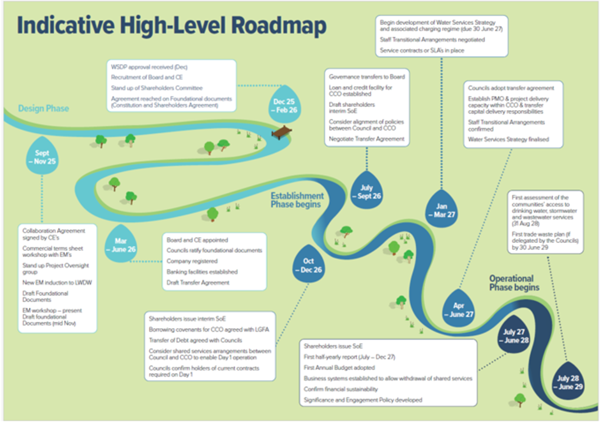
13. The
immediate focus (December 2025-February 2026 in the timeline above) is on
agreeing key terms relating to the governance and commercial arrangements for
the new Water Organisation, and including Iwi from the three districts in those
discussions.
14. Following
the appointment of Chris Dyhrberg as Executive Director for the project, the
three Council Chief Executives, who form the Project Steering Group (PSG), in
consultation with the three Mayors, who form the Project Oversight Group (POG),
have finalised an Establishment Team, which includes a secretariat, six
workstream leads, and a transition manager for each Council.
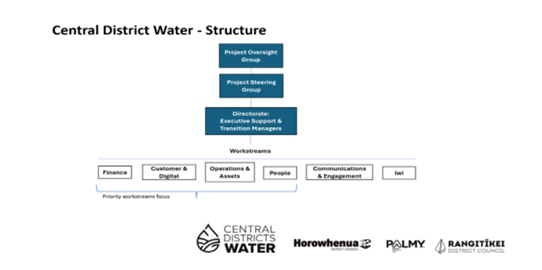
Discussion | HE MATAPAKINGA
15. The
critical step in establishing Central Districts Water is for the three
Councils, as shareholders, to adopt the Constitution and Shareholders’
Agreement for the new entity. These documents have been prepared by Simpson
Grierson, the legal advisors to the three Councils, based on the templates
provided by the Department of Internal Affairs.
16. The
advice and final documents presented to Council for consideration have been
guided by Elected Member voice through a series of joint and individual Council
workshops. It is important to recognise that the documents recommended for
adoption, reflect those preferences where the most alignment exists between the
three shareholding parties.
17. To
guide decision making, Simpson Grierson has prepared a table that identifies
key features of the documents, the various options available relative to those
features, and their recommendations to the Councils. This table is included as Attachment
A.
18. The
Constitution is a document that establishes some of the key frameworks for how
the Water Organisation to be known as Central Districts Water will operate,
sets out its objectives and the rules for its governance structure. Key
provisions include:
· Complying with
budgeting and reporting requirements (under the Local Government (Water
Services) Act 2025 and as required by the Shareholders Committee).
· Requiring an
annual meeting of shareholders (and setting the rules for these).
· Allowing payment
of dividends (or not).
19. The
Shareholders Agreement sets out the details of how the relationships will work
between the three Councils as shareholders, and between the shareholders and
the Board of Central Districts Water, and how mana whenua will be involved in
oversight of Central Districts Water. Key provisions include:
· Establishing the
Shareholders Committee (and defining its terms of reference), as the
representative forum for the shareholders and iwi representatives to provide
oversight of, and exercise powers delegated to the Committee by the
shareholders in respect of, Central Districts Water (including the appointment
of the Board of Directors),
· Defining the share
capital for the company,
· Setting out
‘reserved matters’ – i.e. decisions that require unanimous or
special agreement of the shareholders (such as entry or exit of shareholders,
amalgamation, or liquidation),
· Providing for how
disputes are to be dealt with.
20. Both
documents are intended to apply from establishment of the Water Organisation
and will enable us to progress to the next steps.
21. The
proposed Constitution is included as Attachment B and the
Shareholders’ Agreement as Attachment C.
22. An
introductory briefing on the Foundation Documents was provided for each Council
individually on 23 October 2025 (Rangitīkei) and 29 October 2025
(Horowhenua and Palmerston North). This was followed by a more detailed
briefing for all three Councils on 7 November 2025. This focused on:
· Shareholding
options, decision-making roles and responsibilities, and
· The approach to
involving mana whenua partners is governance and decision-making as part of the
Shareholders Committee.
23. There
was general acceptance of establishing a Shareholders Committee as the basis
for collective decision-making by all three shareholder Councils. Two
characteristics noted:
· It will be a joint
committee under the Local Government Act 2002, and thus subject to the Local
Government Official Information and Meetings Act (LGOIMA) in the same way that
Councils are (in relation to both the official information and meetings).
· Council must
formally appoint all members (including any mana whenua representative
nominated by Iwi), and delegate the necessary powers to make decisions on their
behalf to those members (based on the content of the Shareholders’
Agreement).
24. The
Shareholders Committee’s major functions are:
· Appointment of
directors to the Water Organisation Board.
· Developing,
adopting and providing a Statement of Expectations to Central Districts Water
(which is to inform decisions made by the Water Organisation).
· Commenting
on the Water Services Strategy developed by Central Districts Water but not
approving (the WSS is a document comparable to Councils’ Long Term
Plans).
25. The
proposed governance structure and accountabilities are depicted below:
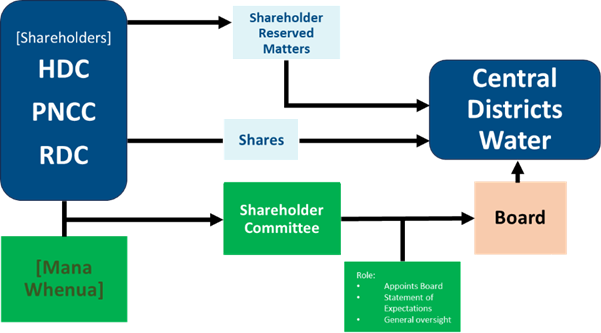
26. There
was general agreement to the principle of having an independent non-voting
chairperson of the Shareholders Committee. This will provide for the
appointment, by the remaining members of the Shareholders Committee, of a
person who can bring relevant skills, knowledge, or expertise (including
relation to governance) to the business of the Committee, be a facilitator for
the Committee’s discussions and help with the workload.
27. Clarification
was provided on the following matters raised:
· A skills matrix
for appointment Directors is essential and is being developed.
· Local pricing will
be a topic for the future Statement of Expectations – but will be
addressed in the WSDP as approved. There will be price harmonisation within
each Council area.
· The borrowing
through the Local Government Funding Agency (LGFA) is not affected by any
credit rating by an external agency such as S&P.
· The Department of
Internal Affairs (DIA) cannot require Central Districts Water to accept another
council as a shareholder in the Water Organisation – but it can require
another council to negotiate entry with the three existing shareholding councils
in the interests of providing a more financially sustainable delivery of water
services.
· Mixed rural water
supplies in Rangitīkei will not be transferred to Central Districts Water.
28. During
discussion, four issues emerged where further consideration was needed before
finalising the provisions of the Constitution and Shareholders’
Agreement. These were:
a) Should
payment of a dividend (i.e. a distribution) to shareholders be permitted?
b) Should
shareholders be required to consult with their respective councils and gain
their endorsement before approving the Statement of Expectations?
c) What is the optimum size
of the Shareholders Committee?
d) How should mana whenua
be represented on the Shareholders Committee?
29. A
separate briefing was prepared in conjunction with Simpson Grierson and
Morrison Low for discussion with each Council. This is included as Attachment
4. It identified the relevant statutory provisions, options, and what other
multi-council Water Organisations are doing, posed some questions and provided
an overall evaluation. This discussion paper was circulated to each Council. It
was also discussed at workshops on 19 November 2025 (Horowhenua), 27 November
2025 (Rangitīkei), and 3 December 2025 (Palmerston North). Feedback and
questions were requested from Palmerston North Elected Members by email. The
proposed position that takes into account all of the three Council’s
views, and reflected in the foundation documents is:
a) Dividends:
Prohibit unless unanimously agreed by the shareholders.
b) Requirement
for consultation on the Statement of Expectation: No specific requirement, this
is a matter for the delegation given by each Council to its appointed
representatives on the Shareholders Committee (so could be an instruction in
that delegation), along with a general expectation that the representatives
would keep the Council informed of progress by the Committee.
c) Size
of the Shareholders Committee: Three representatives per Council (one of which
would be a mana whenua representative). An independent non-voting Chair.
d) Mana whenua
representation: Three mana whenua representatives in total – being one of
each Council’s three representatives (The mana whenua representatives
would be recommended by the mana whenua Roopū (Ngā Tapuwae o Hau)),
and then confirmed by the relevant Council. It is proposed that a Memorandum of
Understanding (MoU) be negotiated and entered into between Ngā Tapuwae o
Hau, the three Councils and Central Districts Water that records the mechanism
to make recommendations and any other relevant matters relating to the
Shareholders Committee or the relationship between the five parties.
30. The
table below summarises where the details of the key matters in the
decision-making table are included in the documents.
|
Constitution
|
|
Key
Matters
|
Clause/Schedule
|
|
Shareholder
role in Water Services Strategy and Annual Budget
|
Clause
3.2
|
|
Dividends
|
Clause
8
|
|
Size
and composition of the WS-CCO Board
|
Clause
12.2
|
|
Board
skills requirement
|
Clause
12.5
|
|
Board
Member term and reappointment
|
Clause
12.6
|
|
Shareholders Agreement
|
|
Share
allocation
|
Schedule
1, Clause 2.2, 7.2
|
|
Board
member term and reappointment
|
Schedule
1
|
|
Establishment
of the Shareholders Committee
|
Schedules
1 & 3, Clause 6.1
|
|
Size and composition of
shareholders
|
Schedule
1, Clause 6.2
|
|
Iwi participation in the
Shareholders Committee
|
Schedule
3
|
|
Decision
making framework
|
Schedule
2 & 3, Clause 5.1 (note clause 12.11 constitution)
|
|
Shareholder exit
|
Schedule
1, Clause 9.5 and 9.7
|
Options | Ngā
Kōwhiringa
Options | Ngā Kōwhiringa
|
Benefits | Ngā Whiwhinga
|
Risks | Ngā Mōrearea
|
|
Option A (recommended)
·
Approve the attached Constitution and
Shareholders’ Agreement
|
·
Aligns with the decisions the three Councils
have made to date
·
Is consistent with the timeframes and
commitments the Councils have made to Internal Affairs in their joint Water
Services Delivery Plan to establish the Water Organisation
·
Documents give effect to agreements and
understandings reached between partner Councils and Iwi.
·
Provides the governance framework for
effective delivery of water services across the three Council areas.
|
·
No known disadvantages
|
|
Option B (status quo)
·
Do not approve the attached Constitution and
Shareholders’ Agreement
|
·
No known advantage.
|
·
Does not align with the decisions which the
three Councils have made to date
·
Does not deliver on the timeframes and
commitments the Councils made to Internal Affairs in their Water Services
Delivery Plan
·
Creates a possible risk of intervention by the
Government, which will be focused on implementing the commitments made in the
WSDP.
·
Does not meet agreements and understandings
reached with partner Councils and with iwi.
·
Leaves the Councils in limbo with no defined
governance framework for delivering water services across their
area.
|
31. Option
A is recommended. Approving the Constitution and Shareholders’ Agreement
enables the establishment of the joint Water Organisation to continue on its
planned timeframes and ensures the three Councils meet the commitments made in
their Water Services Delivery Plan.
ENGAGING WITH MĀORI | TE MAHI TAHI KI TE
MĀORI
32. Council has
various legislative obligations to consider the views of mana whenua in its
decision-making. In particular, Parts 2 and 6 of the Local Government Act 2002
provide principles and requirements for local authorities that are intended to
facilitate participation by Māori in local authority decision-making
processes. These obligations are not affected by the establishment of the Water
Organisation. However, the obligations are relevant to how the councils
undertake their decision-making as shareholders of the Water
Organisation.
33. The
following table sets out the iwi across the three Councils:
|
Horowhenua
District Council
|
Muaūpoko
|
|
|
|
Rangitāne o Manawatū
|
|
|
|
Ngāti Raukawa ki te Tonga
|
Ngāti
Turanga
Ngāti
Rākau
Ngāti
Te Au
Ngāti
Takihiku
Ngāti
Ngārongo
Ngāti
Whakatere
Ngāti
Pareraukawa
Ngāti
Huia ki Poroutawhao
Ngāti
Huia ki Matau
Ngāti
Kikopiri
Ngāti
Hikitanga
Ngāti
Wehi Wehi
|
|
Rangitīkei
District Council
|
Ngāti Parewahawaha
|
|
|
|
Nga Wairiki Ngāti Apa
|
Ngā
Ariki
Ngāti
Kauae/Tauira
Ngā Wairiki
ki Uta Kauangaroa
Whangaehu
|
|
|
Ngāti Hinemanu/Ngāti Paki
|
|
|
|
Mōkai Pātea
|
Ngāti
Hauiti
Ngāti
Whitikaupeka
Ngāti
Tamakōpiri
Ngāi
Te Ohuake
|
|
|
Ngāti Rangitūhia
|
|
|
|
Rātana Community
|
|
|
Palmerston
North City Council
|
Rangitāne o Manawatū
|
|
34. These
Iwi established a Roopū (Ngā Tapuwae o Hau) as the principal contact
for the three Councils in discussing the transition programme and Iwi
involvement.
35. At
the hui hosted by Rangimarie Marae on 19 August 2025, all parties, including
Councils, acknowledged the importance of partnership, and Māori
contribution to decision making.
36. Ngā
Tapuwae o Hau’s legal advisor was provided with a copy of the decision
making table prepared by Simpson Grierson.
FINAnCIAL AND RESOURCING | TE TAHUA PŪTEA ME
NGĀ RAUEMI
37. While
there are no immediate financial implications with adopting the Constitution
and Shareholders’ Agreement, this allows the next phase of the
establishment of Central Districts Water to commence, which has been budgeted
and provisioned for in the WSDP.
38. The
Collaboration Agreement includes a budget for getting Central Districts Water
to be operational: it notes that the transition costs up until 30 June 2027
will be debt funded and transferred to Central Districts Water.
Legal and Risk | Te Ture me ngā
Mōreareatanga
Impact
on Strategic Risks
Delayed
appointment of the Board of Directors
39. Adopting
the Constitution and Shareholders’ Agreement enables the formal
establishment of the Shareholders Committee, which is the forum that will be
responsible for appointing the Water Organisation’s Board of Directors
– and it is the Boards role to appoint the Chief Executive. This
recommended option addresses the risk of director appointments being delayed,
as it:
· Allows the
Shareholders Committee to confirm the composition of the Board by April 2026,
· Adheres to the
implementation timeline in the WSDP (and thus not be an issue in the monitoring
undertaken by the DIA), and
· Provides the
maximum opportunity to ensure an efficient transition of water services from
the three Councils and to negotiate service delivery requirements and the
transfer agreements required by law.
Delayed
engagement with Iwi
40. Including
Iwi representation on the Shareholders Committee from the outset allows their
perspectives to be shared with the Council shareholders and influence the
Statement of Expectations to be provided to the Board. Inviting Iwi to join the
workstreams will broaden Iwi understanding of the transition of water services.
The recommended options addresses the risk of engagement with Iwi being
delayed, as it:
· Demonstrates
compliance with the statutory requirement to facilitate participation by
Māori in local authority decision-making processes,
· Supports input
from Iwi on appointment the Board, and
· Provides
recognition of te ao Māori.
Next Steps | HEI MAHI
41. All
three Councils are considering these documents at meetings on 10 and 11
December 2025.
42. Following
approval of the Shareholders’ Agreement by each Council, which includes
the terms of reference for the Shareholders Committee, the Councils and Iwi
will confirm their nominated representative(s) to the Shareholders Committee,
and delegate all necessary powers to the Committee. This will then enable
continuation of the recruitment process of the Board of Directors initiated by
the Project Oversight Group, and subsequently to make those Director
appointments.
43. Central
Districts Water will need to be legally incorporated and registered with the
Companies Office, with the final Constitution uploaded to the Companies Office
register.
|
Confirmation of statutory compliance
In accordance
with sections 76 – 79 of the Local Government Act 2002, this report is
approved as:
a. containing
sufficient information about the options and their advantages and
disadvantages, bearing in mind the significance of the decisions; and,
b. is
based on adequate knowledge about, and adequate consideration of, the views
and preferences of affected and interested parties bearing in mind the
significance of the decision.
|
Attachments | NGĀ
TĀPIRINGA KŌRERO
|
No.
|
Title
|
Page
|
|
a⇩

|
HDC PNCC RDC - Constitution
|
195
|
|
b⇩
|
HDC PNCC RDC - Shareholders
Agreement
|
217
|
|
c⇩
|
HDC PNCC RDC - LWDW Decision
Making Table
|
249
|
|
Council
10 December 2025
|

|
This page is a placeholder for a single
page of a PDF attachment. It will be replaced by the actual PDF page when the
PDF version of this document is generated.
Report: Local Water Done Well - Foundation
documents for the joint Water Services Council-Controlled Organisation known as
Central Districts Water
Attachment: HDC, PNCC, RDC LWDW Decision
Making Table
Page: 1
This page is a placeholder for a single
page of a PDF attachment. It will be replaced by the actual PDF page when the
PDF version of this document is generated.
Report: Local Water Done Well - Foundation
documents for the joint Water Services Council-Controlled Organisation known as
Central Districts Water
Attachment: HDC, PNCC, RDC LWDW Decision
Making Table
Page: 2
This page is a placeholder for a single
page of a PDF attachment. It will be replaced by the actual PDF page when the
PDF version of this document is generated.
Report: Local Water Done Well - Foundation
documents for the joint Water Services Council-Controlled Organisation known as
Central Districts Water
Attachment: HDC, PNCC, RDC LWDW Decision
Making Table
Page: 3
This page is a placeholder for a single
page of a PDF attachment. It will be replaced by the actual PDF page when the
PDF version of this document is generated.
Report: Local Water Done Well - Foundation
documents for the joint Water Services Council-Controlled Organisation known as
Central Districts Water
Attachment: HDC, PNCC, RDC LWDW Decision
Making Table
Page: 4
This page is a placeholder for a single
page of a PDF attachment. It will be replaced by the actual PDF page when the
PDF version of this document is generated.
Report: Local Water Done Well - Foundation
documents for the joint Water Services Council-Controlled Organisation known as
Central Districts Water
Attachment: HDC, PNCC, RDC LWDW Decision
Making Table
Page: 5
This page is a placeholder for a single
page of a PDF attachment. It will be replaced by the actual PDF page when the
PDF version of this document is generated.
Report: Local Water Done Well - Foundation
documents for the joint Water Services Council-Controlled Organisation known as
Central Districts Water
Attachment: HDC, PNCC, RDC LWDW Decision
Making Table
Page: 6
This page is a placeholder for a single
page of a PDF attachment. It will be replaced by the actual PDF page when the
PDF version of this document is generated.
Report: Local Water Done Well - Foundation
documents for the joint Water Services Council-Controlled Organisation known as
Central Districts Water
Attachment: HDC, PNCC, RDC LWDW Decision
Making Table
Page: 7
|
Council
10 December 2025
|

|
File No.:
25/663
8.7 Waikawa
Beach Vehicle Access
|
Author(s)
|
Lacey Winiata
Parks &
Property Manager | Tumu Rawa, Papa Rēhia
|
|
Approved by
|
Brent Harvey
Group Manager -
Community Experience & Services | Tumu Rangapū, Wheako Hapori,
Ratonga
|
|
|
Monique Davidson
Chief Executive
Officer | Tumuaki
|
Purpose | TE PŪTAKE
1. This report provides Council with options for vehicle access or not
at Waikawa Beach for Council to consider. It reflects the complexities of the
matter and the evolving positions of key stakeholders, including iwi, other
agencies and the community.
This matter does not relate
to a current Council priority.
Executive Summary | TE WHAKARĀPOPOTOTANGA
MATUA
2. Council has worked closely with the Waikawa Beach community,
Ngāti Wehi Wehi, Horizons, and the Department of Conservation (DoC) to
understand viable options for vehicle access at Manga Pirau Street. Horizons
has confirmed that while passive use of the current informal track does not
require consent, any maintenance or vegetation clearance would. DoC has
indicated in-principle support for an easement over its land, which could
provide a lawful mechanism to enable controlled access without requiring active
maintenance.
3. Engagement with the Community Group and neighbouring residents shows
broad support for a trial period of access, supported by strong education and
monitoring. Neighbours have raised concerns around privacy, noise, parking, and
the interim nature of the solution, and all groups emphasise the importance of
continuing to explore longer-term access options.
4. This
report outlines the available options. Council direction is sought on whether
to proceed with a trial and whether additional work on long-term alternatives
is required. If further investigation is desired, Officers recommend that clear
timeframes and boundaries be set to ensure future work remains proportionate
and sustainable.
DELEGATION OR AUTHORITY TO ACT | TE MANA WHAKATAU I
NGĀ KAWENGA
5. Council
has the authority to make this decision through the Local Government Act.
SIGNIFICANCE ASSESSMENT | He Aromatawai Matua
6. This matter is assessed as significant under Council’s
Significance and Engagement Policy due to the high levels of community interest
and the cultural and environmental sensitivities associated with vehicle access
to Waikawa Beach. Officers have been continuously working with the community,
particularly with community groups who represent different factions across
Waikawa Beach, and the neighbours of the area discussed in this report. Their
varying views are represented within this report.
RECOMMENDATION | NGĀ TAUNAKITANGA
A. That Council provide pedestrian and horse access only to Waikawa
Beach, through 47-49 Manga Pirau Street.
OR
B. That Council requests Officers seek an easement with DoC and
provides vehicle access to the beach across reserve land between 47-49 Manga
Pirau Street Waikawa Beach.
OR
C. That Council requests Officers to seek easements across both DoC and
Council land between 47-49 Manga Pirau Street to allow for vehicle access to
Waikawa Beach with the following conditions on the easements:
· Time limit
· Types of vehicles
OR
D. That Council retains the status quo and does not enable vehicle
access at this time, with Officers continuing to monitor informal use of the
existing track and providing a further update to Council if conditions
materially change.
E. That Council requests Officers to continue exploring alternative
long-term access options, including land acquisition or alternative alignments,
and that this work be undertaken within a defined timeframe set by Council.
Background | HE KŌRERO TŪĀPAPA
7. As
previously presented in Council reports on this kaupapa (topic), in the past,
vehicle access to Waikawa Beach has historically been provided by way of a
single access point crossing privately owned land from the mouth of the Waikawa
River, located at the end of Manga Pirau Street. This access had been
graciously provided to the community by the landowner as a gesture of goodwill.
8. Maintaining
that vehicle access point was challenging due to bank erosion from the adjacent
Waikawa Stream and more frequent weather-related events. As a result, over the
years there had been instances where local residents were unable to access the
beach with their vehicles. Management of this issue was previously undertaken
by Horizons Regional Council, primarily through stream "cuts" to
redirect the channel towards the sea. The consent for those remedial actions
expired in 2020.
9. In
November 2021, a petition with 158 signatures was submitted to Council, urging
the establishment of a sustainable vehicle and equestrian access to Waikawa
Beach, using Council-owned land at Reay MacKay Drive. The petition was
presented to the Council on 1 December 2021.
10. During
the 2021-41 Long Term Plan process, Council decided to provide budget for
Officers to identify and evaluate potential options for alternative long-term
vehicle access (suitable for 4WD vehicles, ATV’s and tractors) to Waikawa
Beach and undertake a community engagement process to seek feedback on the
identified options.
11. Council
Officers, in collaboration with external planning and environmental consultants
(Boffa Miskell), identified and assessed various options for potential vehicle
access to Waikawa Beach and presented five access options to Council at its
meeting on 11 October 2023 (along with an option that would see no further
action taken).
12. The
11 October 2023 report received by the Council outlined several complex
considerations, including financial, geomorphological, environmental, and
consenting challenges, as well as the high levels of community interest in
several of the options. At that time, the Council decided that it would consult
the community on three options, two of which involved the existing access at
Manga Pirau Street (but with different maintenance arrangements), with the
third being no vehicle access.
13. A
total of 446 submissions were received and reported to the Council at its 20
March 2024 meeting, with approximately 70% of those indicating support for the
options that allowed for vehicle access. Many of those submissions raised other
options and raised related general concerns with the matter of vehicle access.
14. At
the 20 March 2024 meeting, the Council was advised that continuing to use the
existing access over private land was no longer available. This led to the
Council deciding to leave the matter on the table, with a request made for
Officers to continue to explore potential alternative options for vehicle
access, alongside the option of providing no vehicle access.
15. Following
that meeting, Officers updated submitters and asked those who owned land that
could potentially be utilised for access, to get in touch. Officers and
community members also spoke with some private landowners who may have been
able to provide access options on their land. No potential options were
presented to Officers in response.
16. Council
Officers also discussed the matter with Horizon’s Regional Council
consenting team to obtain advice on what a consent process for access to
Waikawa Beach may involve, including mitigation options to provide for a
vehicle access way on Council-owned land between 47-49 Manga Pirau Street. The
response from Horizons Regional Council requested a “technical
report” on the option.
17. At
the end of 2024, Boffa Miskell developed in draft, a schematic design for each
of the three Council-owned land locations above, to understand if and how
vehicle access could be practically constructed given the site constraints at
each.
18. After
updating the Council on progress at a workshop on 11 September 2024,
Councillors requested a technical report to clearly outline the options,
processes and costs associated.A report was brought back to Council in December
2024 where advice was prepared and framed based on legal counsel. At that
meeting Councillors challenged the community to work together to find a
solution and restore community harmony.
19. A
Community Group was formed with representatives from Walk on Waikawa, Waikawa
Beach Rate Payer Association, Waikawa Beach Environment Group and Vehicles on
Waikawa Group. More recently Ngāti Wehi Wehi have also joined the group,
having previously engaged in the topic separately. This group has been meeting
with Officers and Councillor Barker (and Councillor Brannigan in the previous
term of Council) to discuss and work toward a way forward. Since
the establishment of the community group there has been a reported improvement
in interpersonal behaviour.
20. A track was created to the beach on Council and Department of
Conservation land, between 47-49 Manga Pirau Street. This was done without
consent or permission of Council or DoC. The Community Group alongside Council
issued joint communications outlining there is no formal vehicle access to the
beach. Signage was also installed.
21. While perspectives remain diverse, the Community Groups focused on
collaboration, and all parties made some level of concession and were at a
point where they were interested in pursuing a controlled access trial through
the Council-owned Manga Pirau Street location.
22. Officers brought back an overview report to the 25 June 2025 Council
meeting, where Councillors acknowledged the Community Groups collaborative
progress toward a controlled access trial, and directed Officers to continue
working with the community and Ngāti Wehi Wehi to further explore access
options, both controlled and no access, and report back on progress.
Discussion | HE MATAPAKINGA
23. In
forming the engagement approach underpinning this report, Officers assessed the
adequacy and proportionality of consultation to date.
24. In
forming this assessment, Officers have had regard to both Council’s
Significance and Engagement Policy and legal advice on the suitability of
engagement up until this point. Officers note that consultation on this matter
has occurred at multiple levels: formal statutory consultation through the Long
Term Plan process and the 2023/24 vehicle access options consultation, which
resulted in 446 submissions and prompted clear expression of community
preferences; followed by sustained targeted engagement with the Waikawa
Community Group, Ngāti Wehi Wehi, and affected neighbours. This engagement
has included regular hui, co-designed communication with the community,
facilitated discussions to support consensus-building, and direct dialogue with
adjoining landowners. Based on the legal advice received, officers consider
that this layered engagement approach, and the way in which community feedback
has materially shaped the options presented in this report, is proportionate to
the level of significance and satisfies Council’s consultation
obligations for the decisions now being sought.
25. Work on the Waikawa Beach vehicle access matter has progressed
significantly over the past several months through ongoing engagement with the
Waikawa Community Group. This mahi has helped build a shared understanding of
the competing values at play –environmental protection, recreation and
community use, cultural considerations, public safety, and the need for
certainty and cohesion for the local community.
26. Recent developments have clarified both opportunities and
constraints. Horizons Regional Council has advised that continued public use of
the informal track as it currently exists does not in
itself trigger resource consent requirements. Provided no additional vegetation
clearance, earthworks, or re-formation of the track occur; the One Plan rules
do not require a consent for people using the existing formed surface. This
provides clarity that the current level of use can continue in the interim
without breaching regional planning provisions.
27. However, Horizons has also confirmed that any further vegetation
clearance, sand disturbance, widening, reshaping, or maintenance works within
the foredune area would require resource consent. This is because the foredune
and its associated dune vegetation are classified as “rare, threatened,
or at-risk habitat” under Schedule 6 of the One Plan. As a result, even
routine maintenance, such as smoothing ruts, removing sand that has drifted
onto the track, or trimming vegetation, could trigger consent requirements.
This has important implications for the long-term sustainability of any vehicle
access arrangement.
28. Alongside this, Officers have engaged with the Department of
Conservation (DoC) given that the lower portion of the informal track currently
traverses DoC-administered land. DoC has signalled an openness to considering
an easement that would allow managed public vehicle access across their land,
subject to the standard Conservation Act concession process. This presents a
potential pathway to formalising access in a controlled and lawful manner.
Working with the Community
29. Feedback from
the Community Group has evolved as these constraints and opportunities have
become clearer. At the most recent hui (November 2025), the Group expressed a
strong preference that any potential vehicle access be implemented initially as
a trial, supported by a jointly developed community-led education
campaign, environmental monitoring, and behaviour expectations. The Group
emphasised the importance of communication that reflects the values of the
Waikawa community, Ngāti Wehi Wehi, and local environmental advocates.
30. There
remains, however, diversity of opinion among the group and wider stakeholders
about whether any vehicle access should be provided, and what conditions should
apply. Officers consider that the trial concept, paired with education, agreed
behaviour protocols, and environmental monitoring, could provide valuable
information to inform a future beach bylaw or Coastal Reserves Management Plan.
At the same time, Council must consider its statutory obligations,
environmental responsibilities, available enforcement tools, and the risk of
unintended precedent-setting.
Options | Ngā
Kōwhiringa
31. Officers
have therefore developed a set of options for Council consideration. These
options reflect:
· the current
regulatory framework (One Plan, Reserves Act, Public Places Bylaw),
· the recently
signalled willingness from DoC to consider an easement,
· the
community’s desire for clarity and cohesion,
· ongoing use of the
informal track despite existing “no vehicle” signage,
· and the need for
Council to make a clear, durable, and defensible decision.
· Each option has
different implications for environmental protection, community expectations,
cost, risk, and Council process requirements. These are set out in the
following section.
Options | Ngā Kōwhiringa
|
Benefits | Ngā Whiwhinga
|
Risks | Ngā Mōrearea
|
|
Option 1: No
vehicle access at Waikawa Beach with 47-49 being Pedestrian/Horse Access
Only.
Recommendation A
·
This option would restore the reserve to
pedestrian and horse-only access, prevent vehicles from entering the foredune
and beach area at Manga Pirau Street.
|
·
Avoid the need for approvals or consents.
·
This option aligns most strongly with
environmental protection values.
·
It is easy to implement and has limited to no
cost associated.
|
·
Likely to be strong opposition and could be
seen as a step back from recent collaborative progress.
·
Many in the community may look for ways
elsewhere, by creating other tracks, to enter the beach and therefore
damaging the dunes.
|
|
Option 2: Seek
DoC Easement; Council Manages Access Across Its Land
Recommendation B
·
This option involves seeking an
easement/concession from DoC for the portion of track on their land, while
Council manages access on its own reserve land without granting an easement
over HDC land.
|
·
Avoids the need for public notification under
the Reserves Act (as no easement is required on Council land)
·
Provides a clear regulatory pathway, and
allows a managed trial if Council chooses.
|
·
Environmental impacts would require careful
mitigation, and education and monitoring would be essential.
·
There are some in the community who will feel
this is a step away from the permitted access conversations held previously.
|
|
Option 3: Seek
Easements Across Both DoC and HDC Land
Recommendation C
·
This option would fully formalise the
accessway through easements on both land parcels.
|
·
Creates the strongest and most explicit legal
authorisation pathway for vehicle access, reducing ambiguity around the
status of the track, responsibilities for management, and the scope of
permitted activities.
·
This option allows for Council to define
conditions of use (e.g. hours of use, types of vehicles, safety requirements
etc.)
|
·
It would likely require public notification
under section 48 of the Reserves Act and may face opposition.
·
This could potentially be a longer process.
|
|
Option 4: Status Quo
·
This option retains the
current informal situation.
|
·
Lowest immediate cost option.
|
·
Unmanaged vehicle use, with the risk of
Council being issued a notice to fix.
·
Potential for ongoing environmental impacts.
·
Confusion for the public with no certainty.
|
32. It
should be noted that many in the community believe this is an interim solution
and expect Council to continue looking at other avenues. This is due to a
number of reasons, namely:
· Boats unable to
utilise the track
· The neighbours not
wanting this accessway to be permanent
33. Officers
have also explored the following reasonably practicable options, which have
been ruled out at this stage due to being unable to eventuate:
· Over private land
· Over Council land
via the two current pedestrian walkways on Strathnaver Cresent.
34. A licence to occupy was discussed in this process; however, it has
been indicated that vehicle access of this type is more appropriately
authorised through an easement/concession arrangement rather than a licence. A
licence is generally suited to exclusive or low-impact activities, whereas an
easement provides clearer and more certain public access rights. For this
reason, a licence to occupy is not recommended.
Options Commentary | He
Tāpiringa Kōrero Mō ngā Kōwhiringa
35. Both Option 2
(DoC easement only; HDC-managed access across Council land) and Option 3
(easements across both DoC and HDC land) create a lawful framework that could
be implemented in several different ways depending on Council’s appetite
for intervention, environmental effects, cost, and community expectations.
36. “Leave
as is” / No Maintenance Approach
· Under
either Option 2 or 3, Council could elect to allow access while not
undertaking any physical works to form, shape, or upgrade the track.
· This
approach avoids triggering regional resource consent requirements, as Horizons
has confirmed that continued use of the track in its current condition does not
require consent.
· Access
would be “at the user’s own risk”, and Council could
communicate this clearly through signage and public information.
· While
this reduces cost and regulatory burden, it also limits Council’s ability
to address safety concerns or deterioration of the track surface.
· This
pathway is the lowest-intervention approach available under Options 2 and 3,
but may present challenges if track conditions decline or if community
expectations for safety or usability change over time.
37. Managed
Access with Monitoring (but No Physical Works)
· Council
could enable vehicle access under an easement but focus its role on monitoring
use, education, signage, and behaviour expectations – particularly
important if access is trialled.
· This
approach aligns with the community group’s strong emphasis on education,
behaviour guidelines, and joint monitoring.
· It
avoids triggering resource consent requirements unless environmental protection
or safety necessitates physical changes.
· This
pathway offers a middle ground: access is enabled, but Council does not
undertake works that trigger consent obligations.
38. Consent-Backed
Maintenance or Safety Improvements
· If
Council wishes to ensure the track is safely passable or mitigate erosion or
dune damage, any physical work to reshape, widen, or clear vegetation would
require a resource consent under the One Plan.
· This
applies under both Option 2 and Option 3.
· Examples
of works that would require consent include:
o smoothing or re-levelling the
track surface
o removing sand drift
o repairing dune slumping
o trimming vegetation
o widening the formation
· Choosing
this pathway provides greater certainty and improved safety but introduces
consent costs and potential conditions from Horizons.
· It
may also raise community expectations about the level of service Council
intends to provide.
39. Ability
to Escalate or De-escalate Over Time
· One advantage of
both Option 2 and Option 3 is that Council is not locked into a single
mode of implementation.
· Council may begin
with a “leave as is” or trial-based approach. Monitoring during a
trial could inform whether consented maintenance is required to protect
environmental values or public safety.
· Conversely, if
environmental monitoring indicates unacceptable adverse effects, Council could
scale access back without having invested in significant physical works.
Neighbours Feedback on
Options
40. Engagement
with residents living at or near 47-49 Manga Pirau Street highlighted a number
of strong concerns about the impact of the current informal accessway on their
day-to-day living environment. Neighbours described a “significant
change” in their experience of the beach frontage since the accessway
began being used by vehicles, noting a high and constant flow of 4WDs,
particularly utes and jeeps, with bright headlights shining directly into
properties during evenings and early mornings. This change has affected their
sense of privacy and amenity, with several residents expressing that the current
level of use feels intrusive and unsustainable.
41. As
previously mentioned, residents consistently commented that this is not viewed
as a viable long-term solution and should only be considered as an interim
approach while a more appropriate and permanent access option is explored. Many
reiterated their support for Council continuing to investigate the purchase of
private land as a preferred longer-term option. There was also concern that,
without controls, the accessway may be “used as a highway,”
significantly changing the character of the area.
42. Neighbours also noted that the current informal track is not
suitable for launching or retrieving boats and presents accessibility
challenges for those who are not physically able or who do not have access to
quad bikes or side-by-sides. They emphasised that this reinforces the temporary
nature of this option, and expressed a strong desire for Council to continue
investigating long-term solutions that provide equitable access to the beach.
43. Neighbours
expressed a strong interest in privacy and safety-related mitigations should a
trial proceed. Suggestions included higher fencing, planting or shrub belts to
buffer noise and reduce headlight glare, and additional planting to discourage
parking within the reserve and close to homes.
44. Several
residents expressed a preference for limiting access to lighter recreational
vehicles (side-by-side vehicles and quad bikes), rather than full-sized 4WDs.
One suggestion was to only have access big enough for quads or side-by-sides to
go through, or a gate or one-arm barrier, with a configuration that still
allows quad bike passage but restricts larger vehicles. Time-of-day
restrictions were also considered important, with a preference for these being
managed locally through the Ratepayers Association rather than by Council.
Community Group
Feedback on Options
45. Engagement with the Waikawa Beach Community Group showed a high
level of consensus that, if Council proceeds with an accessway, it should
initially be implemented as a trial. All groups
expressed support for a structured trial period, provided it includes clear
evaluation criteria, environmental and behavioural monitoring, and regular
reporting back to the community and Council. There was strong collective
emphasis on education as a foundation for any trial, particularly education
grounded in local values, tikanga, environmental protection, and expectations
for responsible behaviour on the beach.
46. Within this overall alignment, the groups hold differing views on
the preferred form of access.
· Walk
on Waikawa maintain that a permitted access system (such as a permit
with a gate, and those with a permit get a key) is the most effective way to
limit environmental degradation and improve driver behaviour.
· The Ratepayers
Association strongly opposes a permit system, expressing concern that it could
undermine community harmony and create division; they favour an education-led
approach supported by visible local messaging.
· Ngāti Wehi
Wehi sit between these positions, reiterating that both access and
kaitiakitanga are important, and that whichever model Council chooses,
community harmony and strong education must be at the centre.
· Waikawa Beach
Environment Group express strong opposition to motorbikes
(two-wheels) being permitted on the beach, noting that they do not align with
the safety and environmental objectives of the trial and are not considered
necessary for beach access.
47. Overall,
the group expressed willingness to work collaboratively with Council on a trial
design that reflects shared values while accommodating these differing
perspectives.
Trial Monitoring
48. As
mentioned, a trial is strongly supported. Monitoring could include:
· Bi-monthly photos
of fixed points along the track and foredune to monitor movement.
· Partnering with
Horizons or DoC for quarterly checks on vegetation.
· Creation of CRM
category to capture complaints.
49. A
report with these updates could be shared with the Community Group bi-monthly
for oversight, as well as an update in Council’s OPR.
Beach Bylaw
50. Throughout
engagement on the Waikawa Beach access issue, there has been a consistently
strong desire from community groups and residents for Council to progress work
on a Beach Bylaw. While this report focuses specifically on options for vehicle
access at Waikawa Beach, the feedback received highlights that the
community’s concerns extend far beyond vehicles alone.
51. Matters
such as environmental protection, safe and respectful behaviour by all beach
users, protection of wildlife and dune systems, shared use between walkers,
swimmers, dog owners and vehicles, and the overall character of the beach
environment feature prominently in discussions. These are broader issues that
cannot be fully resolved through an accessway decision alone.
52. A
Beach Bylaw would provide a more comprehensive regulatory framework to manage
behaviour, protect sensitive dune and coastal ecosystems, support mana whenua
values, and give the community clarity about expectations for how the beach
should be enjoyed and cared for. The trial period, if Council chooses to
proceed with one, would generate valuable data to inform such a bylaw,
including insights into environmental impacts, user behaviour, and community
sentiment. Based on the strength and consistency of community feedback,
officers consider that the development of a Beach Bylaw could be identified as
a next step in the wider work programme, following the resolution of the
immediate accessway decision.
Other
accessways in the district
53. Across
the district, Council formally manages five established vehicle beach access
points, each of which are identified in Schedule 3 of the Public Places Bylaw
2024. These are:
· Foxton Beach
– Pinewood Road
· Foxton Beach
– Surf Club Carpark
· Waitārere
Beach – Waitārere Beach Road
· Waitārere
Beach – Windsor Street
· Hokio Beach
– Muaūpoko Street
· Hokio Beach
– Tawhiti Street
54. At
each of these locations, the purpose of the accessway is clearly defined, and
Council applies consistent management practices under the Public Places Bylaw
2024. These include ensuring vehicles access the beach only through the
designated point, managing signage, ensuring safe movement between the road
reserve and the beach environment, and, where required, closing or restricting
access under clause 14.6 to protect public safety or prevent environmental
damage.
55. All
designated accessways have historically developed from long-standing community
use patterns and have formed part of local beach settlement layouts for many
decades. They are typically supported by established public road endings, car
parking areas, and reserve land configured to support beach access.
ENGAGING WITH MĀORI | TE MAHI TAHI KI TE
MĀORI
56. Council has engaged with Ngāti Wehi Wehi throughout this
process, recognising their mana whenua status and ongoing cultural relationship
with the Waikawa coastal environment. Representatives have participated as full
members of the Waikawa Community Group, contributing to discussions on the values
of the area, the importance of protecting the dune and coastal ecosystems, and
the need to maintain community cohesion as decisions are made. Their
involvement has supported a more holistic understanding of the cultural,
environmental, and recreational significance of the site.
57. As
mentioned earlier in this report, Ngāti Wehi Wehi have
expressed support for enabling access to the beach – whether controlled
or unrestricted, while emphasising education,
environmental protection, and community harmony as key foundations of any
future arrangement. They have signalled a willingness to partner with Council
and the community to help shape messaging, support kaitiakitanga-focused
education, and contribute to monitoring and evaluation should a trial proceed.
58. Ongoing engagement will continue as part of this project and any
potential subsequent development of a district-wide Beach Bylaw or Coastal
Reserves Management Plan.
CLIMATE CHANGE | NGĀ ĀHUARANGI HURIHURI
59. The Waikawa coastline is subject to the effects of climate change,
including coastal erosion, dune migration, increased storm frequency, and
sea-level rise. These pressures are already influencing the formation and
stability of the dune systems adjacent to the Manga Pirau Street access point.
The sensitivity of these dune areas underpins Horizons’ identification of
the foredune as a “rare/threatened” habitat and informs the need
for cautious and environmentally responsible decision-making.
60. Any decisions relating to vehicle access must be understood within
this dynamic context. Climate impacts may affect the durability and safety of
access routes over time, and any approved accessway will need to be monitored
for erosion, vegetation loss, or track instability.
61. Future coastal management planning, including the forthcoming
Coastal Reserves Management Plan, will provide a broader framework for
considering adaptation over the longer term.It should be noted that the Waikawa
Beach community are used to operating in this environment with the previous
vehicle accessway often being washed out by the moving river. This is something
they are comfortable with working with.
FINAnCIAL AND
RESOURCING | TE TAHUA PŪTEA ME NGĀ RAUEMI
62. To date, Council has invested $235,771.17 in work related to the
Waikawa Beach access kaupapa. This includes costs for community consultation,
engineering assessments, signage, and surveys, and reflects only the officer
time associated with the public consultation undertaken over summer 2023/24
(with wider staff time not included in this figure).
63. In
the Long Term Plan Council assigned $1.238m for Waikawa Beach Accessway this
financial year. However, Council has already approved replacement of the bridge
from the same budget. This is estimated to cost $500-$550k. The bridge has not
progressed at this stage as the private landowners on the other side of the
bridge are awaiting the decision of this report.
64. As
mentioned earlier in this report there is potential for ongoing maintenance
costs, which will vary depending on which option Council decides to pursue.
There is currently no operational budget available for this.
Legal and Risk | Te Ture me ngā
Mōreareatanga
65. Legal risks arise from the current unauthorised use of the informal
track, the ecological sensitivity of the dune system, and Council’s
obligations under the Reserves Act, Resource Management Act, and Public Places
Bylaw. Legal advice has confirmed that any physical maintenance or modification
of the informal track would likely trigger resource consent due to Schedule 6
habitat rules. In addition, granting an easement over Council reserve land
would normally require public notification unless specific statutory exceptions
apply. An easement over DoC land would be managed through the Conservation Act
concession process.
66. Key risks include potential environmental effects, public safety
issues, community conflict, and clarity of enforcement. A managed trial, if
approved, provides an opportunity to test these risks in a structured way with
appropriate monitoring and the ability to restrict or close access under clause
14.6 of the Public Places Bylaw if required. Retaining the status quo carries
its own risks, including ongoing unauthorised use, track degradation, and
inconsistent public understanding of expectations.
67. Under
the Health and Safety at Work Act 2015 (HSWA), Council’s duty as a Person
Conducting a Business or Undertaking (PCBU) is to take reasonably practicable
steps to manage risks arising from the work Council does.
HSWA does not make Council responsible for all risks that exist in natural
environments or for the actions of members of the public who choose to use
tracks, beaches or open spaces.
Where Council is not carrying out work on a track, and no undertaking is being
provided, Council is not responsible for managing every hazard or preventing
all accidents.
POLICY IMPACT | NGĀ PĀTANGA I NGĀ
KAUPAPA HERE
68. This matter has implications across several existing Council
policies, including the Significance and Engagement Policy, the Open Space
Strategy, and the Climate Action Plan, and must be considered in the context of
these wider frameworks.
69. Future policy tools, such as a Beach Bylaw and the forthcoming
Coastal Reserves Management Plan will also need to align with, and respond to,
any decisions made through this process to ensure a coherent and consistent
approach to coastal access and management.
COMMUNICATIONS AND ENGAGEMENT | TE WHAKAWHITI
PĀRONGO ME TE MAHI
70. This kaupapa requires a carefully phased communication and
engagement approach to ensure the community is well-informed, supported, and
able to participate meaningfully in the next steps. There are two distinct
communications streams associated with this matter.
Communicating with our
Community | Te Whakawhiti Pārongo ki te Hapori
71. The first relates to communicating
Council’s decision and clearly outlining what it
means in practice. This will include explaining the option selected, expected
timeframes, any interim arrangements, and how the community can stay involved
as implementation progresses. The focus will be on providing accurate,
accessible information and ensuring transparency around the process.
72. The
second component is the education and behaviour messaging that the community
group strongly emphasised throughout this process. Regardless of which option
Council ultimately chooses, there remains a clear desire across all groups for
a shared understanding of expected behaviour on the accessway and on the beach
and the environmental and cultural sensitivities of the area. This educational
component will be essential to support safety, environmental protection, and
respectful use of the coastline.
73. Initial
work on this education stream has already begun, and Officers will continue to
collaborate directly with the Community Group to ensure the messaging reflects
their collective voice. This includes working together to determine the
content, format, and tone of any materials, and ensuring that information
reflects local knowledge, cultural perspectives, and the values of the wider
Waikawa community.
74. Both
communication streams will be supported by a tailored engagement plan and
coordinated with Council’s Communications Team to ensure clarity,
consistency, and alignment with Council’s wider coastal work programme.
Next Steps | HEI MAHI
75. Communicating
the decision to the community with expected timeframes and how they can stay
involved in the process.
76. Applying
for any easements, consenting or other applications that may be relevant to the
decision of Council.
77. Councillors
have previously indicated that this matter is not one of Council’s top
organisational priorities; however, it is recognised as a significant and
emotionally charged issue for the Waikawa Beach community. Council has already
invested substantial time and resources into this kaupapa, and if further
exploration of alternative long-term access options is desired, officers
recommend setting clear boundaries and timeframes to ensure any additional work
remains proportionate, targeted, and sustainable.
|
Confirmation of statutory compliance
In accordance with sections 76
– 79 of the Local Government Act 2002, this report is approved as:
a. containing
sufficient information about the options and their advantages and
disadvantages, bearing in mind the significance of the decisions; and,
b. is
based on adequate knowledge about, and adequate consideration of, the views
and preferences of affected and interested parties bearing in mind the
significance of the decision.
|
Attachments | NGĀ
TĀPIRINGA KŌRERO
There are no appendices for
this report
|
Council
10 December 2025
|
|
File No.:
25/688
8.8 Council
Direction Setting
|
Author(s)
|
Monique Davidson
Chief Executive
Officer | Tumuaki
|
|
Approved by
|
Monique Davidson
Chief Executive
Officer | Tumuaki
|
Purpose | TE PŪTAKE
1. The purpose of this report is for Council to endorse the priorities
and direction of Horowhenua District Council for the 2025-2028 triennium.
Executive Summary | TE WHAKARĀPOPOTOTANGA
MATUA
1.1 Following the 2025 triennial election, Council took the time to
discuss key issues and opportunities facing Horowhenua District Council, and
then took the opportunity to set its direction, with emphasis on those areas of
focus which will define the term.
1.2 The context of growth, reform and change has contributed to
Council’s thinking, as has the significant success and progress of many
of the former trienniums priorities.
DELEGATION OR AUTHORITY TO ACT | TE MANA WHAKATAU I
NGĀ KAWENGA
2. Council has
delegation to endorse the direction setting document.
SIGNIFICANCE ASSESSMENT | He Aromatawai Matua
3. That this matter or decision be recognised as not significant in
terms of s76 of the Local Government Act 2002.
RECOMMENDATION | NGĀ TAUNAKITANGA
A. That Council endorse the Council Direction Setting document for
2025-2028 triennium.
Discussion | HE MATAPAKINGA
4. Council
recognises the importance of giving clarity to the community and organisation
on those areas of priorities that require energy and focus, noting that
Community Outcomes and the existing Long-Term Plan and related strategies, and
policies guide business as usual.
5. This
paper seeks Council’s formal endorsement of priorities which will be
guided by the five community outcomes Council seeks to achieve:
· Partnership with
Tangata Whenua
· Outstanding
Environment
· Fit for Purpose
Infrastructure
· Vibrant Economy
· Strong Communities.
6. Delivered
through a deliberate focus on the following top 3 priorities:
Leading to get the best outcomes
for Horowhenua shaped by community voices and partnerships
Priority 1: Going for Growth
What this means:
We have a hunger for growth and want to seize the opportunity to ensure a
return on investment that contributes to Horowhenua’s liveability and
prosperity.
What good looks like:
· Integrated growth
planning informs infrastructure investment and key moves
· Levin Town Centre
transformation acts as a catalyst, making the district a place to be and invest
in
· Ōtaki to
North Levin Expressway anchors our leadership and advocacy as we secure a fair
revocation deal
· Growth delivers
essential services communities can rely on and afford
Priority 2: Future Fit HDC
What this means:
We will foster an agile, high-performing Council ready to meet future
challenges of government reform while delivering fit-for-purpose services to
our community.
What good looks like:
· Adapt to
legislative and structural changes that redefine Council’s role, scope,
and size across reforms (Local Water, Resource Management, Simpler Local
Government, Rates Capping, System Improvement)
· Position HDC as a
leader in reform opportunities for funding and collaboration
· Ensure governance
and decision-making frameworks remain robust and future-proof to support
community voice
Priority 3: Financial Discipline
What this means:
We will manage resources wisely to keep services affordable and investments
sustainable.
What good looks like:
· Strict budget
monitoring and compliance with financial strategy, and balanced budget goals
· Review funding
policies and settings to consider if rates and user fees and charges could be
shared differently
· Advocacy for fair
funding models and external investment opportunities
7. The
Council Plan on a Page also seeks to align the Organisation Vision –
Enabling What Matters, Organisation Values – Mahi Tahi,
#arohatōmahi, Manaakitanga and Tiakitanga. This demonstrates the
commitment to be working together and being aligned – governance and
operations in the way we work together, and the mission we are working towards.
8. The
document attached is provided as a final draft and may be subject to
change between the issue of the agenda and the meeting.
Next Steps | HEI MAHI
9. It
is intended that following the endorsement of the direction setting document,
Council will set Key Performance Indictors for the Chief Executive which will
focus the organisation on delivery and achievement.
|
Confirmation of statutory compliance
In accordance
with sections 76 – 79 of the Local Government Act 2002, this report is
approved as:
a. containing
sufficient information about the options and their advantages and
disadvantages, bearing in mind the significance of the decisions; and,
b. is
based on adequate knowledge about, and adequate consideration of, the views
and preferences of affected and interested parties bearing in mind the
significance of the decision.
|
Attachments | NGĀ
TĀPIRINGA KŌRERO
|
No.
|
Title
|
Page
|
|
a⇩

|
Plan on a Page 2025
|
272
|
|
Council
10 December 2025
|
|
File No.:
25/670
9.1 Organisation
Performance Report - December 2025
|
Author(s)
|
Sue Fifita-Tovo
Executive
Officer | Āpiha Mātāmua
|
|
Approved by
|
Monique Davidson
Chief Executive
Officer | Tumuaki
|
Purpose | TE PŪTAKE
1. This
report presents the full Organisation Performance Report for December 2025.
This matter
relates to Pursuing Organisation Excellence
Continuing the
journey of organisational transformation by enabling a culture of service,
excellence and continuous improvement.
RECOMMENDATION NGĀ | TAUNAKITANGA
A. That Council receive and note Report Organisation Performance Report
- December 2025.
bACKGROUND | hE
KŌRERO TŪĀPAPA
2. The
full Organisation Performance Report is prepared for every second full Council
meeting and aims to provide a comprehensive overview of the activities of each
of the six groups within Council, a financial overview to 31 October 2025 and
reporting on the Statement of Service Performance (SSPs) and Organisation
Performance Measures (OPMs).
3. The
report aligns with the Council 2024/25 Plan on a Page which was adopted in July
2024 and remains active until 31 December 2025, and reports on the status of
each of the top priorities identified by Council.
DISCUSSION | HE MATAPAKINGA
4. The
intent of the report is to prompt open, transparent and constructive discussion
both around the Council table and within the community. It is a record of work
undertaken by the organisational arm of Council and outlines progress against
actions which align with the Council's vision and the community's expectations.
·
|
Confirmation of statutory compliance
In accordance
with sections 76 – 79 of the Local Government Act 2002, this report is
approved as:
a. containing
sufficient information about the options and their advantages and
disadvantages, bearing in mind the significance of the decisions; and,
b. is
based on adequate knowledge about, and adequate consideration of, the views
and preferences of affected and interested parties bearing in mind the
significance of the decision.
|
Attachments | NGĀ
TĀPIRINGA KŌRERO
|
No.
|
Title
|
Page
|
|
a⇩
|
Organisation Performance Report
- 10 December 2025
|
278
|

|
Council
10 December 2025
|

|
File No.:
25/673
9.2 Council
Resolution and Actions Monitoring Report December 2025
|
Author(s)
|
Alice Petersen
Support Officer
- Democracy | Āpiha Tautoko - Manapori
|
|
Approved by
|
Monique Davidson
Chief Executive
Officer | Tumuaki
|
Purpose | TE PŪTAKE
1. The
purpose of this report is to present to Council the updated monitoring report
covering resolutions and requested actions from previous meetings of Council.
This matter
relates to Pursuing Organisation Excellence
Continuing the
journey of organisational transformation by enabling a culture of service,
excellence and continuous improvement.
RECOMMENDATION | NGĀ TAUNAKITANGA
A. That Council receive and note Report 25/673 Council Resolution and
Actions Monitoring Report December 2025.
·
|
Confirmation of statutory compliance
In accordance
with sections 76 – 79 of the Local Government Act 2002, this report is
approved as:
a. containing
sufficient information about the options and their advantages and
disadvantages, bearing in mind the significance of the decisions; and,
b. is
based on adequate knowledge about, and adequate consideration of, the views
and preferences of affected and interested parties bearing in mind the
significance of the decision.
|
Attachments | NGĀ
TĀPIRINGA KŌRERO
|
No.
|
Title
|
Page
|
|
a⇩
|
December 2025 - Actions
Monitoring Report
|
400
|
|
Council
10 December 2025
|

|
File No.:
25/675
9.3 Long
Term Plan 2024-44 Actions Monitoring Report
|
Author(s)
|
Alice Petersen
Support Officer
- Democracy | Āpiha Tautoko - Manapori
|
|
Approved by
|
Monique Davidson
Chief Executive
Officer | Tumuaki
|
Purpose | TE PŪTAKE
1. The
purpose of this report is to present to Council the ongoing monitoring report,
which reflects the progress of those actions and recommendations from the Long
Term Plan 2024 - 44.
This matter
relates to Delivering the Long-Term Plan 2024-44
Delivering the
Long-Term Plan 2024-44
This matter
relates to Pursuing Organisation Excellence
Continuing the
journey of organisational transformation by enabling a culture of service,
excellence and continuous improvement.
RECOMMENDATION | NGĀ TAUNAKITANGA
A. That Council receive and note Report 25/675 Long Term Plan 2024-44
Actions Monitoring Report.
bACKGROUND | hE
KŌRERO TŪĀPAPA
2. During
deliberations for the Long Term Plan 2022-2044, Council gave direction on a
number of actions and recommendations, which are recorded in the attached
monitoring report.
3. It
is intended for this report to be presented to Council on a quarterly basis.
·
|
Confirmation of statutory compliance
In accordance
with sections 76 – 79 of the Local Government Act 2002, this report is
approved as:
a. containing
sufficient information about the options and their advantages and
disadvantages, bearing in mind the significance of the decisions; and,
b. is
based on adequate knowledge about, and adequate consideration of, the views
and preferences of affected and interested parties bearing in mind the
significance of the decision.
|
Attachments | NGĀ
TĀPIRINGA KŌRERO
|
No.
|
Title
|
Page
|
|
a⇩

|
December - LTP Actions
Monitoring 2024-2044
|
404
|
|
Council
10 December 2025
|

|
This page is a placeholder for a single
page of a PDF attachment. It will be replaced by the actual PDF page when the
PDF version of this document is generated.
Report: Long Term Plan 2024-44 Actions
Monitoring Report
Attachment: December - LTP Actions
Monitoring 2024-2044
Page: 1
This page is a placeholder for a single
page of a PDF attachment. It will be replaced by the actual PDF page when the
PDF version of this document is generated.
Report: Long Term Plan 2024-44 Actions
Monitoring Report
Attachment: December - LTP Actions
Monitoring 2024-2044
Page: 2
|
Council
10 December 2025
|

|
Exclusion of the Public : Local Government Official
Information and Meetings Act 1987
The following motion is
submitted for consideration:
That the public be excluded from the following part(s)
of the proceedings of this meeting.
The general subject of each matter to be considered
while the public is excluded, the reason for passing this resolution in
relation to each matter, and the specific grounds under section 48(1) of the
Local Government Official Information and Meetings Act 1987 for the passing of
this resolution follows.
This resolution is made in reliance on section
48(1)(a) of the Local Government Official Information and Meetings Act 1987 and
the particular interest or interests protected by section 6 or section 7 of
that Act which would be prejudiced by the holding of the whole or relevant part
of the proceedings of the meeting in public, as follows:
C1 Levin Town Centre Transformation -
Expressions of Interest - Redevelopment of the Levin Bath Street/Salisbury
Street Carpark
|
Reason:
|
The public conduct of the part of the meeting would be
likely to result in the disclosure of information for which good reason for
withholding exists under section 7.
|
|
Interests:
|
s7(2)(h) - The withholding of the information is necessary
to enable the local authority to carry out, without prejudice or
disadvantage, commercial activities.
|
|
Grounds:
|
s48(1)(a)
The public conduct of the part of the meeting would be
likely to result in the disclosure of information for which good reason for
withholding exists under section 7.
|
|
Plain English Reason:
|
This report contains commercially sensitive information on
the proposed redevelopment of the Bath Street and Salisbury Street Carpark
Redevelopment.
|
C2 Okarito-Magnolia Stormwater Connection -
Procurement
|
Reason:
|
The public conduct of the part of the meeting would be
likely to result in the disclosure of information for which good reason for
withholding exists under section 7.
|
|
Interests:
|
s7(2)(h) - The withholding of the information is necessary
to enable the local authority to carry out, without prejudice or
disadvantage, commercial activities.
|
|
Grounds:
|
s48(1)(a)
The public conduct of the part of the meeting would be
likely to result in the disclosure of information for which good reason for
withholding exists under section 7.
|
|
Plain English Reason:
|
This report includes commercially sensitive information in
relation to negotiation of a contract..
|
C3 Tara-Ika - North South Wastewater Connection
- Procurement
|
Reason:
|
The public conduct of the part of the meeting would be
likely to result in the disclosure of information for which good reason for
withholding exists under section 7.
|
|
Interests:
|
s7(2)(h) - The withholding of the information is necessary
to enable the local authority to carry out, without prejudice or
disadvantage, commercial activities.
|
|
Grounds:
|
s48(1)(a)
The public conduct of the part of the meeting would be
likely to result in the disclosure of information for which good reason for
withholding exists under section 7.
|
|
Plain English Reason:
|
This report includes commercially sensitive information in
relation to negotiation of a contract.
|
C4 Consideration of Applications to the
Horowhenua Major Events Fund
|
Reason:
|
The public conduct of the part of the meeting would be
likely to result in the disclosure of information for which good reason for
withholding exists under section 7.
|
|
Interests:
|
s7(2)(a) - The withholding of the information is necessary
to protect the privacy of natural persons, including that of a deceased
person.
s7(2)(h) - The withholding of the information is necessary
to enable the local authority to carry out, without prejudice or
disadvantage, commercial activities.
|
|
Grounds:
|
s48(1)(a)
The public conduct of the part of the meeting would be
likely to result in the disclosure of information for which good reason for
withholding exists under section 7.
|
|
Plain English Reason:
|
This report contains personal details of applicants along
with commerically sensitive financial information..
|
C5 Youth Empowerment Fund 2025/26 – Round
3
|
Reason:
|
The public conduct of the part of the meeting would be
likely to result in the disclosure of information for which good reason for
withholding exists under section 7.
|
|
Interests:
|
s7(2)(a) - The withholding of the information is necessary
to protect the privacy of natural persons, including that of a deceased
person.
|
|
Grounds:
|
s48(1)(a)
The public conduct of the part of the meeting would be
likely to result in the disclosure of information for which good reason for
withholding exists under section 7.
|
|
Plain English Reason:
|
This report contains applications for funding which
include personal details.
|
C6 Council Resolution and Actions Monitoring
Report December 2025
|
Reason:
|
The public conduct of the part of the meeting would be
likely to result in the disclosure of information for which good reason for
withholding exists under section 7.
|
|
Interests:
|
s7(2)(c)(ii) - The withholding of the information is
necessary to protect information which is subject to an obligation of
confidence or which any person has been or could be compelled to provide
under the authority of any enactment, where the making available of the
information would be likely to damage the public interest.
s7(2)(h) - The withholding of the information is necessary
to enable the local authority to carry out, without prejudice or
disadvantage, commercial activities.
|
|
Grounds:
|
s48(1)(a)
The public conduct of the part of the meeting would be
likely to result in the disclosure of information for which good reason for
withholding exists under section 7.
|
|
Plain English Reason:
|
These actions relate to potential or actual sales of
property, and contract negotiations. The public release of these actions at
this time may affect sales prices or disclose negotiation points.
|